How Credit Scores Work: What Counts, What Doesn’t and the Myths
Payment history drives 35% of a FICO score and amounts owed 30%. What goes into a score, how it differs from a report, and how to see your reports free.
Key Takeaways
- FICO says payment history makes up 35% of its scores and amounts owed 30%, so those two categories together account for 65% of the formula.
- You can see your credit reports from Equifax, Experian and TransUnion free once a week at AnnualCreditReport.com, and checking your own report does not lower your score, according to the CFPB.
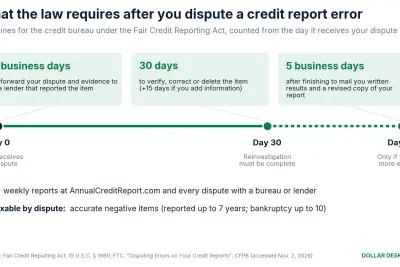
- Credit bureaus can generally report most negative information for seven years and bankruptcies for up to ten, and no one has the right to remove accurate negative information, according to the CFPB.
In this article
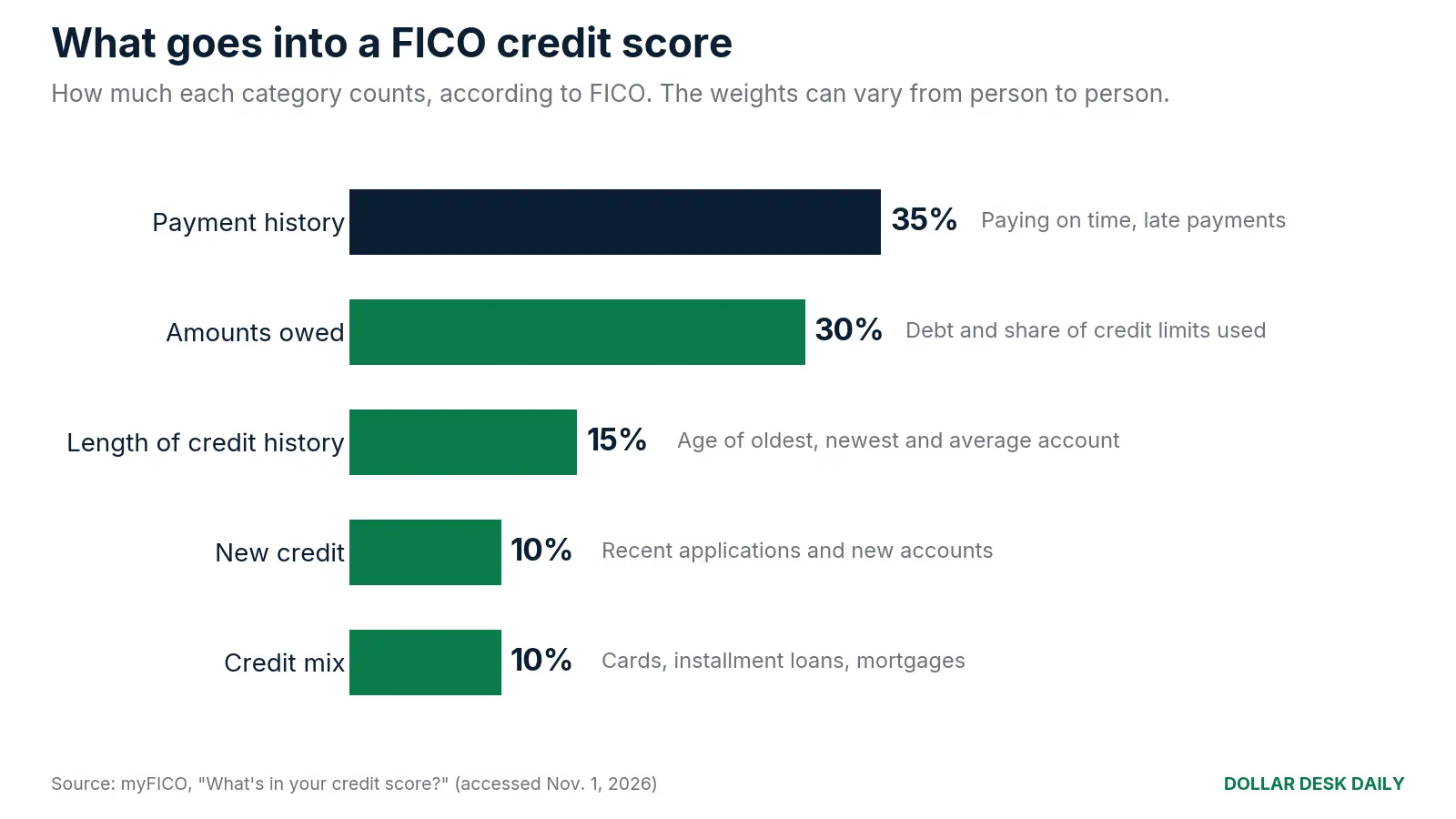
A credit score is a number, usually between 300 and 850, that predicts how likely you are to repay debt on time, based on what is in your credit reports. In FICO’s scoring model, payment history counts for 35% of the score and the amounts you owe for 30%, according to FICO.
Lenders use scores to decide whether to approve you for a mortgage, credit card or auto loan, and what interest rate and credit limit to offer. The Consumer Financial Protection Bureau (CFPB) says scores are also used for tenant screening and insurance.
What goes into a credit score?
A scoring model is a formula that turns the data in your credit report into a number. The CFPB lists the factors that models typically weigh: your bill-paying history, your current unpaid debt, the number and type of loan accounts, how long they have been open, how much of your available credit you use, new applications for credit, and any collections, foreclosure or bankruptcy.
FICO publishes how much each category counts in its scores:
| FICO category | Share of score | What it looks at |
|---|---|---|
| Payment history | 35% | Whether past accounts were paid on time |
| Amounts owed | 30% | Total debt and share of available credit used |
| Length of credit history | 15% | Age of oldest, newest and average account |
| New credit | 10% | Recent applications and new accounts |
| Credit mix | 10% | Cards, retail accounts, installment loans, mortgages |
FICO notes that these weights can vary from one person to another. It also says a few late card payments are not an automatic “score-killer” when the rest of the history is good. Hard inquiries, the checks lenders run when you apply, count in FICO scores for 12 months, although they stay on your report for two years.
Credit report vs. credit score: what’s the difference?
Your credit report is the record. It lists identifying details, your accounts, credit limits, balances, payment history and any collections, according to the CFPB and the Federal Trade Commission (FTC). Three nationwide credit bureaus compile reports: Equifax, Experian and TransUnion.
Your score is a calculation made from that record. You do not have just one: the CFPB says a score can differ by bureau, by scoring model, by the type of loan it is built for and even by the day it is calculated. Because the score is only as good as the report behind it, an error on your report can pull your score down and raise the rate you are offered.
How to get your free credit reports
Federal law entitles you to one free report from each nationwide bureau every 12 months. The three bureaus have also permanently extended a program that lets you check each report free once a week, according to the FTC. Only one website is authorized to fill those free orders:
- Online: AnnualCreditReport.com, with access right away
- Phone: 1-877-322-8228, with the report mailed within 15 days
- Mail: the Annual Credit Report Request Form, sent to Annual Credit Report Request Service, P.O. Box 105281, Atlanta, GA 30348-5281
You can also get an extra free report if a lender denies you based on your report (ask within 60 days of the notice), if you are unemployed and plan to apply for a job within 60 days, if you receive public assistance, or if your file is inaccurate because of fraud. Otherwise, the CFPB says a bureau can charge no more than $16 for a report.
The free reports do not include your score. The CFPB says your credit card company may show you a score for free, and lenders generally must disclose the score they used if they deny your application or charge you more because of it. The CFPB warns that “free score” offers that require you to enroll in a program are generally not really free.
What it means for you: a worked example
The second-biggest FICO category, amounts owed, includes your credit utilization ratio: your card balances divided by your total card limits. The CFPB says many experts suggest staying under 30% of your limits, and that people with the highest scores often use less than 10%.
Illustration: say you have two cards with limits of $6,000 and $4,000, for $10,000 in total, and you owe $2,500.
- Utilization: $2,500 ÷ $10,000 = 25%
- Close the $4,000 card and keep the same debt: $2,500 ÷ $6,000 = about 42%
- Pay the balance down to $900 with both cards open: $900 ÷ $10,000 = 9%
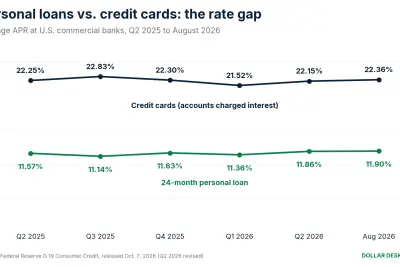
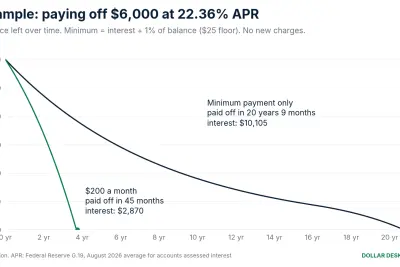
Nothing about your debt changed in the second line, but your utilization jumped. That is why the CFPB warns that closing a card can raise your utilization and lower your score, even though closing may still make sense if the annual fee outweighs the benefits or closing helps you avoid running up debt. Carrying a balance also costs money: at the 22.36% average rate on bank card accounts charged interest in August 2026, according to the Federal Reserve, $2,500 builds about $47 in interest a month ($2,500 × 22.36% ÷ 12). For how that interest builds, see how credit card interest works.
Common credit score myths
“Checking my credit will lower my score.” Checking your own report is a soft inquiry and has no effect on your score, according to the CFPB. Only hard inquiries, made when you apply for credit, are counted.
“I need to carry a balance to build credit.” The CFPB says you do not need to carry a card balance, or any debt, to get a good score. Paying in full each month helps get the best scores and keeps interest costs as low as possible.
“My income and age are part of my score.” FICO says its scores do not consider your age, where you live, race, marital status, salary, occupation or employer. Lenders may still look at income when they decide on an application.
“Closing old cards cleans up my credit.” Not necessarily. Closing a card can lower your score by raising utilization, and older accounts with on-time history can help, according to the CFPB.
“A repair company can erase my late payments.” No one has the right to remove accurate negative information, the CFPB says. Most negative items can be reported for seven years, lawsuits and judgments for seven years or until the statute of limitations runs out, whichever is longer, and bankruptcies for up to ten. You can dispute real errors yourself at no cost.
“There is one official score.” There are many, and the one you buy may not be the one a lender uses, according to the CFPB.
What to do next
The step that costs nothing is to pull your reports from all three bureaus at AnnualCreditReport.com and check each account, balance and late payment. The FTC says each bureau may have different information, so one clean report does not mean the other two are clean. To dispute a mistake, the FTC says to contact both the credit bureau and the business that supplied the information. If high-rate balances are what is holding your score down, compare payoff orders in debt avalanche vs. debt snowball.
Sources
- Consumer Financial Protection Bureau — What is a credit score?
- Consumer Financial Protection Bureau — What is the difference between a credit report and a credit score?
- Consumer Financial Protection Bureau — How do I get a free copy of my credit reports?
- Consumer Financial Protection Bureau — Does requesting my credit report hurt my credit score?
- Consumer Financial Protection Bureau — What is a credit inquiry?
- Consumer Financial Protection Bureau — How do I get and keep a good credit score?
- Consumer Financial Protection Bureau — How long does information stay on my credit report?
- Consumer Financial Protection Bureau — Does it hurt my credit to close a credit card?
- Consumer Financial Protection Bureau — I got my free credit reports, but they do not include my credit scores. Can I get my credit score for free too?
- Consumer Financial Protection Bureau — Can I opt out of having creditors report my accounts to credit reporting companies?
- Federal Trade Commission — Free Credit Reports
- Federal Reserve — G.19 Consumer Credit (released Oct. 7, 2026)
- myFICO — What’s in your credit score?