How to Compare Health Plans at Open Enrollment: 2027 Dates and Limits
2027 Marketplace enrollment runs Nov. 1 to Jan. 15; Dec. 15 is the cutoff for Jan. 1 coverage. How to compare premium, deductible, out-of-pocket max, HSA.
Key Takeaways
- HealthCare.gov says Marketplace Open Enrollment for 2027 coverage began Nov. 1 and ends Jan. 15; enrolling by Dec. 15 starts coverage Jan. 1, and Dec. 16 to Jan. 15 starts it Feb. 1.
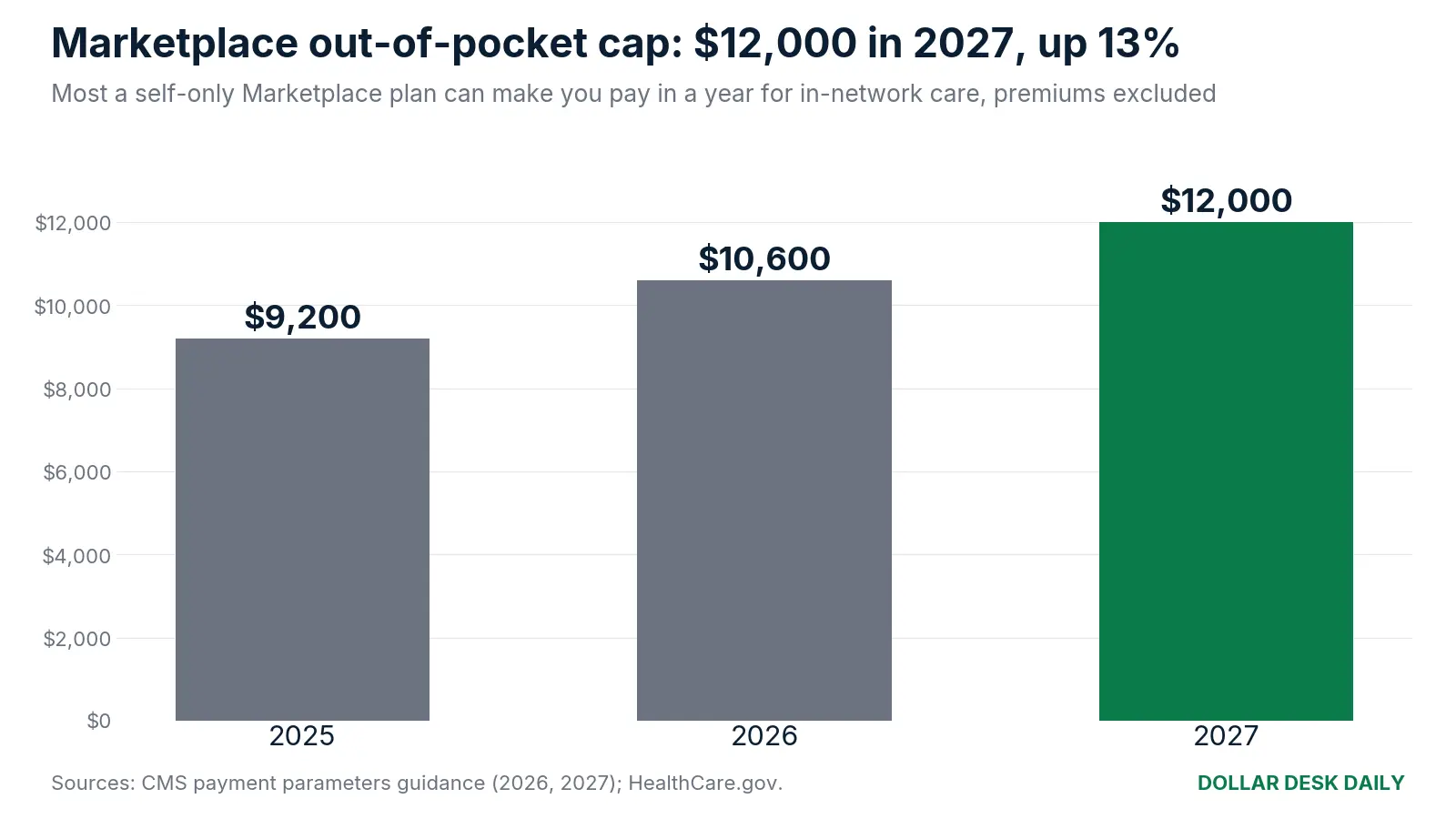
- The most a 2027 Marketplace plan can make you pay for in-network covered care is $12,000 for one person or $24,000 for a family, up from $10,600 and $21,200 in 2026.
- For 2027 the IRS sets the HSA contribution limit at $4,500 for self-only and $9,000 for family coverage, and an HSA-eligible plan needs a deductible of at least $1,750 (self-only) or $3,500 (family).
In this article
- What are the 2027 open enrollment dates?
- What do premium, deductible and out-of-pocket maximum mean?
- How high can the out-of-pocket maximum go in 2027?
- How do the metal tiers compare?
- What does a plan cost across a whole year? A worked example
- How does an HSA-eligible plan work?
- Why does the network matter?
- A checklist before you click enroll
If you buy health insurance through the Marketplace, you have until Jan. 15 to pick a 2027 plan, and until Dec. 15 for coverage to start Jan. 1, according to HealthCare.gov. The most any 2027 Marketplace plan can make you pay in a year for in-network care is $12,000 for one person.
This guide explains how to compare plans, whether on HealthCare.gov or through an employer. The dates and caps below come from HealthCare.gov and CMS and apply to Marketplace plans; employer plans set their own enrollment windows, so check your employer’s deadline.
What are the 2027 open enrollment dates?
HealthCare.gov lists these dates for Marketplace plans:
| Date | What happens |
|---|---|
| Nov. 1 | Open Enrollment starts; first day to enroll in, renew or change plans for the coming year |
| Dec. 15 | Last day to enroll or change plans for coverage to start Jan. 1 |
| Jan. 1 | Coverage starts for people who enroll by Dec. 15 and pay their first premium |
| Jan. 15 | Open Enrollment ends |
| Feb. 1 | Coverage starts for people who enroll Dec. 16 through Jan. 15 and pay their first premium |
After Jan. 15, you can enroll or change plans only if you qualify for a Special Enrollment Period, which HealthCare.gov ties to life events such as getting married, having a baby, moving or losing other coverage. Medicaid and the Children’s Health Insurance Program (CHIP) accept applications at any time.
What do premium, deductible and out-of-pocket maximum mean?
HealthCare.gov defines the four terms that drive most of the cost.
- Premium: the monthly amount you pay for coverage whether or not you use care.
- Deductible: what you pay for covered services each year before your plan starts to pay, except free preventive services.
- Copayment and coinsurance: a copayment is a fixed amount, like $30. Coinsurance is a percentage of the cost, like 20%.
- Out-of-pocket maximum: the most you pay for covered, in-network care in a plan year. After you hit it, the plan pays 100% of covered benefits.
The out-of-pocket maximum does not include premiums, services your plan does not cover, out-of-network care, or charges above the allowed amount for a service.
How high can the out-of-pocket maximum go in 2027?
For plan year 2027, HealthCare.gov says the limit is no more than $12,000 for an individual and $24,000 for a family. For 2026 it is $10,600 and $21,200. CMS describes the 2027 figure as about a 13.2% increase over 2026. The 2026 CMS guidance from October 2024 listed the 2025 limit as $9,200 for self-only coverage, which is what the chart shows.
The federal figure is a ceiling; a plan’s own summary lists its actual cap.
How do the metal tiers compare?
HealthCare.gov sorts Marketplace plans into Bronze, Silver, Gold and Platinum. The tier reflects how costs are split, not the quality of care. These are estimates of the plan’s share of costs for covered services, and actual costs vary by plan:
| Tier | Plan pays | You pay | Deductible is generally |
|---|---|---|---|
| Bronze | 60% | 40% | High |
| Silver | 70% | 30% | Moderate |
| Silver with extra savings | 73% to 94% | 6% to 27% | Low |
| Gold | 80% | 20% | Low |
| Platinum | 90% | 10% | Low |
Two details matter. First, the “extra savings” (cost-sharing reductions) are available only if your income qualifies and you enroll in a Silver plan. Second, the premium tax credit, if you qualify, lowers premiums in any metal tier. You find out about both when you apply. Catastrophic plans, a fifth category, are open to people under 30 or those with a hardship or affordability exemption, where offered.
All Marketplace plans in every tier must cover the same 10 essential health benefits, including preventive services, according to HealthCare.gov. HealthCare.gov also lists 1-to-5-star quality ratings you can compare across plans.
What does a plan cost across a whole year? A worked example
HealthCare.gov says to look at total yearly spending, not just the premium. This is a hypothetical illustration, not advice or a recommendation. The two plans are invented; premiums, deductibles and caps are assumptions, not real quotes. Coinsurance uses the Bronze (40%) and Gold (20%) shares above:
- Bronze (assumed): $350 a month premium, $7,500 deductible, 40% coinsurance, $10,000 out-of-pocket cap.
- Gold (assumed): $550 a month premium, $1,000 deductible, 20% coinsurance, $6,000 out-of-pocket cap.
Yearly premiums are $350 × 12 = $4,200 for Bronze and $550 × 12 = $6,600 for Gold.
| Hypothetical year of in-network care | Bronze total | Gold total |
|---|---|---|
| No care at all | $4,200 | $6,600 |
| $8,000 of covered care | $11,900 | $9,000 |
| $50,000 hospital stay | $14,200 | $12,600 |
How the middle row works. With $8,000 of care on Bronze, you pay the $7,500 deductible plus 40% of the remaining $500, which is $200. That is $7,700, plus $4,200 in premiums, or $11,900. On Gold you pay the $1,000 deductible plus 20% of $7,000, which is $1,400. That is $2,400, plus $6,600 in premiums, or $9,000.
On the $50,000 stay, each plan reaches its cap, so you pay $10,000 on Bronze and $6,000 on Gold, plus premiums. In these three scenarios Bronze costs less only in the no-care year, by $2,400. Real plans and real care costs will differ. For setting money aside for a deductible, see the emergency fund guide.
How does an HSA-eligible plan work?
A Health Savings Account (HSA) lets you set money aside pre-tax for qualified medical costs, according to HealthCare.gov. It generally cannot pay premiums. You can contribute only if you have an HSA-eligible plan, often called a high deductible health plan (HDHP). HealthCare.gov says all Bronze and Catastrophic plans work with HSAs, along with some plans in other tiers, and it offers an “Eligible for an HSA” filter when you preview plans.
The IRS sets the numbers. For 2027, Revenue Procedure 2026-24 says:
| Item | Self-only | Family |
|---|---|---|
| Maximum HSA contribution, 2027 | $4,500 | $9,000 |
| Minimum HDHP deductible, 2027 | $1,750 | $3,500 |
| Maximum HDHP out-of-pocket expenses, 2027 | $8,700 | $17,400 |
| Maximum HSA contribution, 2026 (IRS Pub. 969) | $4,400 | $8,750 |
IRS Publication 969 (2025 edition, the version saved for this article) says the contribution limit rises by $1,000 for an eligible person age 55 or older at the end of the tax year. Rev. Proc. 2026-24 does not restate that add-on, so confirm it for 2027 with the IRS. Note that the HDHP out-of-pocket maximum ($8,700 for one person) is lower than the Marketplace ceiling ($12,000), so an HSA-eligible plan has a tighter cap.
Using the example above, $4,500 contributed to an HSA covers the Bronze plan’s $7,500 deductible in part: the other $3,000 would still come from your budget. Eligibility and tax treatment depend on your situation; Publication 969 explains the rules.
Why does the network matter?
The out-of-pocket maximum counts only in-network care. Out-of-network services, according to HealthCare.gov, are excluded from the cap, so they can cost you far more. Before you enroll, check that your doctors, hospital and pharmacy are in the plan’s network and that the plan lists your prescriptions.
A checklist before you click enroll
- Write down last year’s care: visits, prescriptions, any procedures, and what you paid.
- Estimate a low, medium and high year, as in the table above, for each plan you are considering.
- Check the real out-of-pocket maximum, deductible and coinsurance on each plan summary.
- Confirm that your doctors and drugs are covered and in network.
- If you qualify for extra savings, compare Silver plans with the savings applied.
- If you want an HSA, filter for HSA-eligible plans and compare the deductible with how much you can set aside.
- Add the plan’s maximum exposure (premiums plus out-of-pocket cap) to your monthly budget to see the worst-case year.
Deductibles and premiums work the same way in other kinds of coverage, such as renters insurance and home insurance.
Sources
- HealthCare.gov — When can you get health insurance?
- HealthCare.gov — Out-of-pocket maximum/limit (glossary)
- HealthCare.gov — Health plan categories: Bronze, Silver, Gold & Platinum
- HealthCare.gov — Deductible (glossary)
- HealthCare.gov — Health Savings Account (HSA) (glossary)
- CMS — Final 2027 Premium Adjustment Percentage, Maximum Annual Limitation on Cost Sharing, Reduced Maximum Annual Limitation on Cost Sharing, and Required Contribution Percentage (Jan. 29, 2026)
- CMS — Final 2026 Premium Adjustment Percentage, Maximum Annual Limitation on Cost Sharing, Reduced Maximum Annual Limitation on Cost Sharing, and Required Contribution Percentage (Oct. 8, 2024)
- IRS — Revenue Procedure 2026-24 (2027 inflation-adjusted amounts for Health Savings Accounts)
- IRS — Publication 969, Health Savings Accounts and Other Tax-Favored Health Plans