How to Compare Checking Accounts: Fees, Overdrafts and Switching
A step-by-step way to compare checking accounts using the fee disclosure banks must give you, the CFPB’s overdraft rules and the FDIC’s $250,000 limit.
Key Takeaways
- Under Regulation DD for banks, and a matching NCUA rule for credit unions, an institution must give you its account disclosures before you open an account and upon request, including the amount of each fee and the conditions that trigger it.
- Banks cannot charge an overdraft fee on one-time debit card purchases or ATM withdrawals unless you opted in, but they can still charge for checks and recurring payments; the CFPB says many institutions charge $30 or more per overdraft.
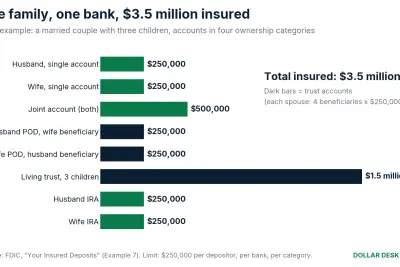
- FDIC insurance covers $250,000 per depositor, per bank, per ownership category, and the NCUA rule for credit unions sets the same $250,000 standard; you can confirm a bank is insured with the FDIC’s BankFind tool.
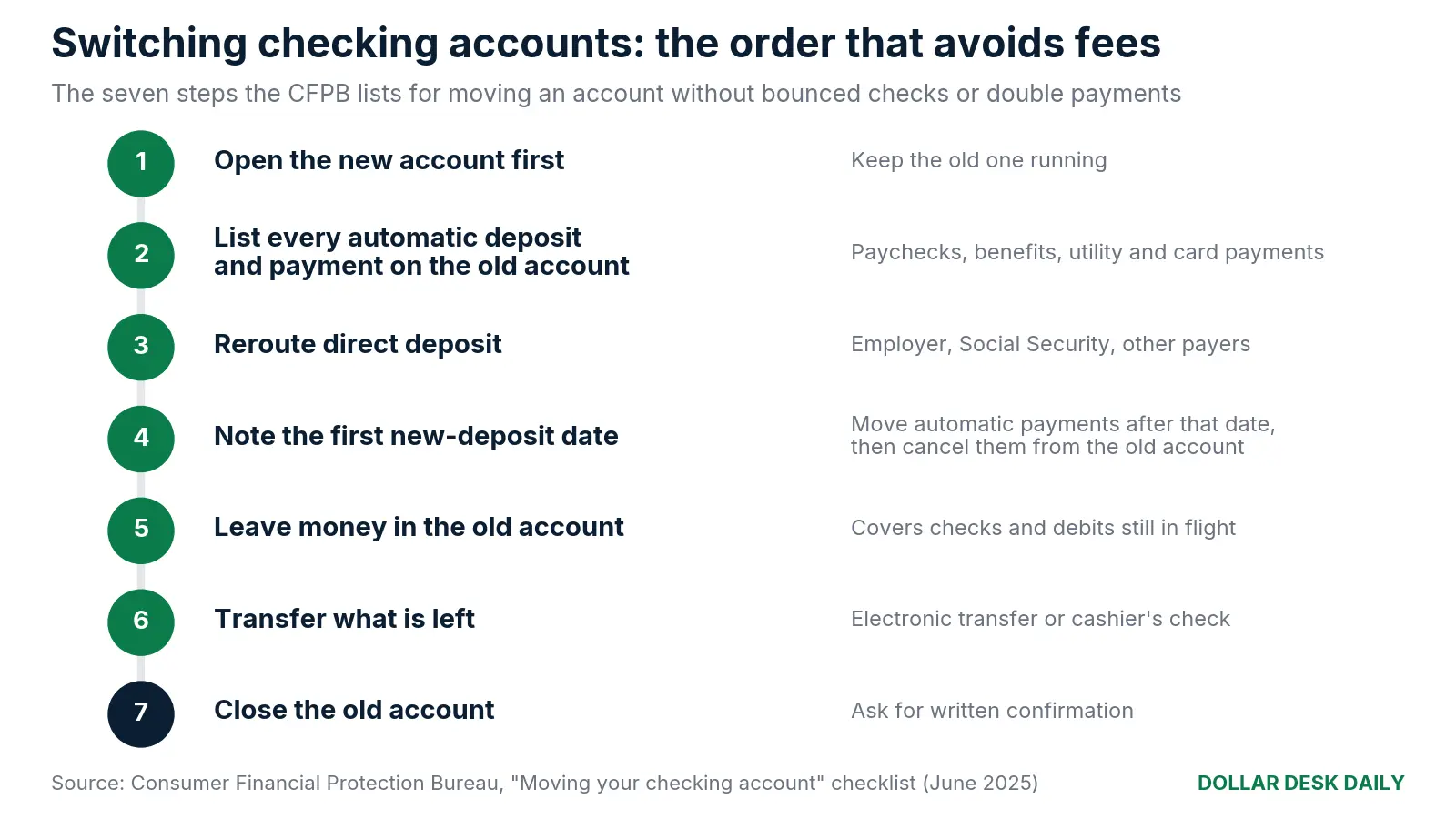
- The CFPB’s switching checklist starts with opening the new account first and ends with closing the old one only after every direct deposit and automatic payment has moved, with written confirmation of the closure.
In this article
- Step 1: Ask for the account disclosure before you compare anything
- Step 2: Compare the fees the rule says must be listed
- Step 3: Read the overdraft policy, then decide whether to opt in
- Step 4: Confirm the deposits are insured
- Step 5: Treat interest as a tiebreaker
- What it means for you: a worked example
- Step 6: Switch in the order that avoids double payments
- Mistakes to avoid
Comparing checking accounts comes down to one document and three questions. The document is the account disclosure that federal rules require banks and credit unions to give you before you open an account. The questions: what will this account cost in fees, what happens when the balance hits zero, and is the money insured?
This guide is for anyone opening a first checking account or moving to a new one. Dollar figures in the examples are illustrations, with the assumptions spelled out.
Step 1: Ask for the account disclosure before you compare anything
Regulation DD, which the FDIC’s examination manual says implements the Truth in Savings Act, applies to depository institutions other than credit unions. The NCUA’s parallel rule, 12 CFR 707.4, sets the same timing for credit unions. Under Regulation DD, an institution “shall provide account disclosures to a consumer before an account is opened or a service is provided.” If you open online, the disclosures must come first. The institution must also provide them upon request, and the CFPB’s interpretation says that asking for written information about an account, even by phone, counts as a request; the CFPB’s official interpretation calls 10 business days a reasonable response time for requests not made in person.
Under § 1030.4(b) the disclosure must list, as applicable, the interest rate and annual percentage yield, any minimum balance needed to open the account, avoid a fee or earn the stated yield, and “the amount of any fee that may be imposed in connection with the account” plus the conditions that trigger it. The credit union rule at § 707.4(b)(4) uses the same fee wording. Get that document from two or three institutions and line them up.
Step 2: Compare the fees the rule says must be listed
The CFPB’s official interpretation of Regulation DD names four groups of fees that must be disclosed. Use them as a checklist.
| Fee group (Regulation DD) | What to look for in each disclosure |
|---|---|
| Maintenance fees, “such as monthly service fees” | The amount, and the exact condition that waives it |
| Fees to open or close an account | Any early-closure charge |
| Deposit and withdrawal fees, “such as fees for use of the institution’s ATMs” | Per-withdrawal charges and the size of the ATM network |
| Special-service fees: stop payments, balance inquiries, “checks returned unpaid” | The non-sufficient funds (NSF) fee and the overdraft fee |
The CFPB’s switching checklist adds a practical tip: ask your current institution for a list of its fees, compare it with the accounts you are considering, and “inquire about ways to avoid fees, such as by maintaining a minimum balance or setting up direct deposit.” Fees tied to other accounts must be stated, so checking fees that depend on a savings balance have to say so.
Step 3: Read the overdraft policy, then decide whether to opt in
An overdraft, in the CFPB’s definition, happens when you lack the money to cover a transaction “but the bank pays the transaction anyway,” then charges a fee on top of repayment. For one-time debit card purchases and ATM withdrawals, the CFPB says banks “cannot charge you an overdraft fee unless you opt in.” For checks and recurring electronic payments, they can charge even if you never opted in.
The CFPB’s overdraft page gives three facts to check in any disclosure: “many banks and credit unions charge $30 or more per transaction”; institutions “can charge you for each overdraft,” so several fees in one day are possible unless a daily maximum is stated; and many add a fee if the shortfall is not repaid within a few days. It also lists three alternatives: opting out of debit and ATM coverage (the card is declined, no fee), linking a savings account (a transfer fee is possible “but less than the fee for an overdraft”), or a line of credit that charges interest.
You “can change your overdraft decision at any time,” the CFPB notes. Opting out has limits: a bounced check can still bring an NSF fee, which the CFPB says “is often the same amount as an overdraft fee,” plus a returned-item fee from the merchant.
Step 4: Confirm the deposits are insured
The FDIC insures deposits “to at least $250,000 per depositor, per ownership category at each FDIC-insured bank,” automatically, for checking accounts at an insured bank. For a credit union, the NCUA rule at 12 CFR 745.1 sets the “standard maximum share insurance amount” at $250,000, and § 745.3 adds together all accounts in an individual’s own name at one credit union and insures them up to that amount.
Verify the institution before opening anything. The FDIC says scammers “create fake bank websites,” some using the “Member FDIC” logo, and points consumers to its BankFind Suite, where you can look up a bank “by name or website address.” For an app, ask which insured bank holds the money: the FDIC says deposit insurance “doesn’t cover default or bankruptcy of any non-FDIC-insured institution.” How the limit works across joint and retirement accounts is in our FDIC insurance explainer.
Step 5: Treat interest as a tiebreaker
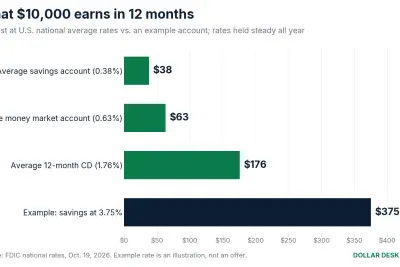
Checking accounts rarely pay much. The FDIC’s national average rate on interest checking was 0.07% as of Oct. 19, 2026, based on a $2,500 balance tier. On $2,500 that is about $1.75 a year ($2,500 × 0.0007). One $30 overdraft fee wipes out 17 years of that interest. For higher yields, see our guides to high-yield savings accounts and APY versus APR.
What it means for you: a worked example
Here is an illustration of two accounts over one year. Assumptions: Account A charges a $10 monthly fee the reader does not qualify to waive, and two overdrafts at $30 each, the floor the CFPB cites. Account B has no monthly fee, and the reader opted out of debit overdraft coverage, so those two purchases are declined with no fee. Both pay the FDIC average of 0.07% on a $2,500 balance.
| Item (illustration) | Account A | Account B |
|---|---|---|
| Monthly fee × 12 | $10 × 12 = $120 | $0 |
| Overdraft fees | 2 × $30 = $60 | $0 (card declined) |
| Interest on $2,500 at 0.07% | +$1.75 | +$1.75 |
| Net cost for the year | $178.25 | −$1.75 (a small gain) |
The $180 gap comes from the fees, not the rate. If Account A’s monthly fee were waived, the gap would shrink to the $60 in overdraft fees, which is why waiver conditions matter.
Step 6: Switch in the order that avoids double payments
The CFPB’s “Moving your checking account” checklist gives a sequence, and the order is the point. Open the new account first, and ask what identification it requires. List every automatic deposit and withdrawal on the old account. Fill out direct-deposit paperwork with your employer or other payer, including Social Security.
Then find the date of the first direct deposit into the new account. Once you know it, “make arrangements for your automatic debits and withdrawals to be made from your new account starting after that date,” and cancel them from the old account “so that your bill is not accidentally paid twice.” Leave enough in the old account to cover checks that have not cleared; the CFPB says this avoids overdrafts, minimum-balance fees and returned debits.
When everything flows through the new account, transfer the rest. Electronic transfers and cashier’s checks are fastest; a personal check “may be cheaper” but can take longer to become available. Then close the old account and get written confirmation.
Mistakes to avoid
- Comparing a “free” headline instead of the disclosure. Regulation DD requires the waiver conditions to be stated; read them.
- Assuming opting out ends all overdraft fees. Checks and recurring payments can still be paid and charged, or returned with an NSF fee.
- Closing the old account before direct deposits and automatic payments have moved. The CFPB says to close it only after they are flowing through the new account.
- Skipping the BankFind check for an online-only bank or app. Insurance applies only to deposits at an insured bank.
Under § 1030.5, a bank must give notice “at least 30 calendar days before” a change that may adversely affect you, so keeping the original disclosure gives you something to compare that notice against. Money set aside for emergencies is covered in our emergency fund guide.
Sources
- CFPB — Regulation DD, § 1030.4 Account disclosures
- CFPB — Regulation DD, § 1030.5 Subsequent disclosures
- CFPB — Know your overdraft options (page last modified June 4, 2025)
- CFPB — What can I do if my bank charged me a fee for overdrawing my account? (reviewed Dec. 18, 2024)
- CFPB — What is an overdraft? (reviewed Jan. 31, 2024)
- CFPB — Bank accounts key terms
- CFPB — Moving your checking account (page last modified June 4, 2025)
- CFPB — What is the best way to move my checking account to another bank or credit union? (reviewed April 22, 2024)
- CFPB — Bank accounts and services
- FDIC — Deposit Insurance
- FDIC — Understanding Deposit Insurance (last updated April 1, 2024)
- FDIC Consumer News — Bank Impersonation Scams and Fake Banks (June 2025)
- FDIC — National Rates and Rate Caps (as of Oct. 19, 2026)
- eCFR — 12 CFR § 745.1 Definitions (NCUA share insurance)
- eCFR — 12 CFR § 745.3 Single ownership accounts (NCUA share insurance)
- eCFR — 12 CFR § 707.4 Account disclosures (NCUA Truth in Savings rule for credit unions)
- FDIC — Compliance Examination Manual, VI-3 Truth in Savings