Index Funds Explained: How They Work and What Fees Really Cost
An index fund copies a market index instead of picking stocks. Here’s how it works, what an expense ratio costs over 30 years, and what index funds can’t do.
Key Takeaways
- An index fund is a mutual fund or ETF that tries to match the return of a market index, generally by holding the securities in that index, rather than trying to beat it.
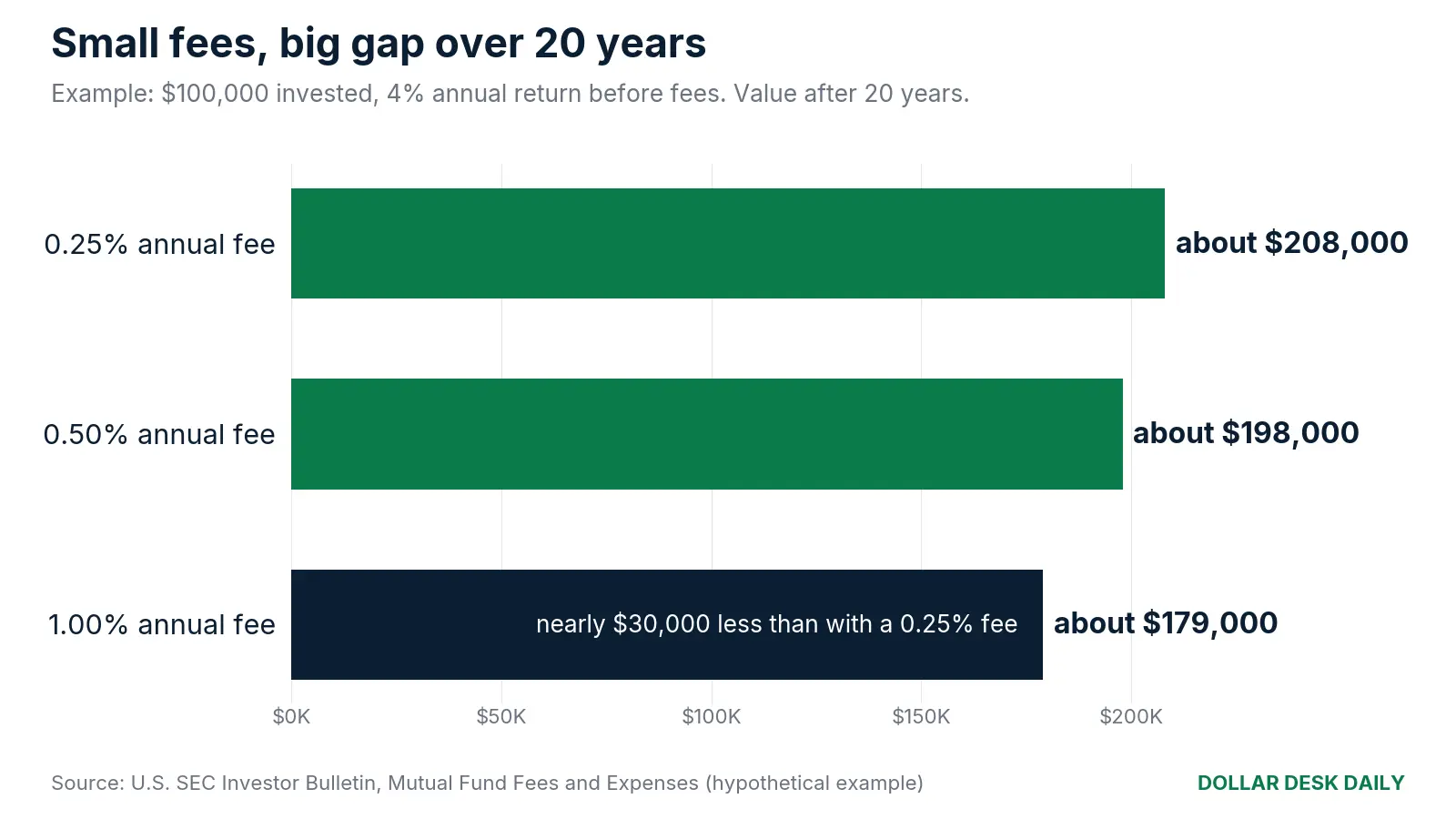
- In an SEC example, $100,000 earning 4% a year for 20 years grows to about $208,000 with a 0.25% annual fee but only about $179,000 with a 1% fee.
- Index funds are not FDIC-insured, can lose money, and can trail their index because indexes have no expenses while funds do.
In this article
An index fund is a mutual fund or exchange-traded fund (ETF) that tries to earn the same return as a market index, such as the S&P 500, generally by owning the securities in that index. It does not try to beat the market; it tries to match it, minus its costs.
Those costs add up over time. In an example from the Securities and Exchange Commission (SEC), $100,000 earning 4% a year for 20 years ends at about $208,000 with a 0.25% annual fee, but only about $179,000 with a 1% fee.
How an index fund works
A market index tracks a group of securities: the whole stock market, companies of a certain size or one industry, for example. An index fund buys what is in the index. When the index drops a company, the fund sells it, and when the index adds one, the fund buys it, according to FINRA (the Financial Industry Regulatory Authority).
Funds track their index in one of two ways, according to the SEC:
- Replication: buying 100% of the securities in the same proportions as the index.
- Sampling: buying a representative sample of the index.
Some index funds also use derivatives, such as futures or options, to help track the index.
This approach is called passive investing. An actively managed fund, by contrast, relies on a manager’s skill to choose investments in an effort to beat a benchmark. FINRA says that in any given year, most actively managed funds do not beat the market, and that studies show very few do so over long periods.
Index mutual funds vs. index ETFs
Both kinds pool money from many investors, and both can track an index. The main differences are in how you buy and sell them.
| Feature | Index mutual fund | Index ETF |
|---|---|---|
| How it is priced | Once each business day, at net asset value (NAV), typically after markets close | All day, at a market price that may or may not equal NAV |
| Where you buy | From the fund, directly or through a broker | On a stock exchange, through a broker |
| Typical costs | Expense ratio; some funds add sales charges | Expense ratio; brokerage commissions |
Source: SEC, Mutual Funds and ETFs: A Guide for Investors.
The SEC adds that index ETFs’ costs and taxes can be even lower than those of index mutual funds because of how ETFs are structured. For how tax-advantaged retirement accounts compare, see our explainer on the 401(k) and Roth IRA.
What is an expense ratio?
The expense ratio is a fund’s total annual operating expenses (management fees, distribution or “12b-1” fees, and other costs) expressed as a percentage of the fund’s average net assets. You never get a bill for it. The fund takes it out of its assets, so it shows up as a slightly lower return. The SEC notes these costs may not appear as line items on your statement.
You find it in the fund’s prospectus, in the fee table under “Annual Fund Operating Expenses.” Index funds typically have lower management fees than actively managed funds, the SEC says. FINRA explains why: index funds do not need active professional managers, and their holdings are not traded as often. But FINRA also notes that fees vary from one index fund to another.
A worked fee example over time
Here is an illustration with assumed numbers, not a forecast. Take $10,000 invested once and an assumed 6% annual return before fees, compounded yearly. Compare two hypothetical expense ratios: 0.20% and 1.00%.
In the first year, the fees are about $20 ($10,000 × 0.20%) and $100 ($10,000 × 1.00%). That gap looks small. But the fee is charged every year on a growing balance, and the money paid in fees stops earning a return.
To keep the math simple, subtract the fee from the return: 6% − 0.20% = 5.80% a year, and 6% − 1.00% = 5.00% a year.
| Years | Balance at 5.80% (0.20% fee) | Balance at 5.00% (1.00% fee) | Difference |
|---|---|---|---|
| 10 | $17,573 | $16,289 | $1,284 |
| 20 | $30,883 | $26,533 | $4,350 |
| 30 | $54,271 | $43,219 | $11,052 |
The 30-year figure is $10,000 × 1.058^30 = $54,271, versus $10,000 × 1.05^30 = $43,219. With no fees at all, the same $10,000 would reach about $57,435. The higher fee costs more than the original $10,000 investment over 30 years.
The SEC’s own examples point the same way. In its mutual fund guide, $10,000 earning 5% a year before expenses grows to roughly $24,002 over 20 years with 0.5% in annual expenses, but only about $19,612 with 1.5%, a 23% difference.
Why index funds help with diversification
Diversification means spreading money across many investments so one loser does less damage. “A total stock market index fund, for example, owns stock in thousands of companies,” the SEC notes in its beginners’ guide, adding that owning only four or five individual stocks does not make a portfolio diversified.
The SEC describes diversification at two levels: within an asset category (many companies and industries) and between categories, such as stocks, bonds and cash. A fund that holds only stocks spreads money within one asset category, not between categories.
Common misunderstandings
“An index fund can’t lose money.” It can. Mutual funds and ETFs are not guaranteed or insured by the FDIC or any government agency, even when sold by a bank, the SEC says. If the index falls, the fund falls with it, and the SEC notes an index fund may have less flexibility to react to price declines. Our explainer on FDIC insurance covers what is protected.
“An index fund earns exactly the index’s return.” It can earn less. Market indexes have no expenses, so even a passively managed fund can underperform its index because of fees and taxes, according to the SEC.
“All funds tracking the same kind of index are the same.” Not necessarily. The SEC warns that index funds with seemingly similar benchmarks can be quite different and deliver very different returns, partly because some hold every company in the index and others a sample.
“Any index fund is diversified.” Only as diversified as its index. A fund tracking a narrow index, such as one industry, does not give broad diversification, and the SEC notes that adding more funds can also add fees.
“Past returns show which index fund is best.” An index fund’s past performance is related to how its market index did, the SEC says, and past performance does not necessarily predict future returns.
How to compare index funds
The prospectus fee table lists the expense ratio and any shareholder fees, such as a sales charge. A 5% front-end load on a $1,000 purchase, for example, takes $50 off the top and leaves $950 invested, according to the SEC. FINRA’s online Fund Analyzer lets you enter an amount and holding period and compare the costs of up to three funds side by side.
Sources
- U.S. Securities and Exchange Commission — Mutual Funds and ETFs: A Guide for Investors
- U.S. Securities and Exchange Commission — Investor Bulletin: Mutual Fund Fees and Expenses
- U.S. Securities and Exchange Commission — Investor Bulletin: How Fees and Expenses Affect Your Investment Portfolio
- U.S. Securities and Exchange Commission — Beginners’ Guide to Asset Allocation, Diversification, and Rebalancing
- FINRA — Mutual Funds