FDIC Insurance Explained: How the $250,000 Limit Really Works
FDIC insurance covers $250,000 per depositor, per bank, per ownership category. See how single, joint, trust and IRA accounts add up and what a failure means.
Key Takeaways
- FDIC deposit insurance covers at least $250,000 per depositor, per FDIC-insured bank, per ownership category, including interest accrued through the day the bank closes.
- Since April 1, 2024, trust accounts are insured for $250,000 per unique eligible beneficiary, up to $1,250,000 per owner at each bank.
- When Nano Banc of Irvine, California, failed on Sept. 25, 2026, another bank agreed to assume substantially all of its deposits and the FDIC said customers would have immediate access to their money.
In this article
FDIC insurance is a federal guarantee that you get your deposits back if your bank fails, up to at least $250,000 per depositor, per FDIC-insured bank, per ownership category. Coverage is automatic when you open a deposit account at an insured bank, and it includes interest earned through the day the bank closes. Since the FDIC was founded in 1933, no depositor has lost a penny of FDIC-insured funds, according to the agency.
Because the limit applies separately to each bank and each ownership category, one household can be insured for far more than $250,000.
What the FDIC covers, and what it doesn’t
The insurance protects deposits, not investments, even when the investment is sold at a bank.
| Covered at an FDIC-insured bank | Not covered |
|---|---|
| Checking and NOW accounts | Stocks and bonds |
| Savings accounts | Mutual funds, including money market funds |
| Money market deposit accounts | Annuities and life insurance |
| CDs | Crypto assets |
| Cashier’s checks and money orders issued by the bank | Safe deposit boxes and their contents |
| Prepaid cards, if FDIC requirements are met | U.S. Treasury bills, bonds and notes |
Treasury securities are not FDIC-insured but are backed by the full faith and credit of the U.S. government, the FDIC notes. Insurance on prepaid cards applies only if the bank behind the card fails; it does not cover a lost card or a bankrupt card company.
The three parts of the limit
Per depositor. The FDIC adds together everything you hold in the same ownership category at the same bank, whether it sits in checking, savings, a money market account or a CD.
Per insured bank. Deposits at separate branches of the same bank are not insured separately. Deposits at a different insured bank are.
Per ownership category. The category depends on how you hold the money, not on the type of product. The main categories for households are single, joint, certain retirement and trust accounts.
How the ownership categories work
| Category | What it is | Coverage at one bank |
|---|---|---|
| Single | Owned by one person, no beneficiaries | $250,000 per owner |
| Joint | Two or more people, no beneficiaries | $250,000 per co-owner’s share |
| Certain retirement | IRAs, self-directed 401(k)s and similar plans | $250,000 per owner |
| Trust | Payable-on-death (POD), living and irrevocable trusts | $250,000 per unique beneficiary, up to $1,250,000 per owner |
Single accounts. In an FDIC example, one depositor has a $15,000 money market account, $20,000 in savings, a $200,000 CD and $25,000 in checking for her sole proprietorship, which the FDIC counts as hers. The total is $260,000, so $10,000 is uninsured.
Joint accounts. All co-owners must be living people with equal rights to withdraw, and each must sign the signature card (or bank records must show co-ownership), a rule that does not apply to CDs. The FDIC assumes equal shares unless bank records say otherwise. Two co-owners with a $350,000 joint CD and a $150,000 joint savings account have $500,000, which is fully insured at $250,000 each. Switching the order of names or using “and” instead of “or” does not raise coverage.
Retirement accounts. IRAs and self-directed plans are added together per owner. Naming a beneficiary does not raise coverage. In the FDIC’s example, one depositor with $255,000 across two IRAs at one bank has $5,000 uninsured.
Trust accounts. Each owner is insured for $250,000 per unique eligible beneficiary, and since April 1, 2024, the maximum is $1,250,000 per owner at each bank, for five or more beneficiaries. One owner naming three beneficiaries on a POD account can be insured up to $750,000.
What it means for you: one household, .5 million at one bank
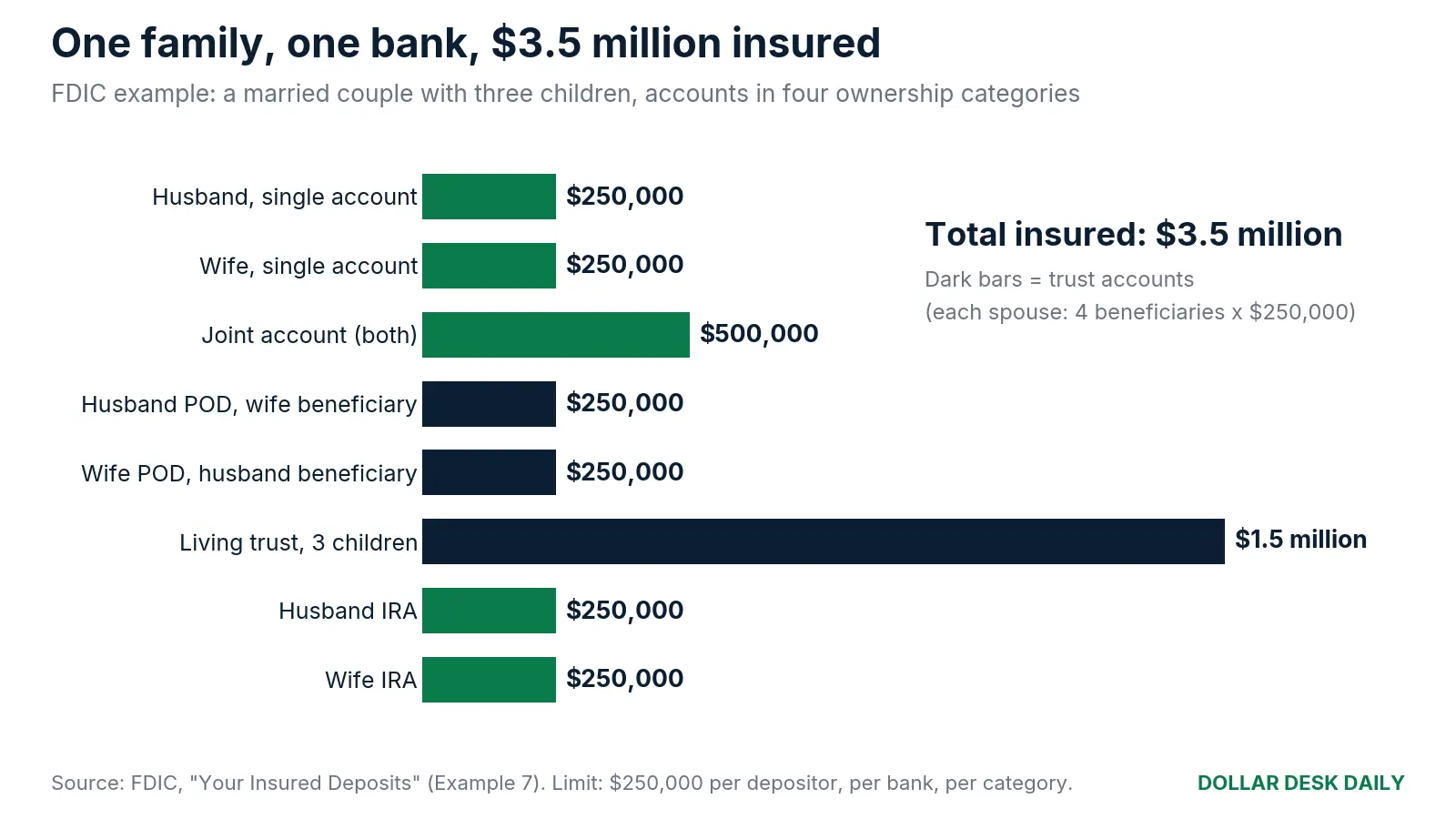
The FDIC’s own example shows how the categories stack for a married couple with three children who keep everything at one insured bank:
| Account | Category | Maximum insured |
|---|---|---|
| Husband, single | Single | $250,000 |
| Wife, single | Single | $250,000 |
| Husband and wife, joint | Joint | $500,000 |
| Husband POD, wife as beneficiary | Trust | $250,000 |
| Wife POD, husband as beneficiary | Trust | $250,000 |
| Couple’s living trust, three children | Trust | $1,500,000 |
| Husband IRA | Retirement | $250,000 |
| Wife IRA | Retirement | $250,000 |
| Total | $3,500,000 |
The trust math: each spouse has four unique beneficiaries (the other spouse and three children), so each is insured up to 4 × $250,000 = $1,000,000 for trust deposits. Together that covers the two POD accounts and the $1.5 million living trust, $2,000,000 in all.
A simpler illustration: a single person with no beneficiaries keeps $180,000 in savings and a $120,000 CD at one bank. Both are single accounts, so the FDIC adds them: $300,000 − $250,000 = $50,000 uninsured. The FDIC’s Electronic Deposit Insurance Estimator (EDIE) runs this math for your actual accounts.
What happens when a bank fails
A bank failure is when a federal or state regulator closes a bank, usually because it cannot meet its obligations to depositors. The FDIC then acts twice: as insurer, it pays insured deposits, and as receiver, it sells the bank’s assets and settles its debts.
Historically, the FDIC pays within a few days, usually the next business day. It either opens a new account for you at another insured bank or mails a check for your insured balance. Money above the limit becomes a claim on the failed bank; uninsured depositors may get back part of it, in periodic “cents on the dollar” payments that can take years. The FDIC mails each depositor a notice after the closing.
The most recent failure shows the usual path. California regulators closed Nano Banc of Irvine on Sept. 25, 2026. Sunwest Bank of Sandy, Utah, agreed to assume substantially all of its $686 million in deposits (as of June 30, 2026), and its sole branch was set to reopen as a Sunwest branch on Sept. 28. The FDIC said customers would have immediate access to their deposits by check, ATM or debit card. The FDIC preliminarily estimated the failure would cost the Deposit Insurance Fund about $114 million. It was the sixth bank failure of 2026 on the FDIC’s failed bank list.
That fund is paid for by premiums from insured banks and interest on Treasury securities, not by taxes, and it is backed by the full faith and credit of the U.S. government.
Credit unions use the NCUA instead
Credit unions are not insured by the FDIC. Their accounts are insured in a similar way by the National Credit Union Administration, also up to $250,000, according to the CFPB. The NCUA offers its own online tool to check coverage.
Common mistakes
- Counting accounts instead of categories. Opening a second savings account at the same bank in your own name adds no coverage.
- Counting branches as banks. Two branches of one bank share one limit.
- Assuming everything sold at a bank is insured. Annuities and mutual funds are not deposits.
How to check that your bank is insured
Search the bank’s name in the FDIC’s BankFind Suite, which shows whether it is insured and its current operating status. You can also look for the FDIC sign where deposits are taken, ask the bank, or call 1-877-ASK-FDIC (1-877-275-3342). For choosing an account, see CDs vs. high-yield savings vs. money market accounts and our emergency fund guide.
Sources
- FDIC — Understanding Deposit Insurance
- FDIC — Your Insured Deposits
- FDIC — Deposit Insurance At A Glance
- FDIC — Are My Deposit Accounts Insured by the FDIC?
- FDIC — Deposit Insurance FAQs
- FDIC — When a Bank Fails: Facts for Depositors, Creditors, and Borrowers
- FDIC — Sunwest Bank Assumes All Deposits and Certain Assets of Nano Banc, Irvine, California (Sept. 25, 2026)
- FDIC — Failed Bank List
- CFPB — How can I be sure my money is safe in my bank account?
- CFPB — What is a certificate of deposit (CD)?
- CFPB — What is a money market account?