How Fed Rate Decisions Reach Your Savings, Cards and Mortgage
A Fed rate move hits variable-rate cards and HELOCs first, savings when your bank decides, and fixed loans only when you sign a new one. Here is how it works.
Key Takeaways
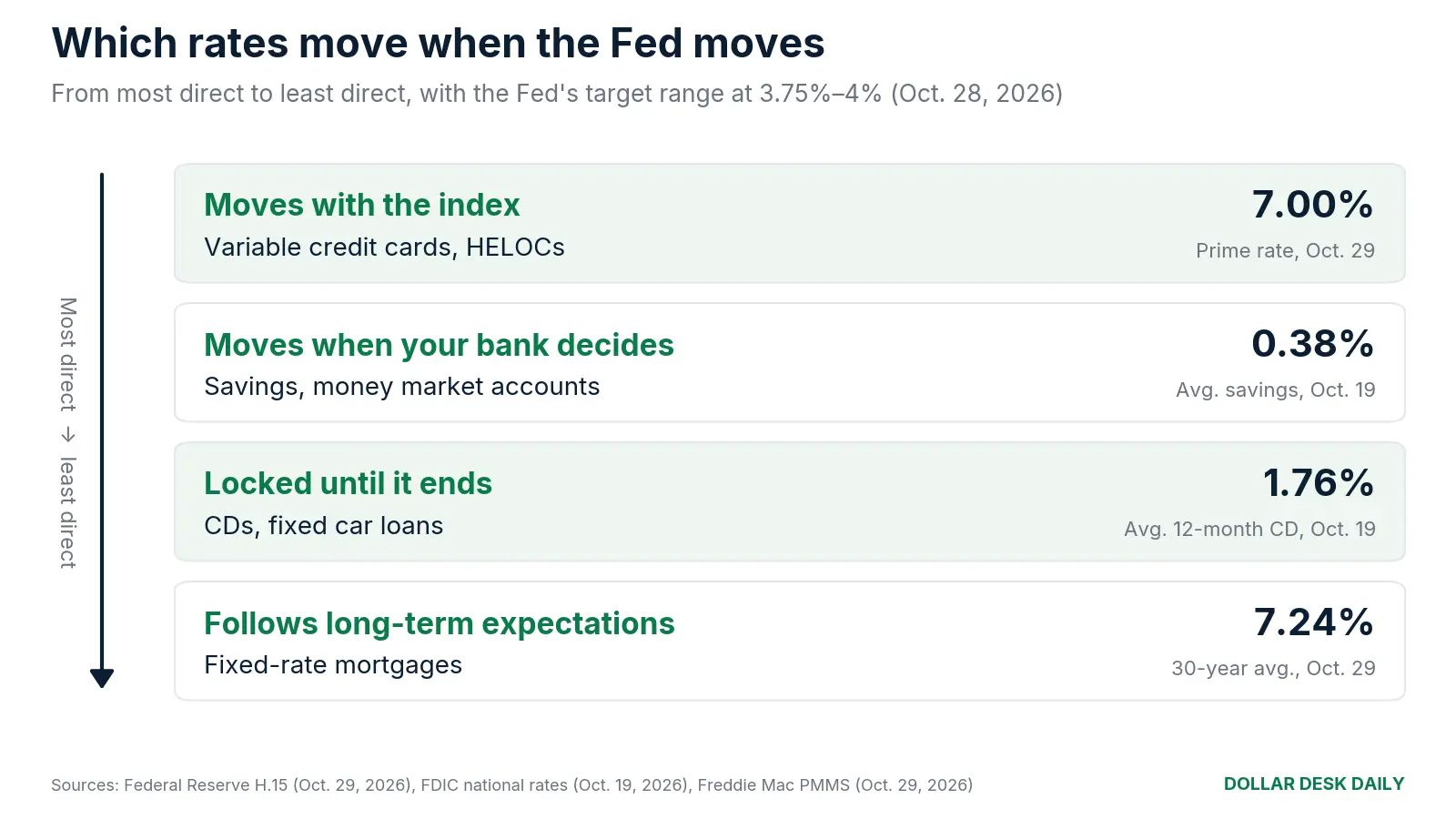
- The prime rate, the benchmark behind most variable-rate credit cards and many HELOCs, was 7.00% on Oct. 29, 2026, three percentage points above the top of the Fed’s 3.75%–4% target range.
- Savings rates move at the bank’s discretion and without advance notice; the national average savings account paid 0.38% as of Oct. 19, 2026, according to the FDIC, while the effective federal funds rate was 3.88%.
- Fixed mortgage rates respond to expectations about the years ahead, not just the Fed’s overnight rate: the 30-year average fell to 7.24% in the week to Oct. 29, 2026, from 7.32% a week earlier, with no change in the Fed’s target.
In this article
A Federal Reserve rate decision reaches your money at different speeds depending on the product. Variable-rate credit cards and home equity lines of credit (HELOCs) follow it most closely, because they are typically tied to an index such as the prime rate, which was 7.00% on Oct. 29, 2026, three percentage points above the top of the Fed’s 3.75%–4% target range. Savings yields move when your bank decides, and CDs, fixed car loans and fixed mortgages stay put once you sign.
For the Fed’s latest decision itself, see our report on the October 2026 meeting.
What the Fed actually sets
The Fed does not set the rate on your card or your mortgage. The Federal Open Market Committee (FOMC) sets a target range for the federal funds rate: the rate banks pay to borrow reserve balances from each other overnight. The FOMC holds eight regularly scheduled meetings a year, and the next one is Dec. 8–9, 2026.
The Fed steers that rate mainly through the interest it pays banks on reserves, since a bank is unlikely to lend for less than it earns at the Fed. On Oct. 29, 2026, the effective federal funds rate, the rate actually traded in the market, was 3.88%, according to the Fed’s H.15 release.
According to the Fed, changes in the federal funds rate are “rapidly reflected” in rates on floating-rate loans, including “many personal and commercial credit lines.”
Fast, slow or locked: how each product responds
| Product | How the rate is set | When a Fed move reaches you | Latest average |
|---|---|---|---|
| Prime rate | Posted by a majority of the 25 largest U.S. banks | Benchmark for many variable loans | 7.00% (Fed H.15, Oct. 29, 2026) |
| Variable-rate credit card | Index, often prime, plus a margin | When the index changes, as your card agreement describes | 22.36% for accounts charged interest (Fed G.19, Aug. 2026) |
| HELOC | Index, often prime, plus a margin | When the index changes | — |
| Savings / money market | Bank’s discretion, or an index if the account says so | Whenever the bank changes it | 0.38% / 0.63% (FDIC, Oct. 19, 2026) |
| 12-month CD | Fixed for the term | New CDs and renewals only | 1.76% (FDIC, Oct. 19, 2026) |
| 60-month new-car loan | Set when you sign | New loans only | 7.54% at banks (Fed G.19, Aug. 2026) |
| 30-year fixed mortgage | Long-term expectations, not just the Fed’s current rate | New loans and refinances only | 7.24% (Freddie Mac, Oct. 29, 2026) |
First to move: credit cards and HELOCs
A variable APR “changes with the index interest rate, such as the prime rate,” according to the Consumer Financial Protection Bureau (CFPB). Issuers generally cannot raise the rate on an existing balance, but a rise in the index behind a variable rate is an exception. So a Fed increase can reach balances you already carry.
The margin, the fixed amount added to the index, matters too. In an analysis of 2023 data, the CFPB found the APR margin on revolving card accounts had reached 14.3 percentage points, and that rising margins drove about half of the increase in card rates over the prior decade.
HELOCs work the same way: index plus margin, with the prime rate a common index, according to the CFPB. Because the rate floats, your payment can change even if you draw no new money.
Bank’s call: savings and money market accounts
Under the federal Truth in Savings rules, a variable-rate account must say how its rate is set. If it is not tied to an index, the bank must state that changes are at its discretion. Banks do not have to give advance notice when a variable rate changes.
The national averages show the gap. The average savings account paid 0.38% as of Oct. 19, 2026, according to the FDIC, about 3.5 percentage points below the 3.88% effective federal funds rate. Rates differ from bank to bank, as our guide to high-yield savings accounts explains.
Locked in: CDs and fixed loans
A fixed-rate CD keeps its rate until maturity, so a Fed move affects only new CDs and renewals. The FDIC advises checking whether a CD renews automatically at the old rate or the current one. Fixed car loans and fixed mortgages you already have do not change at all.
Least direct: mortgages
The Fed says rates on long-term loans depend on expectations of how policy and the economy will evolve over the life of the loan, not just on today’s federal funds rate. Freddie Mac’s 30-year average fell to 7.24% in the week to Oct. 29, 2026, from 7.32% the week before, a week in which the Fed left its target unchanged.
Adjustable-rate mortgages use an index plus a margin but change only on set dates. In a 5/6m ARM, the starting rate lasts five years and can then adjust every six months, according to the CFPB.
What it means for you
Here is what a quarter-point move would change. This is an illustration: it assumes the full quarter point passes through, and the 1-point HELOC margin is hypothetical.
| Example | At today’s rate | After +0.25 point | Change |
|---|---|---|---|
| $4,000 card balance, 22.36% | $74.53 interest/month | $75.37 | +$0.83/month |
| $30,000 HELOC, 8.00% (prime + 1) | $200.00 interest/month | $206.25 | +$6.25/month |
| New $35,000 car loan, 60 months, 7.54% | $701.99/month | $706.16 | +$4.17/month, +$250.07 total interest |
| New $300,000 mortgage, 30 years, 7.24% | $2,044.49/month | $2,095.59 | +$51.10/month |
| Existing fixed loan or CD | No change | No change | $0 |
The card math is $4,000 × 22.36% ÷ 12 = $74.53. The HELOC math is $30,000 × 8.00% ÷ 12 = $200.00. On savings, the same quarter point on $15,000 would be worth $37.50 a year ($15,000 × 0.25%), but only if your bank passes it on.
Common misconceptions
“The Fed sets mortgage rates.” It sets an overnight target; fixed mortgage rates also reflect expectations over the life of the loan.
“A Fed cut lowers what I owe right away.” Only variable-rate debt moves; fixed loans stay the same until you refinance.
“My savings rate will follow the Fed.” Your bank decides, unless the account ties its rate to an index.
“Only decision day matters.” The Fed says its communications about the likely path of short-term rates can also affect longer-term rates.
What to check before the next meeting
- Credit card: whether your APR is variable, and which index and margin your agreement uses. Our explainer on how credit card interest works shows the daily math.
- HELOC: the index, the margin, and the rate cap and floor. Federal rules require variable-rate contracts secured by your home to state a maximum rate.
- Savings: how the rate is set and how often it can change.
- CDs: the maturity date and what rate applies if it renews.
- ARM: the date of your first or next rate change, and which index it uses; the CFPB lists the prime rate and the Constant Maturity Treasury rate, a Treasury yield, as common ones.
Sources
- Federal Reserve — Monetary Policy: What Are Its Goals? How Does It Work?
- Federal Reserve — How does the Federal Reserve affect inflation and employment? (FAQ)
- Federal Reserve — Federal Open Market Committee
- Federal Reserve — Meeting calendars, statements, and minutes
- Federal Reserve — FOMC statement, October 28, 2026
- Federal Reserve — H.15 Selected Interest Rates (released Oct. 30, 2026)
- Federal Reserve — G.19 Consumer Credit (released Oct. 7, 2026)
- FDIC — National Rates and Rate Caps (as of Oct. 19, 2026)
- FDIC — Shopping for a Certificate of Deposit?
- Freddie Mac — Primary Mortgage Market Survey (Oct. 29, 2026)
- CFPB — When can my credit card company increase my interest rate?
- CFPB — What is the difference between a fixed APR and a variable APR?
- CFPB — Credit card interest rate margins at all-time high
- CFPB — What You Should Know About Home Equity Lines of Credit (HELOC)
- CFPB — Consumer Handbook on Adjustable-Rate Mortgages
- CFPB — Regulation DD § 1030.4 Account disclosures
- CFPB — Regulation DD § 1030.5 Subsequent disclosures
- CFPB — Regulation Z § 1026.30 Limitation on rates