Social Security COLA 2027: 3.6% Raise Adds $75 a Month on Average
Social Security benefits rise 3.6% in January 2027, SSA announced Oct. 14. The average retirement check goes from $2,095 to $2,170. Here is what it means.
Key Takeaways
- The Social Security Administration announced on Oct. 14, 2026, that benefits will rise 3.6% for 2027, starting with January 2027 payments.
- SSA estimates the average retired worker’s monthly benefit will go from $2,095 to $2,170 in January 2027, an increase of $75 a month or $900 a year.
- The 2027 Medicare Part B premium had not been published as of Nov. 1, 2026; the 2026 standard premium is $202.90 a month.
In this article
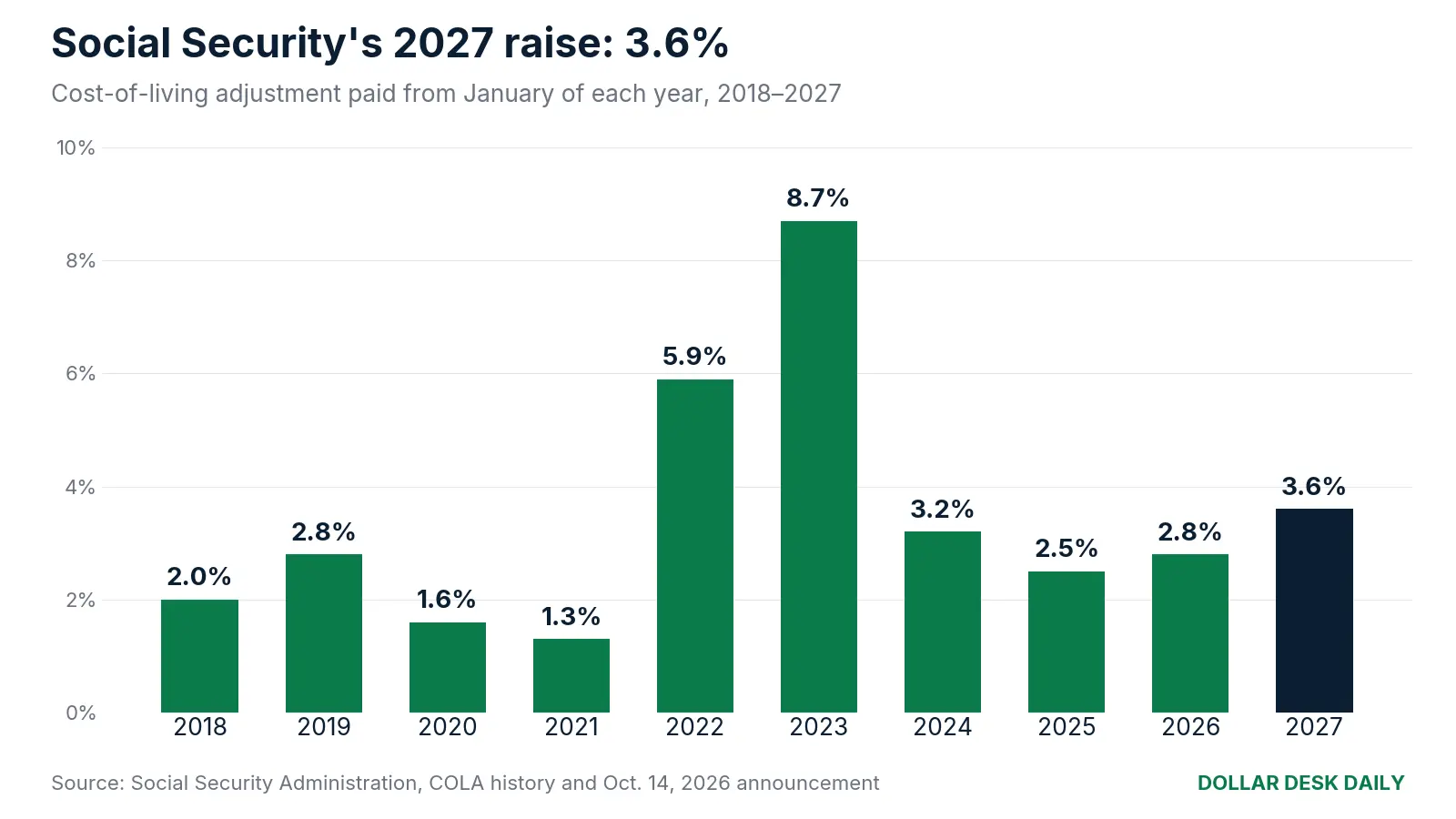
Social Security benefits will rise 3.6% in 2027. The Social Security Administration (SSA) announced the cost-of-living adjustment, or COLA, on Oct. 14, 2026, and said the average retirement benefit will go up by $75 a month.
The raise reaches nearly 72 million Social Security beneficiaries starting with their January 2027 payments. About 7.3 million people who receive Supplemental Security Income (SSI), a separate program for people with low income and few assets, get their higher payments on Dec. 31, 2026. Counting people who get both, SSA says the increase applies to 76 million Americans.
Why the raise is 3.6%
The COLA is set by a formula in the Social Security Act, not by a vote. SSA compares the average of a price index called the CPI-W (the Consumer Price Index for Urban Wage Earners and Clerical Workers) in July, August and September of this year with the same three months a year earlier.
According to SSA’s notice in the Federal Register, the CPI-W averaged 328.746 in the third quarter of 2026, up from 317.265 in the third quarter of 2025. That is an increase of 3.6% after rounding to the nearest tenth. Over the 12 months through September 2026 alone, the CPI-W rose 3.9%, according to the Bureau of Labor Statistics.
The 2027 COLA is the largest since January 2023, when benefits rose 8.7%. The past three raises were 3.2% in 2024, 2.5% in 2025 and 2.8% in 2026, according to SSA’s COLA history.
What it means for you
SSA’s fact sheet estimates average monthly benefits before and after the 3.6% increase, payable in January 2027:
| Type of beneficiary | Before 3.6% COLA | After 3.6% COLA | Monthly change |
|---|---|---|---|
| All retired workers | $2,095 | $2,170 | +$75 |
| Aged couple, both receiving benefits | $3,238 | $3,355 | +$117 |
| Aged widow(er) alone | $1,936 | $2,005 | +$69 |
| Widowed mother and two children | $3,932 | $4,074 | +$142 |
| All disabled workers | $1,642 | $1,701 | +$59 |
| Disabled worker, spouse and one or more children | $2,970 | $3,077 | +$107 |
Worked example (the average retiree): a retired worker at the SSA average sees the monthly check go from $2,095 to $2,170. That is $75 more a month, or $75 × 12 = $900 more over 2027, before any change in Medicare premiums or tax withholding.
Worked example (your own check): multiply your current monthly benefit by 0.036. As an illustration, a $1,800 benefit × 0.036 = $64.80, so the check would rise to about $1,864.80 before SSA’s rounding. Your COLA notice will show the exact figure.
A raise that matches inflation keeps buying power roughly level; it does not make you better off. If your own costs, such as rent, insurance or medicine, are rising faster than 3.6%, the raise will not fully cover them.
SSI payments and other amounts that change
The maximum federal SSI payment rises to $1,029 a month for an individual and $1,544 for a couple in 2027, up from $994 and $1,491 in 2026. The SSI resource limits stay at $2,000 for an individual and $3,000 for a couple.
The maximum benefit for a worker retiring at full retirement age goes from $4,152 to $4,188 a month.
If you still work
The earnings test, which holds back benefits from people who work while claiming before full retirement age, gets higher limits in 2027:
- Under full retirement age all year: $25,560 (up from $24,480). SSA withholds $1 in benefits for every $2 earned above that.
- Reaching full retirement age in 2027: $67,920 (up from $65,160), counting only earnings before the month you reach that age. SSA withholds $1 for every $3 above the limit.
Once you reach full retirement age, there is no earnings limit.
For workers, the maximum amount of earnings subject to the Social Security tax rises to $192,300 in 2027 from $184,500. The employee tax rate stays at 7.65% for Social Security and Medicare combined.
Medicare Part B: the 2027 premium is not out yet
For many retirees, the Medicare Part B premium is the number that decides how much of the raise they keep. As of Nov. 1, 2026, the Centers for Medicare & Medicaid Services (CMS) had not announced the 2027 Part B premium. Its newsroom showed no 2027 Part B notice, and none had appeared in the Federal Register.
For context, the standard Part B premium for 2026 is $202.90 a month, and the 2026 deductible is $283, according to CMS’s Federal Register notice of Nov. 19, 2025.
A provision of federal law known as the hold-harmless provision protects many people. If you have the Part B premium deducted from your Social Security benefit and your COLA increase is smaller than the premium increase, the premium increase is reduced so that your net monthly payment does not go down, according to CMS’s Federal Register notice. The protection does not apply to people who pay an income-related monthly adjustment amount, a surcharge on higher-income enrollees.
SSA said people with Medicare will be able to see their 2027 premium amount in the my Social Security Message Center starting in late November.
When the new amounts show up
- Late November 2026: COLA notices start appearing online in personal my Social Security accounts. SSA says people who do not have an account must create one and sign up for paperless notices by Nov. 18 to see the notice online.
- December 2026: paper COLA notices go out by mail to everyone else. SSA says the new notice is a simplified one-page letter showing the new benefit amount and any deductions.
- Dec. 31, 2026: higher SSI payments begin.
- January 2027: the first Social Security payments with the 3.6% increase arrive.
The 3.6% COLA applies to people who were eligible for benefits before 2027, generally meaning they turned 62, became disabled or died before 2027. People first eligible in 2027 will have their benefits figured with the 2027 formula instead. Our explainer on how Social Security benefits are calculated walks through that formula.
What to watch next
- The 2027 Medicare Part B premium and deductible from CMS. Last year’s notice for 2026 was published in the Federal Register on Nov. 19, 2025. The size of any increase will decide how much of the $75 average raise retirees keep.
- Your COLA notice in late November (online) or December (mail), which shows your exact new benefit and deductions.
- The October consumer price index from the BLS on Nov. 10, 2026, the first inflation reading after the COLA was set. It will not change the 2027 raise, but it shows whether prices are still climbing faster than benefits. For savers still building retirement accounts, our comparison of 401(k) vs. Roth IRA covers the other side of retirement income.
Sources
- Social Security Administration — Social Security Announces 3.6 Percent Benefit Increase for 2027 (Oct. 14, 2026)
- Social Security Administration — 2027 Cost-of-Living Adjustment (COLA) Fact Sheet
- Social Security Administration — Cost-of-Living Adjustment (COLA) Information
- Federal Register — Cost-of-Living Increase and Other Determinations for 2027 (Oct. 26, 2026)
- Federal Register — Medicare Part B Monthly Actuarial Rates, Premium Rates, and Annual Deductible Beginning January 1, 2026 (Nov. 19, 2025)
- Centers for Medicare & Medicaid Services — Newsroom
- Bureau of Labor Statistics — Consumer Price Index, September 2026