Required Minimum Distributions (RMDs): Rules, Math and Penalties
RMDs are yearly withdrawals the IRS requires from most retirement accounts at age 73. See the formula, a worked example, the deadlines and the 25% penalty.
Key Takeaways
- According to the IRS, you generally must start taking required minimum distributions from traditional IRAs and workplace plans when you reach age 73, and each later withdrawal is due by Dec. 31.
- The IRS formula is the prior Dec. 31 balance divided by a factor from its Uniform Lifetime Table, so a $300,000 balance at age 73 (factor 26.5) means a required withdrawal of $11,321.
- Missing an RMD can trigger a 25% excise tax on the amount not withdrawn, or 10% if corrected within two years, and the IRS can waive it for reasonable error.
In this article
A required minimum distribution (RMD) is the least amount the IRS says you must withdraw each year from most tax-deferred retirement accounts, starting at age 73. The amount is your prior year-end account balance divided by a life-expectancy factor from an IRS table, and missing it can cost 25% of the shortfall. The rules below come from IRS publications and notices.
RMDs exist because tax-deferred accounts, such as traditional IRAs and 401(k)s, let money grow without annual income tax. The IRS says you cannot keep those funds in the account forever, so it requires withdrawals that are then taxed as income.
Who has to take RMDs?
The IRS says RMD rules apply to traditional IRAs, SEP IRAs, SIMPLE IRAs, and employer plans including 401(k), 403(b), 457(b) and profit-sharing plans. Beneficiaries of Roth IRAs and designated Roth accounts must also take them.
Roth IRAs and designated Roth accounts (the Roth option inside a 401(k) or 403(b)) do not require withdrawals while the original owner is alive, according to the IRS. If you are weighing account types, our guide to 401(k) vs. Roth IRA covers how they differ.
One workplace-plan rule differs from IRAs. Per the IRS, participants in a 401(k) or similar plan can generally delay RMDs from that plan until the year they retire, unless they own 5% or more of the business sponsoring the plan. IRA owners must start at the required age even if they are still working. A plan document can also set an earlier start, so check yours.
What is the RMD starting age under SECURE 2.0?
The IRS says you generally must start RMDs when you reach age 73. This age comes from SECURE 2.0, a 2022 law that raised the starting age from 72. Before that, the age was 70½ for tax years 2019 and earlier, according to Publication 590-B.
SECURE 2.0 also provides for a later age for younger savers. In the final regulations (T.D. 10001, published in Internal Revenue Bulletin 2024-33), the Treasury and IRS set the applicable age at 73 for employees born on or after Jan. 1, 1951 but before Jan. 1, 1959, and at 75 for those born on or after Jan. 1, 1960. For people born in 1959, the preamble says the SECURE 2.0 text is ambiguous, so the final regulations reserve that paragraph and address it in a separate proposed rule. If you were born in 1959 or later, confirm your own starting age in IRS Publication 590-B or with the IRS. The IRS pages on which the rest of this article relies describe the age-73 rule.
How is the RMD amount calculated?
The IRS says the RMD for each account is the account balance on Dec. 31 of the prior year divided by a distribution period (a life-expectancy factor) from an IRS table. Most owners use Table III, the Uniform Lifetime Table, in Publication 590-B.
Table III applies to unmarried owners, married owners whose spouse is not more than 10 years younger, and married owners whose spouse is not the sole beneficiary. A different table (Table II) applies if your sole beneficiary is a spouse more than 10 years younger.
Here are a few factors from Table III in Publication 590-B (2025 edition):
| Age | Factor (divisor) | RMD on a $100,000 balance |
|---|---|---|
| 73 | 26.5 | $3,774 |
| 75 | 24.6 | $4,065 |
| 80 | 20.2 | $4,950 |
| 85 | 16.0 | $6,250 |
The last column is our arithmetic ($100,000 divided by the factor, rounded to the dollar). The factor shrinks each year, so the required share of the balance rises with age.
A worked example
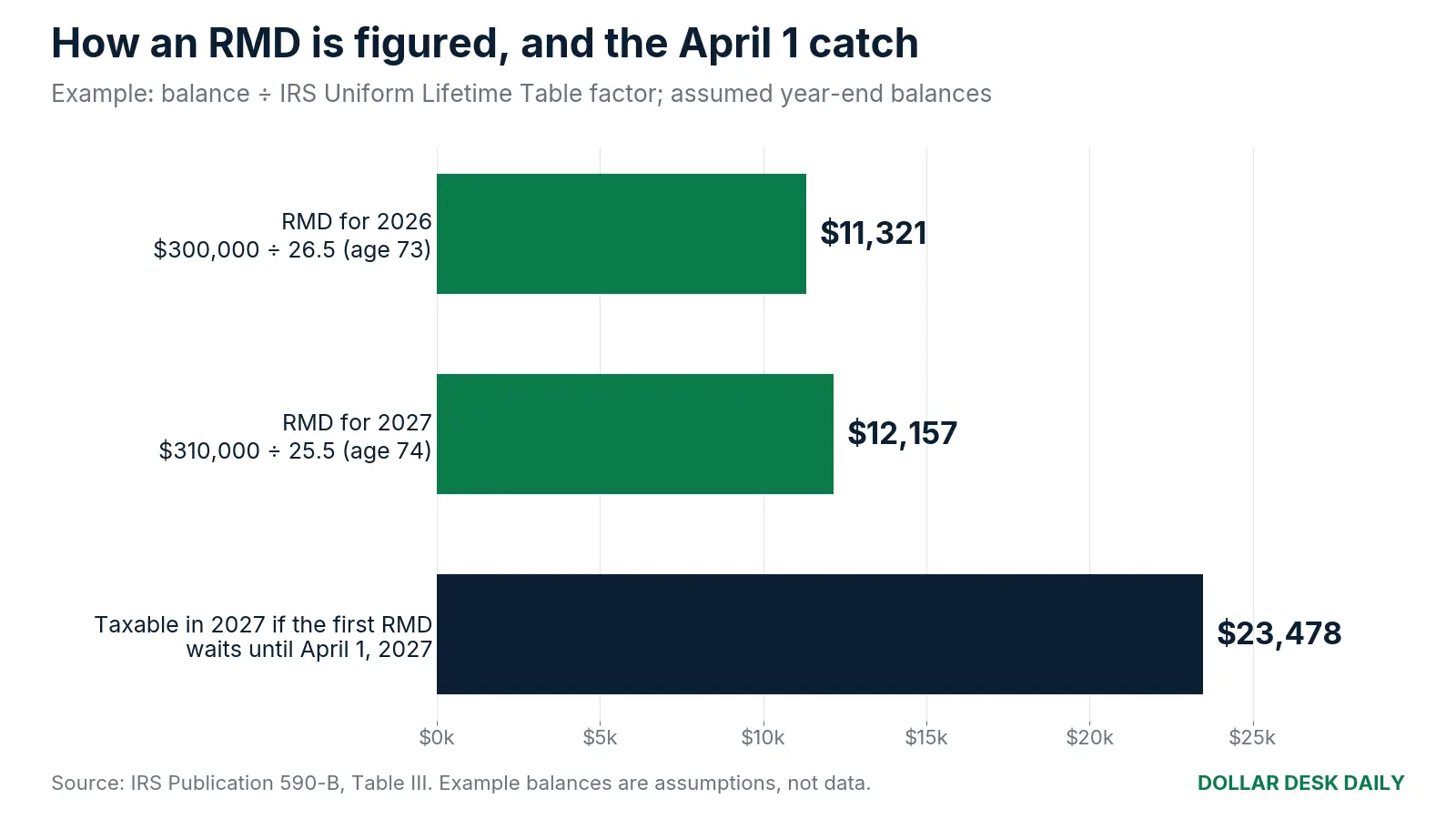
This is an illustration with assumed balances. Dana turns 73 in 2026 and has one traditional IRA. Its balance on Dec. 31, 2025 was $300,000.
- 2026 RMD: $300,000 ÷ 26.5 = $11,321 (rounded)
- Dana turns 74 in 2027. If the Dec. 31, 2026 balance is $310,000, the 2027 RMD is $310,000 ÷ 25.5 = $12,157
The IRS lets you withdraw more than the minimum. But it says an extra amount in one year cannot be credited to a future year’s RMD.
Owners with several accounts follow account-specific rules. The IRS says an IRA owner must calculate the RMD separately for each IRA but can withdraw the total from one or more of them. The same applies to 403(b) contracts. For 401(k) and 457(b) plans, the RMD must be taken separately from each plan.
When is the deadline, and what is the April 1 exception?
After your first RMD, each one is due by Dec. 31 of the year. Your first RMD is special. The IRS says you must take it for the year you reach the required age, but you can delay that first withdrawal until April 1 of the following year.
That delay has a catch. If you wait, you will take two RMDs in the same calendar year: the first one by April 1, and the second by Dec. 31. The IRS gives this example: a person who reached 73 on Aug. 20, 2024 had to take the 2024 RMD by April 1, 2025 and the 2025 RMD by Dec. 31, 2025.
In Dana’s case, waiting until April 1, 2027 for the 2026 RMD means $11,321 + $12,157 = $23,478 withdrawn in 2027. Both count as taxable income that year, which can push income into a higher bracket. Our explainer on marginal vs. effective tax rates shows how brackets work, and the 2026 tax brackets article lists the current thresholds.
The IRS notes you can instead take the first withdrawal by Dec. 31 of the year you reach the age, which would put the two distributions in separate tax years. Which is better depends on your total income, so this is a tax question to check against your own return.
What is the penalty for missing an RMD?
According to the IRS, if you do not withdraw the full RMD by the due date, the amount not withdrawn may be subject to an excise tax of 25%. That falls to 10% if the RMD is corrected within two years.
Using Dana’s numbers, if the full 2026 RMD of $11,321 were missed:
| Scenario | Penalty |
|---|---|
| Not corrected: 25% × $11,321 | $2,830 |
| Corrected within two years: 10% × $11,321 | $1,132 |
The IRS says the owner reports this tax on Form 5329 with the federal return for the year the RMD was required but not taken. The penalty may also be waived. The IRS says relief is available if the shortfall was due to reasonable error and you are taking reasonable steps to fix it. To request it, you file Form 5329 and attach a letter of explanation. The IRS reviews the request and decides whether to grant it.
How are RMDs taxed, and can they be given to charity?
The IRS says RMDs are taxed at ordinary income tax rates, except for any part that was already taxed (your basis) or that is a qualified Roth distribution. Pre-tax money you withdraw is added to the income on your return.
Publication 590-B also says a qualified charitable distribution (QCD) counts toward your RMD. A QCD is a transfer made directly by the IRA trustee to an eligible charity, available at age 70½ or older, and the publication has detailed rules on it.
Common mistakes to avoid
- Assuming the custodian handles it. The IRS says the custodian or plan administrator may calculate the RMD, but the account owner is ultimately responsible for taking the correct amount.
- Using the wrong balance. The calculation uses the prior Dec. 31 balance, not the current one.
- Counting extra withdrawals toward next year. The IRS says excess withdrawals cannot be applied to a future year.
- Treating all accounts alike. IRAs can be combined for the withdrawal; 401(k) accounts cannot.
- Forgetting inherited accounts. The IRS says separate rules apply to beneficiaries, including a 10-year payout rule for many who inherit after 2019.
For retirees who also draw Social Security, see how Social Security benefits are calculated for the other piece of retirement income.
Sources
- IRS — Retirement topics: Required minimum distributions (RMDs)
- IRS — Retirement plan and IRA required minimum distributions FAQs
- IRS — Publication 590-B, Distributions from Individual Retirement Arrangements (IRAs) (for 2025 returns), including Appendix B, Table III (Uniform Lifetime)
- IRS — Instructions for Form 5329 (Additional Taxes on Qualified Plans (Including IRAs) and Other Tax-Favored Accounts)
- IRS — Internal Revenue Bulletin 2024-33 (T.D. 10001, final regulations on required minimum distributions)
- IRS — Notice 2023-54, Transition Relief and Guidance Relating to Certain Required Minimum Distributions