2027 401(k) and IRA Limits: $25,500 Cap, $11,750 Catch-Up at 60–63
The IRS raised the 2027 401(k) limit to $25,500 and kept the IRA limit at $7,500. See the catch-up amounts, the new Roth catch-up wage line and income ranges.
Key Takeaways
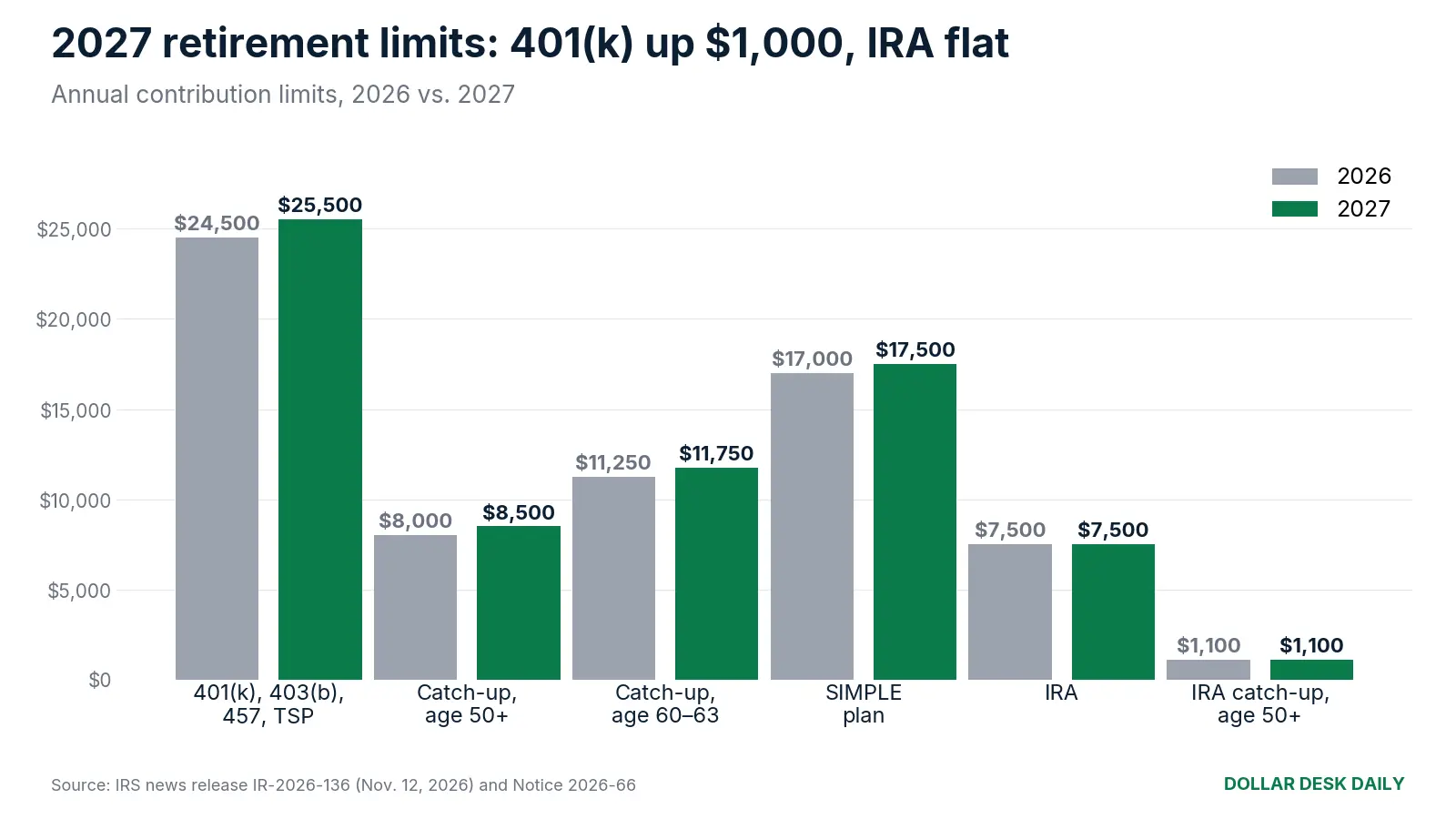
- The IRS announced on Nov. 12, 2026 that the 401(k), 403(b), governmental 457 and Thrift Savings Plan limit rises to $25,500 for 2027, up from $24,500 in 2026.
- Workers 50 and older can add $8,500 (total $34,000), and those who turn 60, 61, 62 or 63 in 2027 can add $11,750 instead, for a possible $37,250.
- The IRA limit stays at $7,500 with a $1,100 catch-up, the Roth IRA phase-out for single filers moves to $158,000–$173,000, and the Roth catch-up wage threshold rises from $150,000 to $155,000.
In this article
The IRS announced on Nov. 12, 2026 that the most an employee can contribute to a 401(k) in 2027 is $25,500, up from $24,500 in 2026. The same limit covers 403(b) plans, governmental 457 plans and the federal Thrift Savings Plan. The limit for an individual retirement account (IRA) does not change: it stays at $7,500.
These numbers come from the IRS news release (IR-2026-136) and the technical guidance behind it, Notice 2026-66. The limits are adjusted for the cost of living each year, and the IRS rounds them to set steps, which is why some amounts rise and others sit still.
What are the 2027 limits compared with 2026?
| Limit | 2026 | 2027 |
|---|---|---|
| 401(k), 403(b), governmental 457, TSP employee deferral | $24,500 | $25,500 |
| Catch-up, age 50 and older | $8,000 | $8,500 |
| Catch-up, ages 60 to 63 | $11,250 | $11,750 |
| IRA contribution | $7,500 | $7,500 |
| IRA catch-up, age 50 and older | $1,100 | $1,100 |
| SIMPLE plan salary deferral | $17,000 | $17,500 |
| SIMPLE plan, certain applicable employers | $18,100 | $19,100 |
A “deferral” is money you choose to have taken from your paycheck and put into the plan. A “catch-up” is an extra amount allowed for older workers on top of the regular limit. The chart above shows the same data. The IRS also says the overall cap on a defined contribution plan, which counts employee and employer money together, goes from $72,000 to $75,000 in 2027 (Notice 2026-66).
How do the catch-up limits work?
Employees age 50 and older in most 401(k), 403(b), governmental 457 and TSP plans can add $8,500 in 2027. The IRS says that means they can generally contribute up to $34,000 a year ($25,500 plus $8,500).
A higher catch-up applies to people who are 60, 61, 62 or 63 in 2027. Under a change in the SECURE 2.0 Act of 2022, their catch-up is $11,750 instead of $8,500. Adding that to the regular limit gives $37,250. The IRS notice ties the higher amount to people who reach age 60, 61, 62 or 63 in 2027.
SIMPLE plans, which are retirement plans for small employers, have their own catch-up amounts. For 2027 the IRS says the general catch-up stays at $4,000, the age 60 to 63 catch-up stays at $5,250, and the catch-up for certain applicable SIMPLE plans stays at $3,850. The IRS says plans “may permit” catch-up contributions, so they depend on your plan’s rules.
For IRAs, the catch-up for people 50 and older stays at $1,100, so the most a 50-plus saver can put in an IRA is $8,600 in 2027. The IRS notes the IRA catch-up now gets a yearly cost-of-living adjustment because of SECURE 2.0, but it did not move this year.
Which catch-ups have to be Roth in 2027?
SECURE 2.0 added a rule for higher earners. The IRS says that beginning in 2026, participants in plans with Roth features that offer catch-up contributions must make them on a Roth basis if their prior-year wages with the plan sponsor exceeded a threshold ($150,000 for 2026). Roth contributions are made with after-tax money, so you get no tax deduction now, but qualified withdrawals later are tax-free.
Notice 2026-66 raises the Roth catch-up wage threshold for 2026 from $150,000 to $155,000 and says it is used to decide whether catch-ups made for 2027 must be designated as Roth. The wages that count are those from the plan sponsor in the prior year. In plain terms, wages above $155,000 from that employer in 2026 mean 2027 catch-up dollars must be Roth.
The rule applies only to the catch-up part. The first $25,500 can still go in pre-tax (or Roth, if you choose and your plan allows). The notice excludes SEP and SIMPLE plans from this rule. The IRS pages cited here do not spell out how individual plans will administer it, so plan administrators hold those details.
What are the 2027 income ranges for IRAs?
Whether you can deduct a traditional IRA contribution, or contribute to a Roth IRA at all, depends on your adjusted gross income (AGI, as the tax code defines it for these rules). The IRS raised these ranges for 2027:
| Rule (2027) | Phase-out range | 2026 range |
|---|---|---|
| Traditional IRA deduction, single, covered by a workplace plan | $83,000–$93,000 | $81,000–$91,000 |
| Traditional IRA deduction, married filing jointly, contributor covered by a workplace plan | $133,000–$153,000 | $129,000–$149,000 |
| Traditional IRA deduction, contributor not covered but spouse is | $250,000–$260,000 | $242,000–$252,000 |
| Roth IRA, single or head of household | $158,000–$173,000 | $153,000–$168,000 |
| Roth IRA, married filing jointly | $250,000–$260,000 | $242,000–$252,000 |
A phase-out range is the band where your allowed amount shrinks as income rises, reaching zero at the top. For a married person filing separately and covered by a workplace plan, the range is not adjusted and stays at $0 to $10,000, for both the deduction and Roth contributions. If neither you nor your spouse is covered by a plan at work, the deduction phase-outs do not apply.
The IRS also raised Saver’s Credit income limits for 2027, but notes the credit applies to ABLE account contributions after Dec. 31, 2026, because Saver’s Match contributions replace it for retirement plans and IRAs (Notice 2026-66). The top limits are $83,000 for married couples filing jointly (up from $80,500), $62,250 for heads of household (up from $60,375), and $41,500 for singles and married people filing separately (up from $40,250).
What it means for you
Here is an illustration, not a prediction for any one person. Suppose a worker turns 61 in 2027, earned $160,000 from her employer in 2026, and wants to contribute the maximum.
- Regular limit: $25,500
- Age 60 to 63 catch-up: $11,750
- Total possible: $25,500 + $11,750 = $37,250
Because $160,000 is above the $155,000 threshold, the $11,750 must go in as Roth under the SECURE 2.0 rule, assuming her plan offers catch-ups. Spread over 26 paychecks, the full $37,250 would be about $1,433 per paycheck ($37,250 ÷ 26 = $1,432.69).
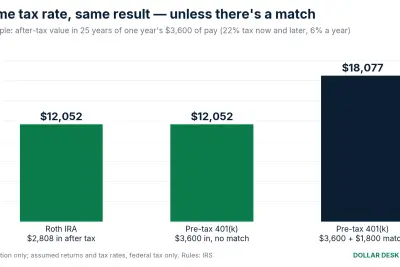
A second illustration: a 52-year-old with $140,000 of prior-year wages. The cap is $25,500 + $8,500 = $34,000, and the Roth catch-up requirement would not apply because $140,000 is below $155,000. If that person also files as single with $165,000 of income, the income falls inside the $158,000–$173,000 Roth IRA range, where the allowed contribution is reduced. For how the 401(k) and Roth IRA compare on taxes, see 401(k) vs. Roth IRA.
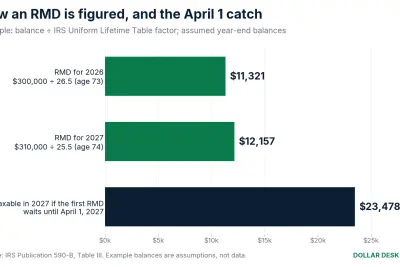
The limits cap what you can contribute, not what you must. These examples use the IRS figures only and are not advice for any reader. Pre-tax contributions lower taxable income, which interacts with tax brackets, covered in 2026 Tax Brackets and Standard Deduction for Returns Filed in 2027. Money in pre-tax accounts is also eventually subject to withdrawal rules, explained in Required Minimum Distributions.
What to watch next
Employers set their own plan rules within these limits, so plan documents show which features, such as catch-ups or Roth contributions, a given plan offers. Notice 2026-66 contains additional limits not covered here, such as the thresholds for highly compensated employees ($170,000) and key employees ($245,000).