401(k) vs. Roth IRA: Taxes, 2026 Limits and Which Fits You
A 401(k) lets you defer $24,500 in 2026, plus any employer match; a Roth IRA allows $7,500 with tax-free qualified withdrawals. How the rules and math compare.
Key Takeaways
- For 2026, the IRS lets employees put up to $24,500 into a 401(k) and up to $7,500 into an IRA; the IRS had not published 2027 limits as of Nov. 1, 2026.
- A Roth IRA has income limits, with eligibility phasing out between $153,000 and $168,000 of modified AGI for single filers in 2026, while a 401(k) has no income limit to participate.
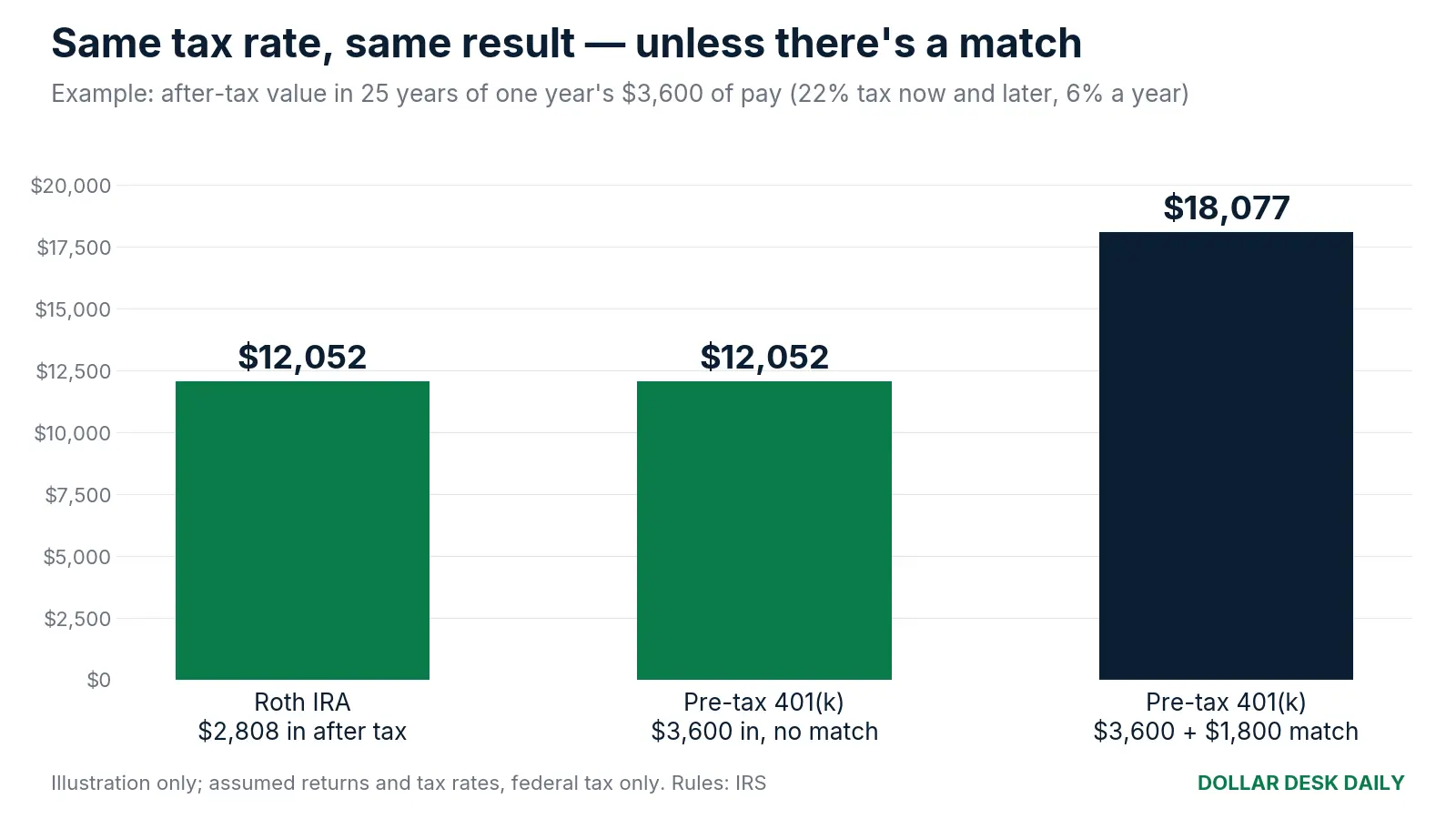
- In an example with a 22% tax rate now and in retirement and 6% yearly growth for 25 years, $3,600 of pay ends up as $12,052 after tax in either a pre-tax 401(k) or a Roth IRA, and $18,077 with a 50% employer match.
In this article
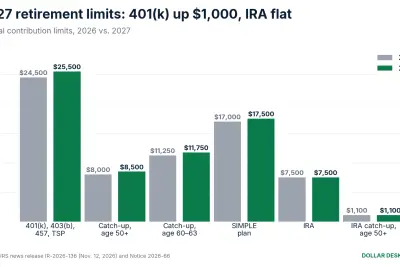
A 401(k) and a Roth IRA both help you save for retirement, but they flip the timing of the tax. A traditional 401(k) takes money out of your paycheck before income tax and taxes it when you withdraw; a Roth IRA takes money you have already paid tax on and, if you follow the rules, lets you withdraw it tax-free. For 2026, the IRS lets you defer up to $24,500 into a 401(k) and contribute up to $7,500 to an IRA.
The IRS had not announced 2027 limits as of Nov. 1, 2026, so this comparison uses 2026 figures. Last year, the 2026 limits were announced on Nov. 13, 2025.
The trade-offs in brief
Where a traditional 401(k) has the edge: – an employer match, if the plan offers one, is extra money available only through the plan; – the 2026 limit is $24,500, compared with $7,500 for an IRA; – pre-tax saving comes out ahead when your tax rate in retirement is lower than it is now; – there is no income limit to participate.
Where a Roth IRA has the edge: – you can open one yourself, with or without a workplace plan; – tax-free qualified withdrawals come out ahead when your tax rate in retirement is higher than it is now; – your own contributions can be taken out without tax; – there are no required withdrawals while you are alive.
The two limits are separate. Roth IRA eligibility depends on taxable compensation and modified adjusted gross income, not on whether you have a workplace plan, so a 401(k) participant under the income limits can contribute to both.
Side by side: 2026 rules
| Feature | Traditional 401(k) | Roth IRA |
|---|---|---|
| Who offers it | Your employer | You open it yourself |
| Tax on money going in | Pre-tax (no income tax now) | After tax |
| Tax on qualified withdrawals | Taxed as income | Tax-free |
| 2026 contribution limit | $24,500 | $7,500 |
| Extra if 50 or older (2026) | $8,000 ($11,250 at ages 60–63) | $1,100 |
| Income limit to contribute | None | Phases out at $153,000–$168,000 (single), $242,000–$252,000 (married filing jointly) |
| Employer match | If the plan offers one | No |
| Penalty-free withdrawals start | 59½ (or after leaving the job in or after the year you turn 55) | Contributions anytime; earnings at 59½ after 5 years |
| Required withdrawals | Generally from age 73 | None while the owner is alive |
How a 401(k) works
Tax treatment. Pre-tax deferrals are excluded from your taxable income in the year you make them, and the money grows untaxed until you withdraw it, according to the IRS. Deferrals still count as wages for Social Security and Medicare taxes. Withdrawals, including earnings, are taxed as income.
A plan can also offer a Roth 401(k) option. Those “designated Roth” deferrals go in after tax and can come out tax-free in a qualified distribution. The $24,500 limit is per person and covers your pre-tax and Roth 401(k) deferrals combined.
Limits. Workers 50 and older can add an $8,000 catch-up for a total of $32,500 in 2026. A higher catch-up of $11,250 applies to people aged 60 to 63. Combined employee and employer contributions to one person’s account are capped at $72,000 for 2026.
Employer match. If the plan allows it, your employer can match what you defer. The IRS gives the example of a plan that contributes 50 cents for each dollar you put in. Your own deferrals are always 100% vested, meaning they are yours. Matching money can follow a vesting schedule, so you may need to stay a certain number of years to keep all of it.
Withdrawals. Money taken out before age 59½ usually owes an extra 10% tax on top of income tax, unless an exception applies. One exception covers people who leave their job during or after the year they turn 55. Required minimum distributions generally start at 73, though some plans let you wait until you retire.
How a Roth IRA works
Tax treatment. You cannot deduct Roth IRA contributions. In return, qualified distributions are tax-free. A distribution is qualified when the account has met a five-year holding period and you are 59½ or older, disabled, or the owner has died; a first-time home purchase can also qualify.
Limits. The $7,500 limit for 2026 is shared across all your traditional and Roth IRAs, plus $1,100 if you are 50 or older. You need taxable compensation, such as wages, to contribute. Eligibility phases out between $153,000 and $168,000 of modified adjusted gross income (MAGI) for single filers and between $242,000 and $252,000 for married couples filing jointly. You can contribute at any age, up to your tax-filing deadline for that year, not counting extensions.
Withdrawals. The IRS treats your regular contributions as coming out first, and taking back your own contributions is not taxed. Earnings withdrawn before a qualified distribution can be taxed and may face the 10% additional tax. There are no required withdrawals while you are alive.
Worked example: same paycheck, three outcomes
This is an illustration, not a forecast. Assumptions: you set aside $3,600 of pay this year; your federal income tax rate is 22% now and 22% in retirement; the money earns 6% a year for 25 years, which multiplies it by about 4.2919 (1.06 to the 25th power). State taxes are ignored.
Pre-tax 401(k), no match: $3,600 goes in. It grows to $3,600 × 4.2919 = about $15,451. At withdrawal, 22% tax leaves $12,052.
Roth IRA: you first pay 22% tax on the $3,600, so $3,600 − $792 = $2,808 goes in. It grows to $2,808 × 4.2919 = about $12,052, tax-free.
Pre-tax 401(k) with a 50-cent match: you put in $3,600 and your employer adds $1,800, so $5,400 goes in. It grows to $5,400 × 4.2919 = about $23,176, and 22% tax leaves $18,077.
With equal tax rates, the two accounts tie. In this example, the match adds $6,025 after tax.
The tax rate in retirement breaks the tie. If your rate falls to 12% in retirement, the no-match 401(k) leaves $15,451 × 0.88 = about $13,597, beating the Roth’s $12,052. If it rises to 24%, the 401(k) leaves about $11,743 and the Roth comes out ahead. Our explainer on marginal vs. effective tax rates shows which rate to use in this kind of comparison.
How to decide
- Check whether your employer matches, and how. Look up the match formula and vesting schedule in your plan documents.
- Compare your tax rate now with what you expect later. In the example above, a lower rate later favors pre-tax saving, a higher rate favors the Roth, and an equal rate is a tie. Future tax rates are not known in advance.
- Check your income against the Roth IRA phase-out. Above $168,000 single or $252,000 joint (2026 MAGI), you cannot contribute directly.
- Think about access. Roth IRA contributions can come out without tax; most early 401(k) withdrawals owe the 10% extra tax unless an exception applies.
- Remember Social Security is the base. Your savings add to the benefit described in our guide to how Social Security benefits are calculated.
Watch the IRS newsroom for the 2027 contribution limits, which will set how much you can put into each account starting in January.
Sources
- IRS — 401(k) limit increases to $24,500 for 2026, IRA limit increases to $7,500 (IR-2025-111, Nov. 13, 2025)
- IRS — COLA increases for dollar limitations on benefits and contributions
- IRS — News releases for current month
- IRS — 401(k) Resource Guide: Plan Participants — 401(k) Plan Overview
- IRS — 401(k) plans
- IRS — Roth IRAs
- IRS — Roth comparison chart
- IRS — Retirement topics: Exceptions to tax on early distributions
- IRS — Retirement topics: Required minimum distributions (RMDs)
- IRS — Publication 590-A (2025), Contributions to Individual Retirement Arrangements (IRAs)
- IRS — Publication 590-B (2025), Distributions from Individual Retirement Arrangements (IRAs)