Renters Insurance Explained: What It Covers, Excludes and Costs
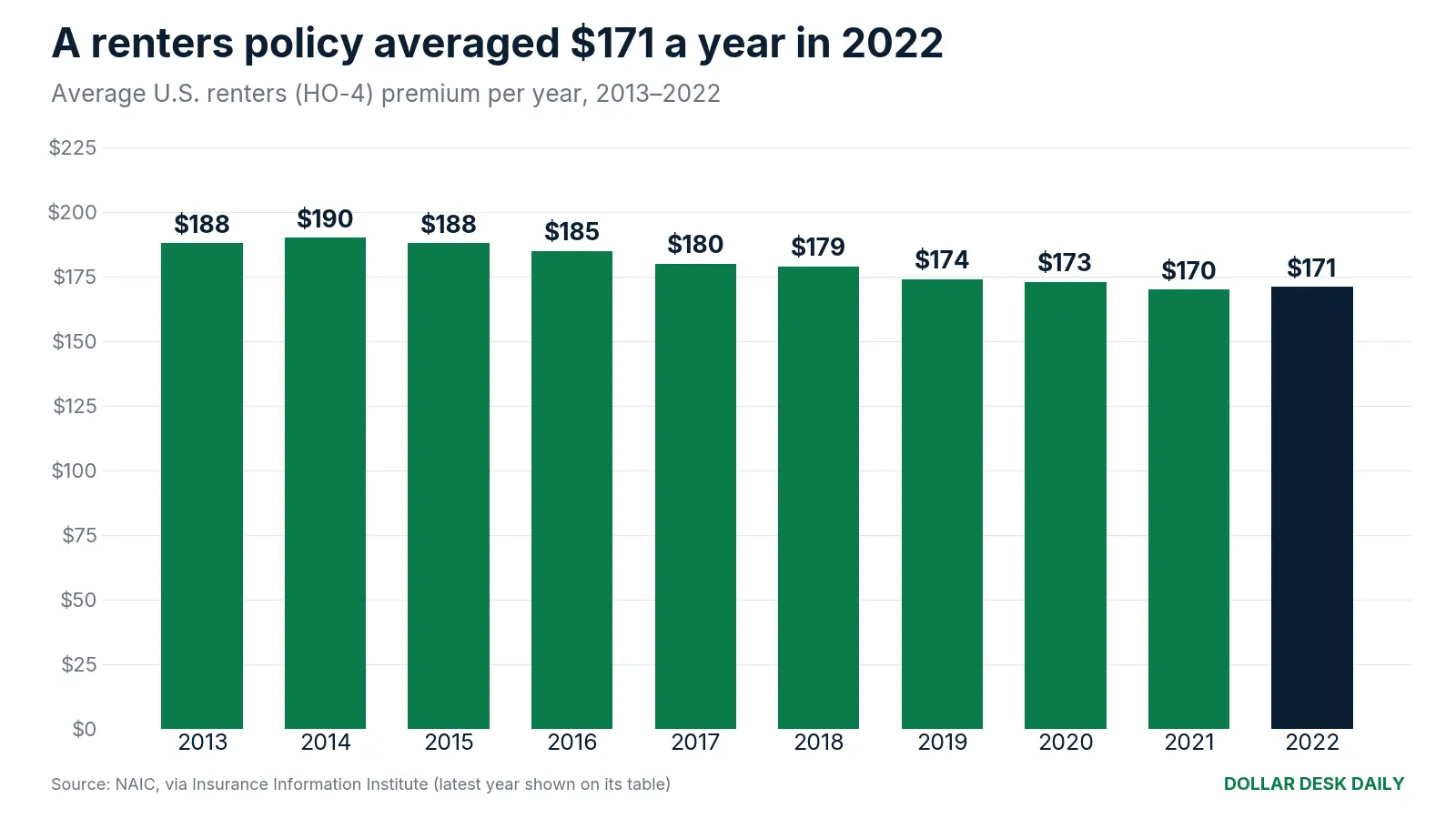
Renters insurance pays for your belongings, liability and temporary housing after a covered loss. The average policy cost $171 a year in 2022, per NAIC data.
Key Takeaways
- A renters policy covers your belongings, your legal liability and extra living costs after a covered loss, while the landlord’s policy covers only the building, according to the New Jersey Department of Banking and Insurance.
- The average U.S. renters premium was $171 a year in 2022, about $14 a month, ranging from $123 in North Dakota to $262 in Mississippi, according to NAIC data published by the Insurance Information Institute.
- Actual cash value pays for an item as it is now, minus depreciation, while replacement cost pays to buy a new one, and flood and earthquake damage are generally excluded from standard policies.
In this article
Renters insurance is a policy that pays for your belongings, your legal liability and some extra living costs after a covered loss, such as a fire or a theft. It does not cover the building itself. The average U.S. renters policy cost $171 a year in 2022, about $14 a month, according to National Association of Insurance Commissioners (NAIC) data published by the Insurance Information Institute.
Your landlord’s insurance is a separate policy. As the New Jersey Department of Banking and Insurance puts it, the landlord’s coverage takes care of damage to the building’s structure, so a tenant’s own belongings are not protected unless the tenant buys a policy.
What does a renters policy cover?
Most policies bundle several coverages. The New Jersey guide lists the usual ones by their standard labels.
| Coverage | What it pays for |
|---|---|
| Personal property (Coverage C) | Your belongings if a covered loss damages or destroys them |
| Loss of use (Coverage D) | Additional living expenses, meaning costs above your normal housing and food spending, if damage makes your home uninhabitable |
| Personal liability (Coverage E) | Your legal defense and damages if you are found responsible for someone else’s injury or property damage |
| Medical payments to others (Coverage F) | Medical bills of people hurt on your property, and some injuries away from home |
Covered causes of loss in the New Jersey guide include fire and lightning, smoke, explosion, theft, vandalism, windstorm and hail, sudden and accidental water damage, and the weight of ice and snow. Dollar limits and deductibles vary by company and policy, so the limits in your own policy decide what is paid.
The NAIC describes two common policy types. A “broad form” policy covers belongings against named events and is the most commonly purchased. A “comprehensive form” policy covers a range of events except those it specifically excludes, and its premiums may be higher.
Actual cash value vs. replacement cost
This choice often matters most when you file a claim. Actual cash value (ACV) pays what your item is worth now, taking its age and condition into account, minus your deductible. Replacement cost pays what it costs to buy a new equivalent, still minus the deductible.
The Louisiana Department of Insurance says renters policies normally pay only actual cash value, but replacement coverage is available at a higher up-front price. The NAIC notes the choice may not change short-term premiums much, yet it can make a large difference at claim time. In the NAIC’s description, replacement cost pays after you buy the new item and submit receipts.
New Jersey’s guide gives an example: a three-year-old computer damaged by lightning could have an actual cash value of only $650, but it would cost $1,100 to replace.
Here is that example with a deductible added. The $500 deductible is an assumption for this illustration, not a typical figure.
| Policy type | Computer value used | Minus $500 deductible | Claim payment |
|---|---|---|---|
| Actual cash value | $650 | $500 | $150 |
| Replacement cost | $1,100 | $500 | $600 |
The gap grows with every item. A policy that pays $450 more on one laptop pays far more on a whole living room of furniture, clothing and electronics.
What is typically excluded?
Even broad policies leave out some losses. The New Jersey guide says flooding, including tidal surge, is not covered, and the NAIC says homeowners and renters insurance generally do not protect against flood losses. Flood coverage is sold separately through the National Flood Insurance Program.
New Jersey’s list of exclusions also includes:
- earthquakes, earth movement, landslides, mudslides and sinkholes
- termites, insects, rats, mice, birds and other vermin
- wear and tear, rot and pollution
- water damage from continuous and repeated seepage
- losses while the unit is vacant for longer than the policy allows
- intentional acts by you or a resident of your home, and war or nuclear hazard
- mold, unless it results from a covered loss
Hurricanes show how the line works. The NAIC says wind and hail damage from a hurricane is usually covered, but flood or storm surge damage from the same storm is not. Louisiana’s insurance department notes that anyone on a ground-floor unit in that state may consider a “contents only” flood policy.
Theft is generally covered up to policy limits, but the NAIC says jewelry, antiques and art often carry lower sublimits. Expensive items may need a “rider,” a policy add-on that raises coverage for specific things.
How much does renters insurance cost?
According to NAIC data published by the Insurance Information Institute, the average renters premium in 2022 was $171 a year. That was up 0.6% from 2021, which ended seven straight annual declines. It had been $188 in 2013 and as high as $190 in 2014.
Premiums differ widely by state in the same 2022 data.
| State | Average renters premium, 2022 | Per month (annual ÷ 12) |
|---|---|---|
| Mississippi (highest) | $262 | about $21.83 |
| Louisiana | $243 | about $20.25 |
| United States | $171 | about $14.25 |
| Minnesota | $135 | about $11.25 |
| South Dakota | $129 | about $10.75 |
| North Dakota (lowest) | $123 | about $10.25 |
The 2022 table is the latest premium year the Insurance Information Institute shows, so today’s prices may differ. A newer gauge is the Consumer Price Index for tenants’ and household insurance, which prices only renters’ policies, according to the Bureau of Labor Statistics. It stood at 175.093 in September 2026 against 169.935 in September 2025, a 3.0% rise over 12 months (175.093 ÷ 169.935 = 1.030). For comparison, the home-side picture is covered in why home insurance premiums are rising.
What it means for you
Start with a rough tally of what you own. The NAIC and the Illinois Department of Insurance both recommend keeping a home inventory, and Illinois says an inventory with photos and proof of ownership makes it easier to file an accurate claim. The inventory total gives you a number to compare with the policy’s personal property limit. The Insurance Information Institute reports that in a 2023 survey, 47% of homeowners said they had prepared such an inventory.
Then compare options on the same terms. Ask each insurer for ACV and replacement-cost prices, the deductible, the liability limit, the loss-of-use limit and any sublimits on jewelry or electronics. Costs for the same coverage can differ from company to company, according to New Jersey’s guide.
An illustration of the trade-off, using the national average: if replacement cost coverage added $5 a month to a $14.25 monthly premium, that would be $60 a year more. On the $650 vs. $1,100 computer claim above, the difference in payout is $450. The $5 figure is an assumption for the example; actual price differences depend on the insurer and the limits chosen.
Also check who is covered. The NAIC says dependents such as college students are generally covered under a parent’s policy, typically up to 10% of that policy’s amount, and the Louisiana guide says that with non-relative roommates it is best for all occupants to be on the same policy, though each can buy their own. A deductible is money you pay out of pocket first, which is one reason it ties into emergency fund and monthly budget planning. Renters insurance is one of several coverage types, and term and whole life insurance answer a different question.
Common mistakes and misconceptions
- Assuming the landlord’s policy covers your belongings. It covers the building, not your property.
- Assuming flood is included. Standard renters policies generally exclude it.
- Skipping the ACV vs. replacement cost question. The default payout may be depreciated value.
- Forgetting that limits apply. Sublimits can cap payouts for jewelry, art and antiques.
- Leaving no records. Without an inventory, proving what you lost is harder.
State insurance departments, including those in New Jersey, Louisiana and Illinois, publish renters guides that list a policy’s exclusions and limits.
Sources
- New Jersey Department of Banking and Insurance — A Consumer Guide to Renters Insurance
- Louisiana Department of Insurance — Guide to Renters Insurance (Rev. 02/2025)
- Illinois Department of Insurance — What You Need To Know About Renters Insurance
- National Association of Insurance Commissioners — Consumer Insight: Renters Insurance, Purchase or Not Purchase
- National Association of Insurance Commissioners — Consumer Insight: My Insurance Doesn’t Cover What?
- Insurance Information Institute — Facts + Statistics: Homeowners and renters insurance (NAIC premium tables)
- Bureau of Labor Statistics — CPI Tenants’ and household insurance, series CUUR0000SEHD (via BLS Public Data API)
- Bureau of Labor Statistics — Measuring Price Change in the CPI: Tenants’ and Household Insurance