Stocks vs. Bonds: How Each Earns a Return and Why Bond Prices Fall
A stock is an ownership share; a bond is a loan. See how each earns a return, the risks of each, and why a bond’s price falls when rates rise, with the math.
Key Takeaways
- A stock is an ownership share that can pay dividends and gain or lose value; a bond is a loan that pays interest and returns face value at maturity, according to FINRA.
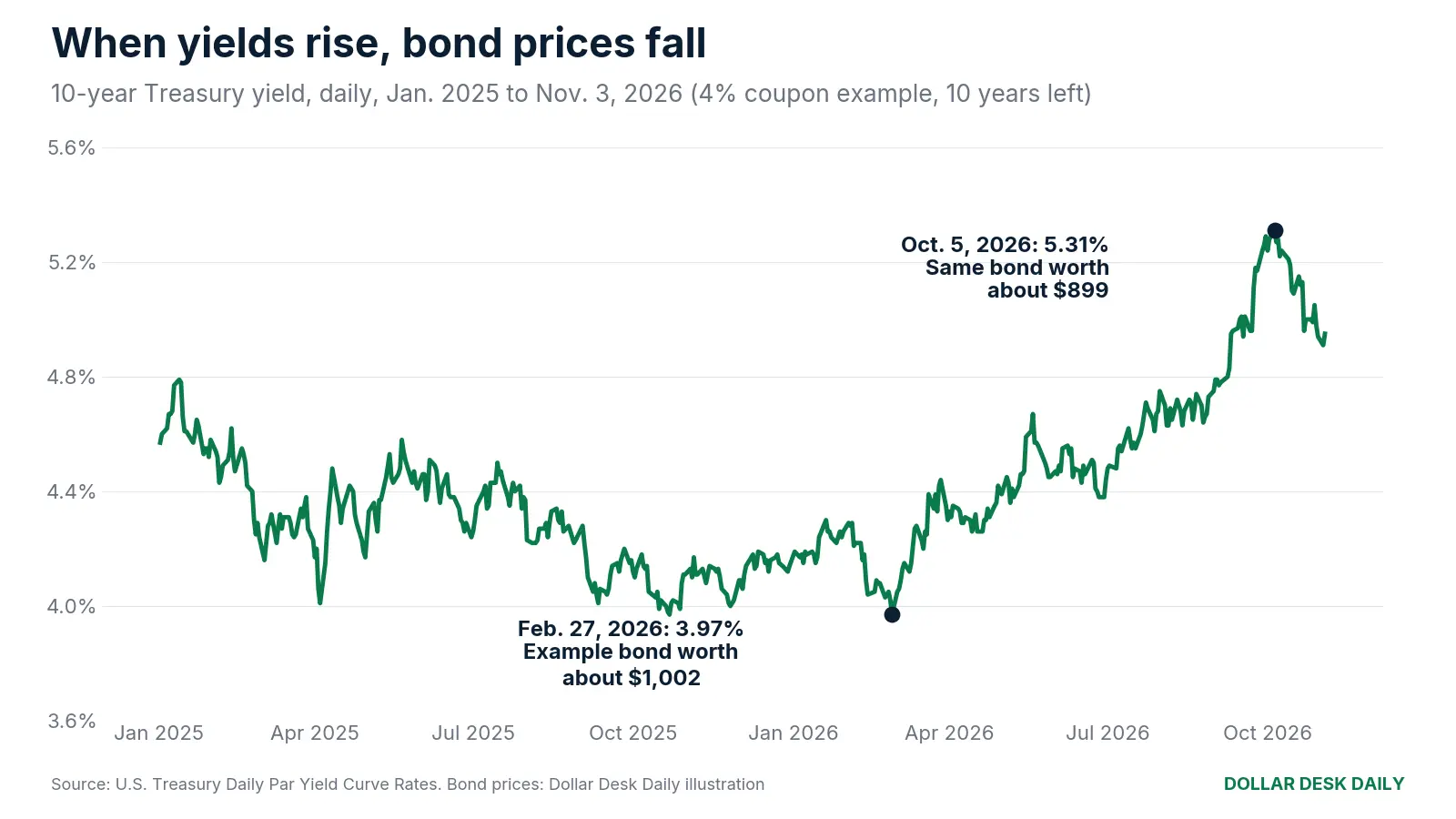
- The 10-year Treasury yield rose from 3.97% on Feb. 27, 2026 to 5.31% on Oct. 5, 2026, according to the Treasury Department; by Nov. 3 it was 4.95%.
- In an illustration, a 10-year bond with a 4% coupon is worth about $922 per $1,000 of face value if market yields rise to 5%, and about $1,086 if they fall to 3%.
In this article
A stock is a share of ownership in a company. A bond is a loan to a company or government that pays interest. Stock returns depend on how the company does, while a bond’s interest payments are set when it is issued, which is why the two react differently to the economy and to interest rates.
The gap shows up in the numbers. The 10-year Treasury yield, the return on a loan to the federal government, climbed from 3.97% on Feb. 27, 2026 to 5.31% on Oct. 5, 2026, and stood at 4.95% on Nov. 3, according to the Treasury Department. That swing changed what existing bonds were worth, as the math below shows.
What is a stock?
When you buy stock, you buy equity shares, a piece of a company. FINRA, the securities industry’s self-regulator, says your return “depends on the success or failure of that company.” If the business does well, the share price is likely to reflect it. If it struggles, or investors sell more than they buy, shares can be worth less than you paid.
What is a bond?
A bond is a loan. The borrower promises to pay interest, called the coupon, and to repay the face value (also called par value) on a set maturity date, according to FINRA. A bond with a $1,000 face value and a 4.5% coupon pays $45 a year, usually in two $22.50 payments.
U.S. Treasury securities are backed by the “full faith and credit” of the federal government, and FINRA calls them among the safest investments, while corporate bonds carry more risk of the issuer not paying. See Treasury Yields Explained.
How does each one earn a return?
| Stocks | Bonds | |
|---|---|---|
| What you own | A share of a company | A loan to a borrower |
| Income | Dividends, if the company pays them; not guaranteed | Interest (coupon), set at issue |
| Price gains | Capital gains if you sell above your cost | Gains if you sell above your cost; at maturity you get face value |
| If the issuer fails | Common stockholders are paid after bondholders | Bondholders are paid before stockholders |
| Main source of uncertainty | The company’s profits and investor demand | Interest rates, and whether the issuer pays |
Source: FINRA.
For stocks, FINRA lists two sources of return: dividends and capital gains. A company “doesn’t have to” pay a dividend, and if it does, it can cut or end it. For bonds, the coupon and face value are fixed, but the price in between is not. If you sell before maturity, you may receive more or less than face value, FINRA says.
FINRA also notes that stocks “have historically outperformed bonds over the long term,” but that stock prices “can go down, sometimes quite dramatically,” which makes stocks risky for short-term goals. Bond prices fluctuate too, although FINRA says they “tend to be less volatile than stocks.”
What are the main risks?
FINRA describes several risks that matter most.
- Market risk. Stock prices rise and fall daily, and the size of those swings is called volatility.
- Interest-rate risk. FINRA says this is the risk that changes in interest rates “may reduce, or increase, the market value of a bond you hold.” FINRA measures a bond’s sensitivity to rate changes with duration, covered below.
- Credit risk. This is the risk that a bond issuer fails to make interest payments or repay principal. FINRA says Treasuries are generally deemed free of default risk, while most other bonds face some degree of it, often shown in a credit rating.
- Inflation risk. If prices rise faster than a bond’s interest, the interest buys less. FINRA’s example is a 5% coupon with 8% inflation. Treasury Inflation-Protected Securities, or TIPS, adjust principal for inflation.
The Consumer Price Index rose 3.7% over the 12 months ending in September 2026, according to the Bureau of Labor Statistics. See What Is the CPI? and Inflation Hits 3.7% as Gas Jumps.
Why do bond prices fall when interest rates rise?
Because a bond’s coupon is fixed, its price has to adjust when new bonds pay a different rate. FINRA states three rules: when rates rise, bond prices generally fall; when rates fall, prices generally rise; and every bond carries interest-rate risk. TreasuryDirect adds that a bond’s price “depends on the yield to maturity and the interest rate.”
Suppose you own a bond paying 4%, and new bonds now pay 5%. No one will pay full price for the 4% bond, so its price drops until a buyer’s overall return, interest plus the gain from buying below face value, matches new bonds. In the reverse case, FINRA says, a bond with a coupon above current rates sells at a premium.
A worked example
Illustration, not a forecast: a $1,000 bond with a 4% coupon, paying $20 every six months, with 10 years left, valued with the standard present-value formula (each payment discounted at the market yield, compounded twice a year).
| Market yield for similar bonds | Bond price | Change from $1,000 |
|---|---|---|
| 3% | $1,086 | +$86 (+8.6%) |
| 4% | $1,000 | $0 |
| 5% | $922 | -$78 (-7.8%) |
| 6% | $851 | -$149 (-14.9%) |
An owner who holds to maturity still collects $20 every six months and gets the $1,000 back, assuming the issuer pays. The loss shows up if the bond is sold early.
The 2026 Treasury data shows the same pattern. The 10-year yield was 3.97% on Feb. 27, 2026. The same 4% example bond, with 10 years left, would have been worth about $1,002 then. At the Oct. 5 yield of 5.31%, it would be worth about $899, a drop of roughly 10%, even though its coupon never changed.
Longer bonds move more
With yields rising from 4% to 5%, the example bond loses far less if it matures soon:
| Years to maturity | Price at 4% yield | Price at 5% yield | Change |
|---|---|---|---|
| 2 | $1,000 | $981 | -1.9% |
| 10 | $1,000 | $922 | -7.8% |
| 30 | $1,000 | $845 | -15.5% |
FINRA explains this with duration, stated in years: “The higher the duration number, the more sensitive your bond investment will be to changes in interest rates.”
How do rates affect stocks?
Rates reach stocks through companies. FINRA says rising rates make borrowing costlier for businesses that need financing, and if rates climb during inflation, a company’s financing costs can rise as the value of the dollars it takes in falls. The effect on any one stock depends on the company. The Fed’s role in this chain is covered in How Fed Rate Decisions Reach Your Savings, Cards and Mortgage.
What it means for you
A stockholder shares in a company’s profits and losses; a bondholder is a lender who is paid first but whose upside is capped by the coupon. Neither is “safe” or “risky” in every case.
To read a bond’s risk, FINRA’s list suggests three questions. Who is borrowing, and could they fail to pay (credit risk)? How long until maturity (interest-rate risk)? Could the coupon buy less over time (inflation risk)? For stocks, the questions are about the business and how much its price swings.
Many people own both through funds. Fees and how index funds work are covered in Index Funds Explained. The right mix depends on goals, time horizon and risk tolerance, which is a question for a licensed adviser.
Common mistakes and misconceptions
- “Bonds can’t lose money.” A bond held to maturity returns face value if the issuer pays, but its market price can fall before then, as the tables show.
- “The coupon is the return.” FINRA’s example: a $1,000 bond paying $65 yields 6.5% at par, but if its price falls to $950, the current yield is 6.84%.
- “Stocks always pay dividends.” They do not, and the amount is not guaranteed.
What to watch next
The Treasury publishes yields every business day. When the 10-year yield moves, existing bond prices move the other way, and the size of the move depends on maturity.