I Bonds and TIPS Explained: How Inflation-Protected Treasuries Work
I bonds pay 5.51% for Nov 2026–Apr 2027 issues; TIPS adjust principal with CPI. How each works, the composite-rate math, limits, lockups and taxes.
Key Takeaways
- Treasury set the I bond composite rate at 5.51% for bonds issued November 2026 through April 2027: a 1.40% fixed rate plus a 2.04% six-month inflation rate.
- I bonds are capped at $10,000 per person per calendar year in electronic form, cannot be cashed for 12 months, and lose the last 3 months of interest if cashed before 5 years.
- TIPS principal rises and falls with CPI, you never get back less than face value at maturity, and the yearly increase in principal is reported for federal tax (IRS Pub. 550) even though you receive it only at maturity or sale.
In this article
Two U.S. Treasury products adjust for inflation: Series I savings bonds and Treasury Inflation-Protected Securities (TIPS). I bonds issued from November 2026 through April 2027 earn a 5.51% annual composite rate, according to TreasuryDirect. TIPS work differently: their principal, the amount the interest is calculated on, moves with the Consumer Price Index.
Both are built so that higher inflation raises what they pay. They differ in how much you can buy, how you get out and when the tax bill arrives.
How an I bond earns interest
An I bond has two parts. The fixed rate is set when the bond is issued and never changes for the life of the bond. The inflation rate is reset every six months and applies to all I bonds ever issued. TreasuryDirect bases it on changes in the non-seasonally adjusted CPI-U, the all-items index for urban consumers that includes food and energy. For background on that index, see what the CPI is and how it is measured.
Treasury combines the two into a composite rate (also called the combined or earning rate). Interest accrues monthly and is added to the bond’s value twice a year, so the next six months of interest is calculated on a larger balance. You receive the money only when you cash the bond or it reaches 30 years.
The composite rate formula, as TreasuryDirect publishes it, is: fixed rate + (2 × semiannual inflation rate) + (fixed rate × semiannual inflation rate).
Worked example: the 5.51% rate
The inputs for bonds issued November 2026 through April 2027 are a 1.40% fixed rate and a 2.04% semiannual inflation rate. The math:
- Fixed rate: 0.0140
- 2 × inflation rate: 2 × 0.0204 = 0.0408
- Fixed × inflation: 0.0140 × 0.0204 = 0.0002856
- Sum: 0.0140 + 0.0408 + 0.0002856 = 0.0550856, which rounds to 0.0551, or 5.51%
This matches TreasuryDirect’s rate. The inflation rate is a six-month figure, so it is doubled.
Now put dollars on it. This is an illustration, not a forecast. A $10,000 bond at 5.51% earns about $10,000 × 0.0551 ÷ 2 = $275.50 in its first six months. Later periods will differ. If inflation turns negative, the composite rate can fall below the fixed rate, but Treasury does not let it drop below zero.
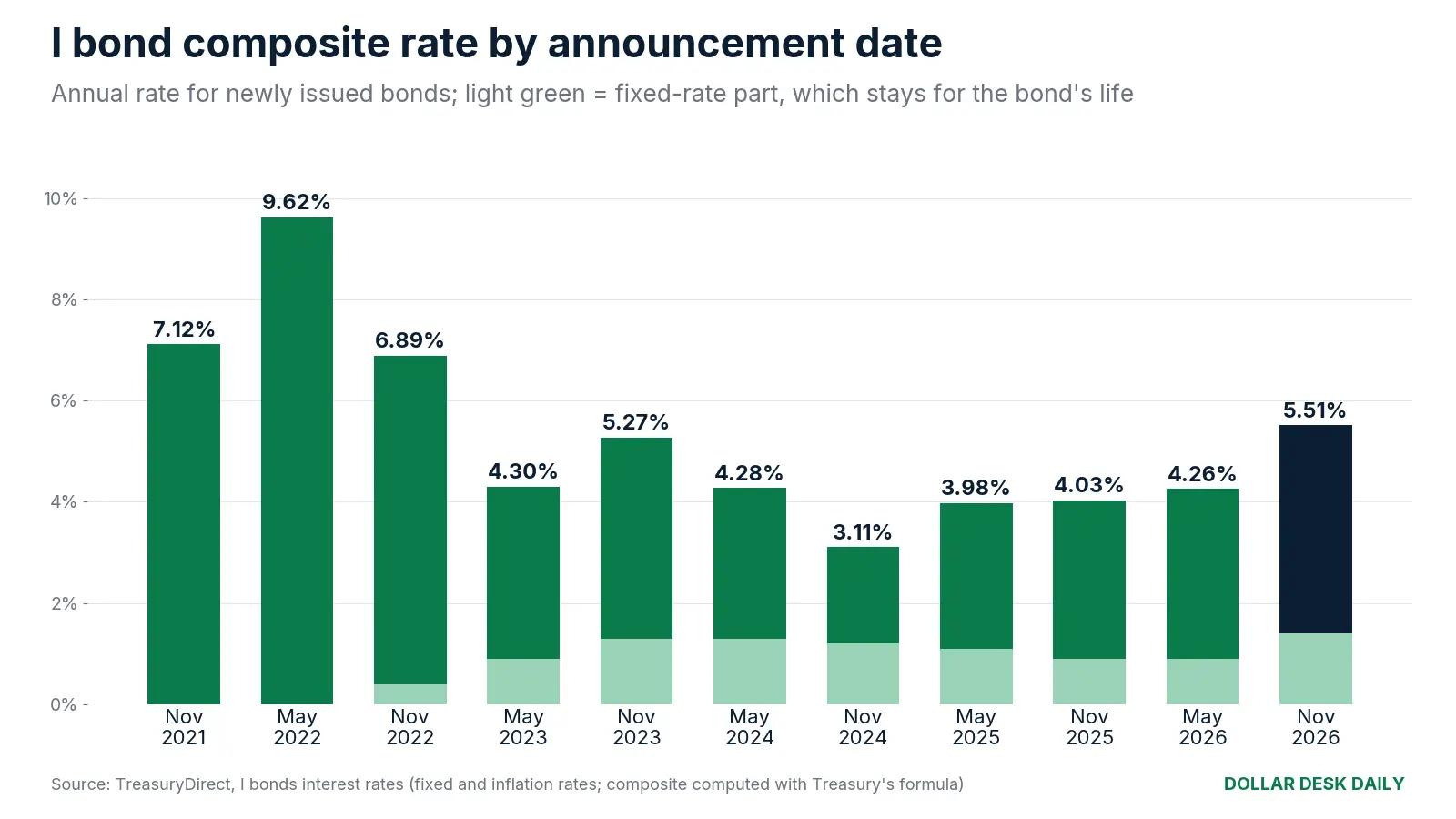
The chart shows how much the rate has moved. Using TreasuryDirect’s published fixed and inflation rates, the composite rate for newly issued bonds was 9.62% at the May 2022 announcement, 3.11% in November 2024 and 5.51% now.
| Rate set on | Fixed rate | Semiannual inflation rate | Composite rate |
|---|---|---|---|
| Nov. 1, 2026 | 1.40% | 2.04% | 5.51% |
| May 1, 2026 | 0.90% | 1.67% | 4.26% |
| Nov. 1, 2025 | 0.90% | 1.56% | 4.03% |
| Nov. 1, 2024 | 1.20% | 0.95% | 3.11% |
| May 1, 2022 | 0.00% | 4.81% | 9.62% |
Fixed and inflation rates are from TreasuryDirect. Composite rates are calculated with the formula above.
I bond limits, lockup and penalty
As of January 1, 2025, I bonds are sold only electronically, through a TreasuryDirect account. The minimum purchase is $25, and amounts can go to the penny. One Social Security number or employer identification number can buy up to $10,000 in electronic I bonds per calendar year, according to TreasuryDirect.
You cannot cash an I bond during the first 12 months. After that you can redeem it, but if you cash it in less than 5 years after purchase, you lose the last 3 months of interest. TreasuryDirect’s example: cash in after 18 months and you receive the first 15 months of interest.
On a $10,000 bond earning 5.51%, three months of interest is roughly $10,000 × 0.0551 ÷ 4 = $137.75. The actual balance and rate change over time.
How TIPS work
TIPS are marketable securities sold for 5, 10 or 30 years. Unlike ordinary Treasury notes and bonds, a TIPS principal is not fixed. TreasuryDirect says the principal goes up with inflation and down with deflation, and that interest is paid every six months on the adjusted principal.
The interest rate is fixed at auction and is never less than 0.125%. Because that rate is multiplied by a changing principal, each payment varies. At maturity you receive the adjusted principal or the original principal, whichever is greater. That is the deflation floor: you never get less than the original amount.
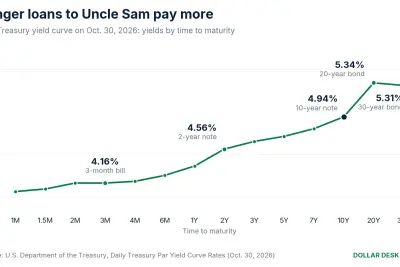
Treasury’s TIPS yield figures are “real” yields, meaning the return above inflation. These secondary-market yields move daily. According to Treasury’s par real yield curve, on November 20, 2026 the 5-year real yield was 2.53%, the 10-year 2.77% and the 30-year 3.17%. For how nominal yields work, see Treasury yields explained.
TIPS can be bought at Treasury auctions, with a $100 minimum in $100 steps, or in the secondary market before maturity. The maximum is $10 million for a non-competitive bid and 35% of the offering for a competitive bid. A TIPS held to maturity returns the adjusted principal, but one sold early is sold at the market price, which can be above or below the adjusted principal.
A TIPS example
Illustration with assumed numbers: take $10,000 of principal and a 1.00% interest rate. If the CPI index measure used for TIPS rises 3% during a year, the principal becomes $10,000 × 1.03 = $10,300. The next six-month interest payment is $10,300 × 0.01 ÷ 2 = $51.50. If prices fell 3% instead, principal would fall to $9,700 and the payment would shrink to $48.50, but at maturity the floor returns at least $10,000.
How each is taxed
Both are exempt from state and local income tax, according to TreasuryDirect. Both are subject to federal income tax.
For I bonds, you choose whether to report each year’s interest or wait and report everything when you cash the bond. Interest used for qualified higher-education expenses may be tax-free under certain conditions.
For TIPS, TreasuryDirect says federal tax is due each year on interest earned, and that any increase or decrease in principal during the year may affect your federal taxes. IRS Publication 550 (2025 edition) is more specific: a holder must report as original issue discount (OID) any increase in the inflation-adjusted principal that occurs during the year, and the payer should send Form 1099-OID. In the example, the $300 principal gain would be reported for that year even though the cash arrives only at maturity or sale. Check the IRS publication for how decreases are treated.
I bonds vs. TIPS at a glance
| Feature | I bonds | TIPS |
|---|---|---|
| Inflation link | Inflation rate reset every 6 months | Principal adjusted with CPI |
| Rate | Fixed rate plus inflation rate (5.51% for Nov. 2026–Apr. 2027 issues) | Fixed rate set at auction, at least 0.125% |
| Deflation | Composite rate cannot go below 0% | Principal at maturity never below original |
| Minimum purchase | $25 | $100 |
| Maximum purchase | $10,000 a year per SSN or EIN (electronic) | $10 million non-competitive bid |
| Where to buy | TreasuryDirect only | Auctions or secondary market |
| Access to money | After 12 months; 3 months’ interest lost before 5 years | Sell any time at market price, or hold to maturity |
| Term | Up to 30 years | 5, 10 or 30 years |
| Market price risk | None; value is set by Treasury | Yes, if sold before maturity |
| Federal tax | Defer or report yearly | Due yearly, including principal changes |
| State and local tax | None | None |
Common misunderstandings
- The 5.51% is not locked in. Only the 1.40% fixed rate is; the inflation part resets every six months.
- The latest CPI report does not change the rate already set. BLS reported on November 10 that CPI-U rose 0.4% in October 2026 (seasonally adjusted) after 0.6% in September. BLS said it cannot publish 12-month changes for most October indexes because no October 2025 data were collected during a lapse in appropriations. The next I bond rate is set May 1, 2027.
Sources
- TreasuryDirect — I bonds interest rates
- TreasuryDirect — I bonds
- TreasuryDirect — Treasury Inflation-Protected Securities (TIPS)
- IRS — Publication 550, Investment Income and Expenses (2025)
- TreasuryDirect — Understanding Pricing and Interest Rates
- U.S. Treasury — Daily Treasury Par Real Yield Curve Rates (November 2026)
- Bureau of Labor Statistics — Consumer Price Index Summary, October 2026