How to Organize Tax Documents Before Filing Season: 2026 Checklist
Which forms to expect (W-2, 1099s, 1098), when they arrive, how long the IRS says to keep records, and the key dates for the 2026 tax year, in one checklist.
Key Takeaways
- Employers must furnish 2026 Forms W-2 by Feb. 1, 2027; most 1099 and 1098 statements have a standing January 31 due date, and broker Forms 1099-B and 1099-DA a February 15 date, both moved to the next business day when they land on a weekend or holiday.
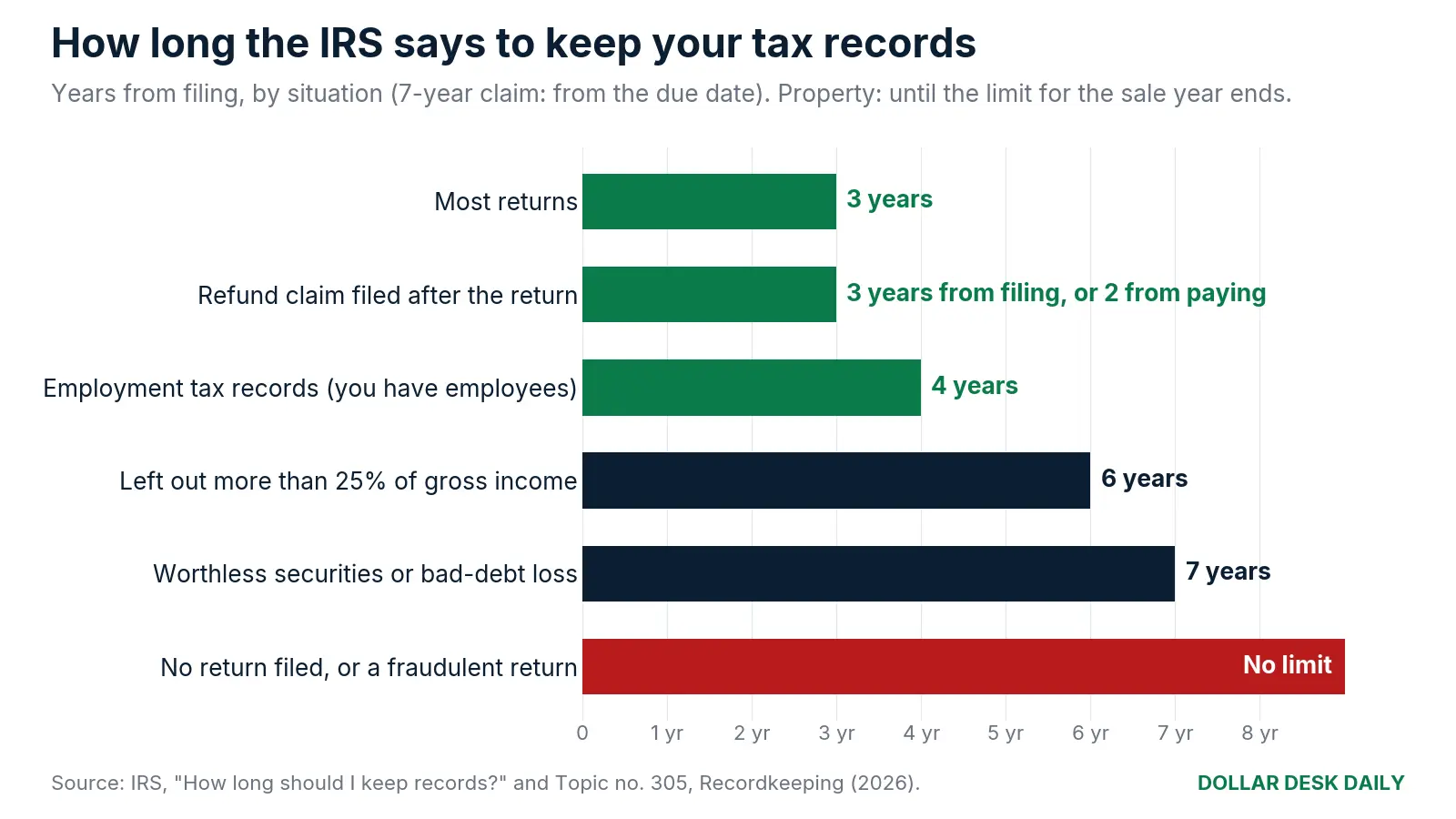
- The IRS says to keep records that support a return for 3 years in most cases, 6 years if you left out more than 25% of gross income, 7 years for a worthless-securities claim, and indefinitely if no return was filed.
- Records tied to property, such as a home purchase, must be kept until the limitations period for the year you sell it runs out, which can mean decades.
- For 2026, payment apps and marketplaces must send a Form 1099-K above $20,000 in more than 200 transactions, though they may send one for less, and all income is taxable whether or not a form arrives.
In this article
- Step 1: Start a folder and a checklist from last year’s return
- Step 2: Know the income forms and when they are due
- Step 3: Collect the forms that lower your bill
- Step 4: Keep your own records for income that has no form
- Step 5: Mark the 2026 tax-year deadlines on your calendar
- How long to keep each record, according to the IRS
- Two situations the IRS flags
The 2026 tax year ends on Dec. 31, and the first forms you need arrive within weeks: employers must furnish Forms W-2 by Feb. 1, 2027, according to the IRS’s 2026 instructions for the form. Most 1099 and 1098 statements have a January 31 due date. A folder set up now makes filing in 2027 a matter of checking boxes.
This guide covers the forms to expect, the dates the IRS has published for the 2026 tax year, and how long the IRS says to keep each record afterward.
Step 1: Start a folder and a checklist from last year’s return
The IRS says organized records make filing easier, reduce errors, speed refunds and help you recognize deductions or credits you may qualify for. A practical starting point is your 2025 return: each form behind it is a form to expect again, unless your situation changed.
If you cannot find it, the IRS says your Individual Online Account shows key details from returns filed in the last five years, including adjusted gross income, and displays “available information return documents, such as Forms W-2 and certain 1099s.” Transcripts by mail take 5 to 10 calendar days. Add one checklist line per form below.
Step 2: Know the income forms and when they are due
The IRS says the sender files each of these forms with the IRS and gives you a copy. The thresholds are the amounts at which the sender must issue the form, from the IRS’s About pages and its General Instructions for Certain Information Returns.
| Form | What it reports | Sender’s threshold | Standing due date to you |
|---|---|---|---|
| W-2 | Wages and tax withheld | Tax withheld, or pay at the reporting threshold | Feb. 1, 2027 |
| 1099-NEC | Nonemployee compensation (payments for services by people who are not employees) | $600 or more | Jan. 31 |
| 1099-INT | Interest | $10 or more | Jan. 31 |
| 1099-DIV | Dividends and distributions | $10 or more ($600 for liquidations) | Jan. 31 |
| 1099-B | Broker sales of stocks, bonds, options | All amounts | Feb. 15 |
| 1099-DA | Digital asset sales through a broker | All amounts | Feb. 15 |
| 1099-R | Retirement distributions, pensions, annuities | $10 or more | Jan. 31 |
| 1099-G | Unemployment compensation, state tax refunds | $10 or more | Jan. 31 |
| 1099-K | Payments for goods or services via apps, marketplaces, cards | Over $20,000 in more than 200 transactions (apps and marketplaces) | Jan. 31 |
| 1099-MISC | Rents, prizes, other income; royalties | $600 ($10 for royalties) | Jan. 31 |
The IRS’s standing dates are January 31 for most recipient statements and February 15 for Forms 1099-B and 1099-DA, including consolidated brokerage statements. When a due date falls on a weekend or legal holiday, the IRS says to furnish by the next business day. Jan. 31, 2027 is a Sunday, which is why the W-2 instructions give Feb. 1, 2027. For the 2025 tax year, the IRS’s instructions listed Feb. 2 and Feb. 17, 2026 for the same reason.
On Form 1099-K, the IRS says apps and marketplaces will send the form in 2027 to people with over $20,000 from more than 200 transactions in 2026, though they “may send you a Form 1099-K with lower amounts and/or transactions.” Card payments received directly produce one no matter the amount.
Step 3: Collect the forms that lower your bill
These forms report payments you made and support deductions and credits:
- Form 1098: mortgage interest of $600 or more. Whether it helps depends on whether you itemize; see standard deduction vs. itemizing.
- Form 1098-E: student loan interest of $600 or more.
- Form 1098-T: tuition statement from an eligible school. The IRS lists the American Opportunity and Lifetime Learning credits among those for students.
- Form 1095-A: Marketplace coverage and advance premium tax credit payments.
- CP01A notice: the IRS issues a new six-digit IP PIN each year to people in the program, and everyone who receives one must enter it on the return.
Keep receipts for anything you plan to claim, plus your bank routing and account number: the IRS is phasing out paper refund checks and will keep asking for banking details for tax year 2026.
Step 4: Keep your own records for income that has no form
The IRS says most income is taxable, “including unemployment income, interest received, gig economy earnings and digital assets,” and must be reported “whether a Form 1099-K, another tax form, or no tax form is received.” Records that can fill the gap include payment-app reports, invoices and the purchase price of anything you sold.
The IRS says that if you sold a personal item, such as furniture or jewelry, for less than you paid, the loss is not deductible but you can “zero out the reported gross income” by reporting the amount at the top of Schedule 1 or on Form 8949. A gain is taxable.
Step 5: Mark the 2026 tax-year deadlines on your calendar
| Date | What happens |
|---|---|
| Dec. 31, 2026 | ITINs not used on a return for 2023, 2024 or 2025 expire |
| Jan. 15, 2027 | Fourth 2026 estimated tax payment due (not required if you file and pay in full by Feb. 1, 2027) |
| Feb. 1, 2027 | Employers must furnish Forms W-2 (Jan. 31 is a Sunday) |
| Feb. 15, 2027 | Standing date for broker statements (1099-B, 1099-DA) |
| Mid-February 2027 | Earliest refunds that include the EITC or Additional Child Tax Credit |
| April 15, 2027 | Calendar-year returns and any tax owed are due; last day to request an extension |
| Oct. 15, 2027 | Filing deadline with an extension; the tax was still due in April |
Topic 301 says calendar-year returns are generally due April 15 each year, and the IRS says a due date on a weekend or legal holiday moves to the next business day. An extension “is only for filing your return,” the IRS says, so any balance is still due in April.
If a W-2 or 1099-R is missing, the IRS says to contact the employer or payer first. If it has not come by the end of February, you can call the IRS at 800-829-1040; the agency will contact the payer and send Form 4852, which lets you estimate wages if needed.
How long to keep each record, according to the IRS
The IRS ties retention to the “period of limitations,” the window in which you can amend a return for a refund or the IRS can assess more tax. Returns filed early count as filed on the due date. Years below run from filing unless noted.
| Situation | Keep records for |
|---|---|
| Most returns | 3 years from filing |
| You file a refund claim after filing | 3 years from filing or 2 years from paying, whichever is later |
| You have employees (employment tax records) | At least 4 years after the tax is due or paid |
| You left out income worth more than 25% of gross income | 6 years |
| You claim a loss from worthless securities or a bad debt | 7 years |
| You filed no return or a fraudulent return | Indefinitely |
Illustration: you file your 2026 return on April 15, 2027. Under the three-year rule, the records behind it stay in the folder until April 15, 2030. If you file in March, the clock still starts April 15.
Property is the exception most households miss. The IRS says to keep records on property “until the period of limitations expires for the year in which you dispose of the property,” because the purchase price and improvement costs set your gain or loss when you sell. Illustration: a home bought in 2016 and sold in 2030 means keeping the 2016 closing documents until the limitations period for the 2030 return ends, about spring 2034 under the three-year rule. The IRS adds that insurers or creditors may require records longer than the IRS does.
Two situations the IRS flags
- Filing before every form is in. If a late or corrected W-2 or 1099-R differs from your estimates, the IRS says you must file Form 1040-X.
- A small or missing 1099-K. Income is taxable with or without the form. For tax rules on deductions, see standard deduction vs. itemizing and 2026 tax brackets.
Sources
- IRS — Get ready to file your taxes (updated Oct. 27, 2026)
- IRS — How long should I keep records?
- IRS — Topic no. 305, Recordkeeping
- IRS — Topic no. 301, When, how and where to file
- IRS — When to file
- IRS — Get an extension to file your tax return
- IRS — 2026 Form 1040-ES, Estimated Tax for Individuals
- IRS — General Instructions for Forms W-2 and W-3 (2026)
- IRS — General Instructions for Certain Information Returns
- IRS — Topic no. 154, Form W-2 and Form 1099-R (what to do if incorrect or not received)
- IRS — Understanding your Form 1099-K
- IRS — What to do with Form 1099-K
- IRS — About Form 1099-INT
- IRS — About Form 1099-R
- IRS — About Form 1099-G
- IRS — About Form 1099-B
- IRS — About Form 1099-MISC
- IRS — About Form 1099-NEC
- IRS — About Form 1098
- IRS — About Form 1098-E
- IRS — About Form 1098-T
- IRS — Get your tax records and transcripts
- IRS — Understanding your CP01A notice