Marginal vs. Effective Tax Rate: How Tax Brackets Really Work
Your marginal rate taxes your last dollar; your effective rate is your whole bill as a share of income. See the math with the IRS 2026 brackets and a raise.
Key Takeaways
- Your marginal tax rate is the rate on your next dollar of taxable income; your effective rate is your total tax divided by your income.
- Using the IRS 2026 brackets, a single filer earning $75,000 is in the 22% bracket but owes about $7,670 in federal income tax, an effective rate of about 10.2% of gross pay.
- Crossing into a higher bracket only raises the rate on the dollars above the threshold, so in the illustration a $2,000 raise adds $466 of federal income tax and leaves $1,534 more before payroll and state taxes.
In this article
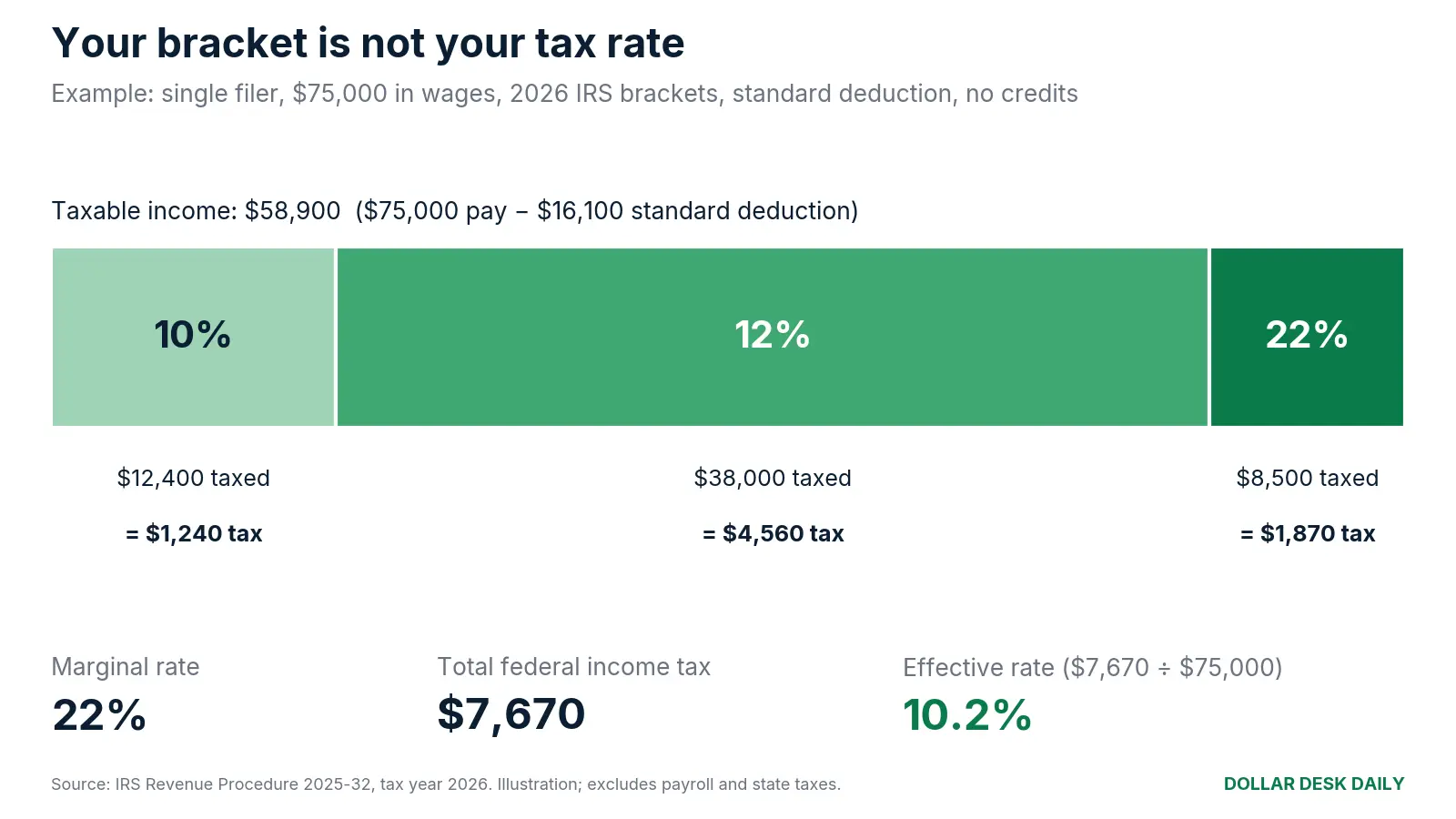
Your marginal tax rate is the rate charged on your next dollar of taxable income. Your effective tax rate is your total income tax divided by your income. Using the IRS brackets for tax year 2026, a single person earning $75,000 has a 22% marginal rate but pays about 10.2% of that pay in federal income tax.
The gap exists because U.S. income tax is charged in layers. In the IRS’s own words, when your income jumps to a higher bracket, “you don’t pay the higher rate on your entire income,” only on the part that falls in the new bracket.
How tax brackets actually work
Think of your taxable income as water filling a row of buckets. The first bucket is taxed at 10%. When it is full, the next dollars spill into the 12% bucket, then the 22% bucket and so on. Earlier buckets keep their lower rates no matter how much you earn later.
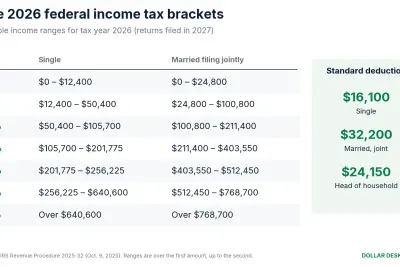
Taxable income is what is left after you subtract the standard deduction or your itemized deductions. For 2026, the standard deduction is $16,100 for single filers and $32,200 for married couples filing jointly, according to the IRS.
These are the 2026 buckets for a single filer, from the IRS tax rate tables in Revenue Procedure 2025-32. Each range means over the first number, up to the second.
| Rate | Taxable income (single, 2026) | Tax on a full bucket |
|---|---|---|
| 10% | $0 – $12,400 | $1,240 |
| 12% | $12,400 – $50,400 | $4,560 |
| 22% | $50,400 – $105,700 | $12,166 |
| 24% | $105,700 – $201,775 | $23,058 |
| 32% | $201,775 – $256,225 | $17,424 |
| 35% | $256,225 – $640,600 | $134,531.25 |
| 37% | Over $640,600 | — |
For married couples filing jointly, the first three buckets are exactly twice as wide: 10% up to $24,800, 12% up to $100,800 and 22% up to $211,400 in 2026. The full joint and head-of-household tables are in our 2026 tax brackets explainer.
Worked example: ,000 salary, single filer, 2026
This illustration assumes $75,000 of wages, single filing status, the 2026 standard deduction, no other deductions and no credits. It covers federal income tax only, not Social Security, Medicare or state taxes.
- Taxable income: $75,000 − $16,100 = $58,900.
- 10% bucket: 10% × $12,400 = $1,240.
- 12% bucket: 12% × ($50,400 − $12,400) = 12% × $38,000 = $4,560.
- 22% bucket: 22% × ($58,900 − $50,400) = 22% × $8,500 = $1,870.
- Total tax: $1,240 + $4,560 + $1,870 = $7,670.
Now the two rates:
- Marginal rate: 22%, because the last dollars land in the 22% bucket.
- Effective rate on gross pay: $7,670 ÷ $75,000 = 10.2%.
- Effective rate on taxable income: $7,670 ÷ $58,900 = 13.0%.
Both effective-rate versions are used, so check which one a calculator or article means. The gross-pay version shows what share of your earnings goes to federal income tax.
Effective rates at different incomes
Using the same assumptions (single filer, 2026 standard deduction, wages only), the effective rate rises gradually while the marginal rate jumps in steps.
| Gross wages | Taxable income | Federal income tax | Marginal rate | Effective rate (gross) |
|---|---|---|---|---|
| $40,000 | $23,900 | $2,620 | 12% | 6.6% |
| $75,000 | $58,900 | $7,670 | 22% | 10.2% |
| $125,000 | $108,900 | $18,734 | 24% | 15.0% |
| $250,000 | $233,900 | $51,304 | 32% | 20.5% |
Even at $250,000, where the marginal rate is 32%, the effective rate is about 20.5%, because most of that income sits in the lower buckets.
Why a raise never lowers your take-home pay because of brackets
A common worry is that a raise “bumps you into a higher bracket” and leaves you with less. The bracket math makes that impossible: only the dollars above the threshold get the higher rate.
Here is an illustration. A single filer has $105,000 of taxable income in 2026, just below the 24% bracket, which starts above $105,700. A $2,000 raise lifts taxable income to $107,000.
- Tax before the raise: $5,800 + 22% × ($105,000 − $50,400) = $5,800 + $12,012 = $17,812.
- Tax after the raise: $17,966 + 24% × ($107,000 − $105,700) = $17,966 + $312 = $18,278.
- Extra tax: $18,278 − $17,812 = $466. That is 22% on the first $700 of the raise ($154) plus 24% on the remaining $1,300 ($312).
- Extra pay kept: $2,000 − $466 = $1,534, before payroll and state taxes.
If the whole $107,000 were taxed at 24%, the bill would be $25,680. It is $18,278, because brackets never reach back to the dollars below the threshold.
Where the extra dollars can cost more than the bracket rate
Brackets are not the only part of the tax code tied to income. Some deductions and credits shrink as income rises, which can make the next dollar cost more than your bracket rate suggests:
- The new deduction of up to $6,000 for people 65 and older phases out above $75,000 of modified adjusted gross income ($150,000 for joint filers), the IRS says.
- The deductions for qualified tips and overtime phase out above $150,000 ($300,000 for joint filers).
- The Lifetime Learning Credit phases out between $80,000 and $90,000 of modified adjusted gross income ($160,000 to $180,000 for joint returns).
If you are near one of these ranges, the change in your total tax, not your bracket, is the number to look at.
How the two rates help with everyday decisions
Deductions are worth your marginal rate. A deduction lowers taxable income. For the $75,000 earner in the 22% bracket, a $1,000 deduction cuts tax by about $220 (22% × $1,000). That is the math behind the choice covered in our guide to the standard deduction vs. itemizing.
Credits come off the tax itself. A credit is subtracted from the tax bill, not from income. The child tax credit is up to $2,200 per child for 2026, according to the IRS, and it is worth the same number of dollars in any bracket, subject to its income rules and to how much tax you owe (up to $1,700 per child is refundable for 2026).
Effective rate is the better budget number. For estimating how much of your pay goes to federal income tax, the effective rate is closer to reality. For judging the tax on extra income, a bonus or a deduction, the marginal rate is the one that applies.
Final step: estimate your 2026 taxable income (pay minus your deduction), find the bucket your last dollar lands in, and divide your total tax by your gross pay to see both of your rates.
Sources
- IRS — Revenue Procedure 2025-32
- IRS — IRS releases tax inflation adjustments for tax year 2026, including amendments from the One, Big, Beautiful Bill (IR-2025-103, Oct. 9, 2025)
- IRS — Federal income tax rates and brackets
- IRS — Working Families Tax Cuts – Individuals and workers
- IRS — New and enhanced deductions for individuals