Buy Now, Pay Later: What a Missed Payment Really Costs
Pay-in-4 loans often cost nothing extra until a payment fails. How BNPL works, what late and bank fees add, how credit reports treat it and which rules apply.
Key Takeaways
- In 2023, six large BNPL lenders made 335.8 million loans worth $45.2 billion, with an average loan of $135 (inflation-adjusted figures), according to a December 2025 CFPB report.
- In a Federal Reserve survey taken in October 2025, 16% of adults had used BNPL in the past year, and 26% of those users had paid late at least once.
- On May 12, 2025, the CFPB withdrew its 2024 interpretive rule saying BNPL lenders must give borrowers credit-card-style rights to dispute charges and get refunds credited.
In this article
A buy now, pay later (BNPL) loan splits a purchase into a few payments, usually four, often with no interest. It stays cheap only if every payment goes through on time. Miss one and you can face a late fee from the lender plus a bounced-payment fee from your bank, which in our example below adds about 10% to a $400 purchase.
The market is still growing, though more slowly than in earlier years. Six large lenders made 335.8 million BNPL loans worth $45.2 billion in 2023, according to a December 2025 report by the Consumer Financial Protection Bureau (CFPB). The average loan was $135. Both dollar figures are adjusted for inflation.
How pay-in-4 works
The CFPB describes the typical pay-in-four loan this way: you pay 25% at checkout, then three more equal payments every two weeks, so the loan is paid off six weeks after you buy. Applicants generally must be 18 or older and have a mobile number and a debit card, credit card or bank account for payments. Most of these loans do not use a hard credit inquiry, the kind of credit check that can lower your score.
Unlike a credit card, your creditworthiness may be checked each time you buy. Most lenders also require autopay. The CFPB’s 2022 market report found that lenders retry failed payments, “in some instances up to eight times for a single installment.”
Use is spreading. In the Federal Reserve’s survey of households, taken in October 2025, 16% of adults said they had used BNPL in the past 12 months, up from 10% in 2021.
Longer BNPL loans work differently
The CFPB separates pay-in-four from point-of-sale installment loans: monthly payments that may include interest or fixed finance charges, terms up to three or four years, usually for large purchases such as furniture. The CFPB says some longer installment loans for larger amounts do use hard credit inquiries and report payment history to the credit bureaus.
| Feature | Pay-in-4 | Longer point-of-sale installment loan |
|---|---|---|
| Payments | 4, every two weeks | Monthly |
| Length | About 6 weeks | Up to 3–4 years |
| Interest | Usually none | May charge interest or fees |
| Hard credit check | Usually not | Some do |
| Reported to credit bureaus | Usually not | Some do |
Sources: CFPB (2022 report and Ask CFPB pages).
Interest changes the math fast. As an illustration, a $1,200 purchase repaid over 12 months at an assumed 20% APR costs about $111.16 a month, or about $134 in interest in total. At 0%, it would be $100 a month and nothing extra. For more on how annual rates work, see APR vs. APY.
What it means for you: the cost of one missed payment
Most BNPL loans charge late fees for missed payments, the CFPB says. Its 2022 report said many lenders charge late fees “often around $7 per missed payment”; in 2021, the three lenders it studied that charged late fees set them at $7 or $8. Across four lenders in 2023, the average late fee assessed was $9.70 (not adjusted for inflation), and 4.1% of loans were hit with a late fee, down from 5.2% in 2022, the CFPB’s December 2025 report found.
The bigger hit can come from your bank. If autopay pulls from a checking account that is short, the CFPB warns your bank may charge an overdraft or non-sufficient funds (NSF) fee. In its May 2023 review, the CFPB found that some banks still charged overdraft fees as high as $37, while several large banks had cut or dropped such fees.
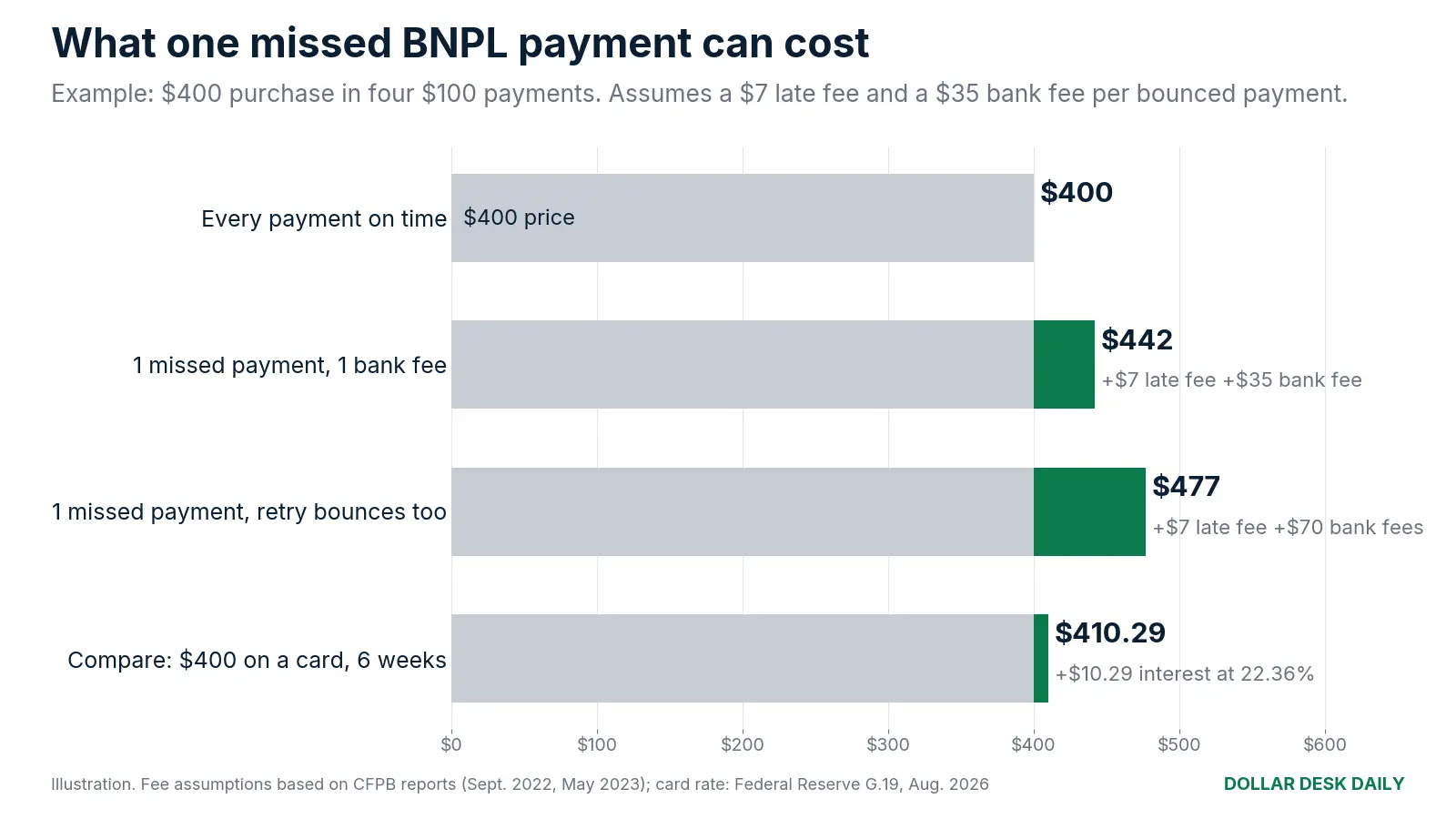
Example (illustration). Assumptions: a $400 purchase paid in four $100 installments; the second payment fails; the lender charges a $7 late fee; your bank charges a $35 fee for each failed withdrawal. Real bank fees vary, and some banks charge none.
| Scenario | Extra cost | Total paid | Extra as % of price |
|---|---|---|---|
| All payments on time | $0 | $400 | 0% |
| One failed payment, one bank fee | $7 + $35 = $42 | $442 | 10.5% |
| Lender retries and it bounces again | $7 + $35 + $35 = $77 | $477 | 19.25% |
| For comparison: $400 on a credit card for 6 weeks at 22.36% | $400 × 22.36% × 42 ÷ 365 = $10.29 | $410.29 | 2.6% |
The 22.36% is the Federal Reserve’s average rate for credit card accounts charged interest in August 2026. The comparison ignores grace periods; it only shows scale. For how card interest is calculated, see how credit card interest works.
This is not rare. In the Fed’s survey, 26% of BNPL users paid late at least once in the prior year. Of those who were late, 64% said they were charged extra. And 11% of all users had a BNPL payment trigger an overdraft or NSF fee from their bank.
Does BNPL show up on your credit report?
Usually not, for pay-in-four loans. The CFPB says most of these lenders do not report payment history to the major credit bureaus, so on-time payments neither help nor hurt your scores. But if you stop paying and the debt goes to a debt collector, it could be reported and hurt your scores.
Many users get this wrong. In the Fed’s October 2025 survey, 53% of BNPL users incorrectly agreed that on-time payments help their credit score, and only 14% answered both of the survey’s credit questions correctly. If you are trying to build a score, see how credit scores work.
Because these loans rarely appear in credit files, they are easy to lose track of. The CFPB’s January 2025 study found that 63% of BNPL borrowers had more than one loan open at the same time during 2022, and 33% had loans at more than one company at once.
Which consumer protections apply?
On May 22, 2024, the CFPB issued an interpretive rule saying BNPL lenders are credit card providers under the Truth in Lending Act. That meant lenders had to investigate disputes and pause payments during the investigation, credit refunds for returned items, and send billing statements.
On May 12, 2025, the CFPB withdrew that rule along with many other guidance documents, according to the agency and the Federal Register. The CFPB’s 2022 report had already noted that most BNPL lenders did not provide the standard cost-of-credit disclosures that Regulation Z requires for other loans.
The withdrawal notice said the CFPB would not enforce or rely on the withdrawn guidance while it reviews it, and that the withdrawal “is not necessarily final.”
Common mistakes to avoid
- Linking autopay to a thin checking account. The CFPB found lenders retry failed payments, and each failed attempt can bring a bank fee. In the example above, two bank fees ($70) are 10 times the $7 late fee.
- Stacking loans. Several small loans with different due dates are easy to lose track of, and they do not show up together on a credit report. An emergency fund is one cushion against a payment that would otherwise fail.
- Assuming a return stops the payments. The CFPB guidance saying lenders must credit refunds and pause payments during disputes was withdrawn in May 2025.
- Treating a longer installment loan like pay-in-4. These loans may charge interest, and some use hard credit checks and report to credit bureaus. The CFPB advises reading the loan details before applying and again before accepting.
Sources
- Consumer Financial Protection Bureau — The Buy Now, Pay Later Market (Data Spotlight, December 2025)
- Consumer Financial Protection Bureau — Buy Now, Pay Later: Market trends and consumer impacts (September 2022)
- Consumer Financial Protection Bureau — Consumer Use of Buy Now, Pay Later and Other Unsecured Debt (January 2025)
- Board of Governors of the Federal Reserve System — Economic Well-Being of U.S. Households in 2025 (May 2026)
- Consumer Financial Protection Bureau — What is a Buy Now, Pay Later (BNPL) loan?
- Consumer Financial Protection Bureau — Do Buy Now, Pay Later (BNPL) loans have fees?
- Consumer Financial Protection Bureau — Will a Buy Now, Pay Later (BNPL) loan impact my credit scores?
- Consumer Financial Protection Bureau — What happens if I can’t pay back a Buy Now, Pay Later (BNPL) loan?
- Consumer Financial Protection Bureau — CFPB Takes Action to Ensure Consumers Can Dispute Charges and Obtain Refunds on Buy Now, Pay Later Loans (May 22, 2024)
- Consumer Financial Protection Bureau — Buy Now, Pay Later (BNPL) products (compliance resources)
- Federal Register — Interpretive Rules, Policy Statements, and Advisory Opinions; Withdrawal (May 12, 2025)
- Consumer Financial Protection Bureau — Overdraft/NSF revenue down nearly 50% versus pre-pandemic levels (May 24, 2023)
- Federal Reserve — G.19 Consumer Credit (released Oct. 7, 2026)