How to Make a Monthly Budget in 5 Steps, With the 50/30/20 Rule
A step-by-step monthly budget using the CFPB’s four-step method and the 50/30/20 rule, with a worked example that splits $4,500 of take-home pay.
Key Takeaways
- The CFPB’s budgeting method has four steps: list every income source, log where the money goes, put bill due dates on a calendar, then pull it together in a budget worksheet.
- A 50-30-20 plan uses 50% of income for needs, 30% for wants and 20% for saving, according to a CFPB student worksheet; NDSU Extension applies the percentages to monthly net income.
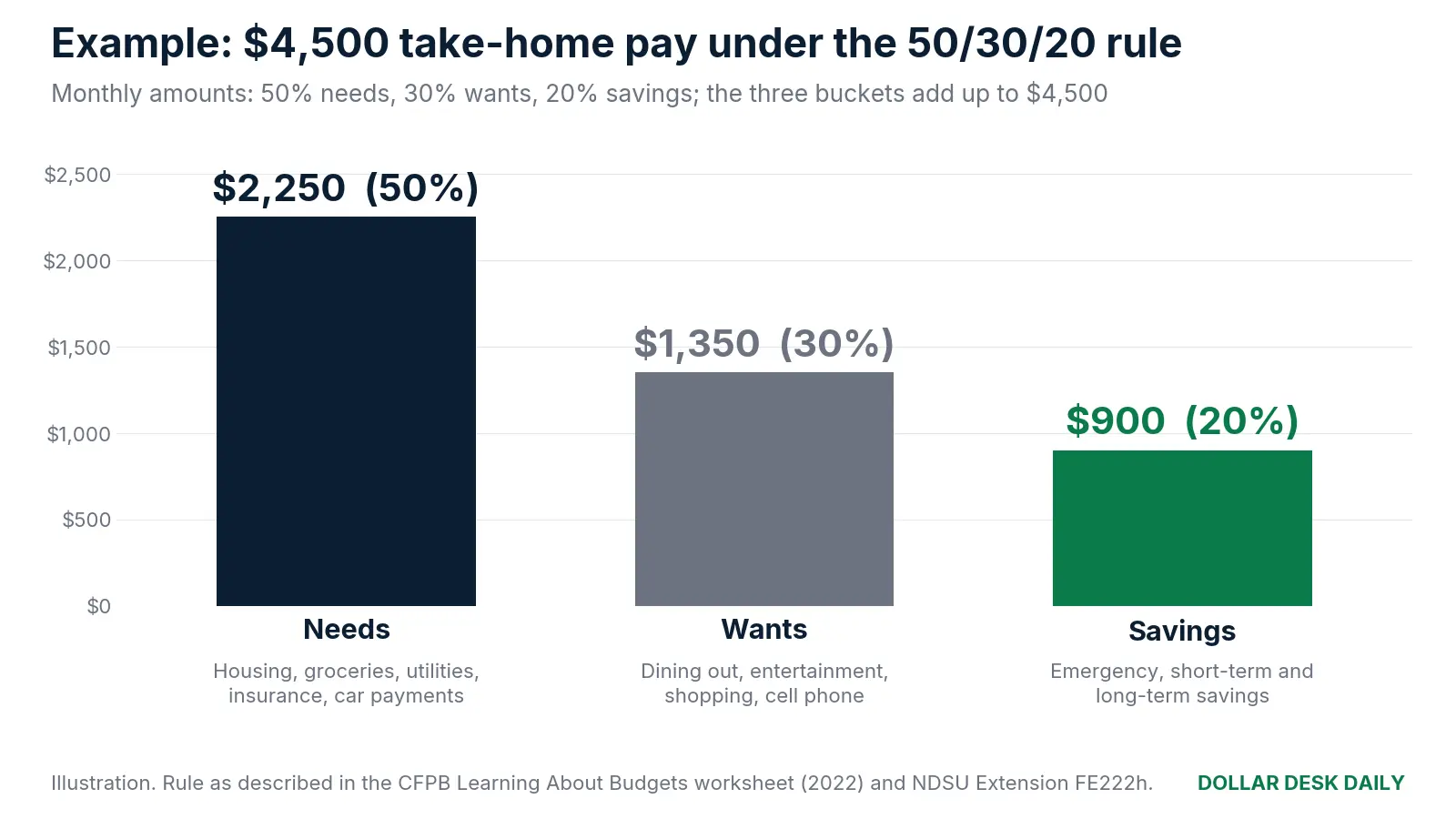
- In an illustration, $4,500 of monthly take-home pay splits into $2,250 for needs, $1,350 for wants and $900 for savings; housing alone took 33.9% of average household spending in 2025, the BLS reported on Oct. 29, 2026.
In this article
- Step 1: Add up every source of monthly income
- Step 2: Log where the money goes now
- Step 3: Put every bill on a calendar
- Step 4: Split your income with the 50/30/20 rule
- What it means for you: a $4,500 worked example
- Why the 50% needs target is tight for many households
- Step 5: Check the plan at the end of the month
- Mistakes to avoid
A monthly budget takes about five steps: add up your income, log your spending, mark your bill due dates, split your take-home pay into needs, wants and savings, then check the plan against what actually happened at the end of the month. The 50/30/20 rule gives you a starting split: on $4,500 of monthly take-home pay, that is $2,250 for needs, $1,350 for wants and $900 for saving.
This guide is for anyone who has never written a budget down. The steps follow the Consumer Financial Protection Bureau’s (CFPB) four-step method and the federal consumer.gov guide, with the 50/30/20 rule deciding where the money goes. A budget, in the CFPB’s words, is “a plan that outlines what money you expect to earn or receive (your income) and how you will save it or spend it (your expenses) for a given period of time.”
Step 1: Add up every source of monthly income
The CFPB says the first place to start is a complete picture of where your money comes from. That means every source: wages from one or more jobs, self-employment income, child support and government benefits.
NDSU Extension applies its percentages to monthly net income, so this guide uses take-home pay, the amount that lands in your account after taxes and payroll deductions. If you are not paid monthly, consumer.gov suggests adding up all your income from last year and dividing by 12. The CFPB’s Income Tracker, part of its Your Money, Your Goals toolkit, is a free worksheet for this step.
Step 2: Log where the money goes now
The CFPB calls this step “the heaviest lift.” Before you set limits, you need a realistic picture of what an average month looks like. Its Spending Tracker sorts spending into categories such as utilities, housing, eating out and entertainment.
If a whole month feels overwhelming, the CFPB suggests starting small: review one week of receipts or checking account transactions at a time, or keep a daily log so small purchases get captured. MyMoney.gov, the federal financial literacy site, adds that phone apps or online tools can do the tracking for you.
Step 3: Put every bill on a calendar
The CFPB says that if you are coming up short at the end of the month, the timing of your bills and income may not match. Consumer.gov makes a related point: without a budget, you might run out of money before your next paycheck.
The CFPB’s Bill Calendar handles this. Its instructions: list all your bills, mark a payment date for each, seven days before the due date if you pay by mail or two days before if you pay online, then enter the days you receive income. The CFPB notes that missing payments or paying late can also hurt your credit scores, which How Credit Scores Work explains in detail.
Step 4: Split your income with the 50/30/20 rule
Now you decide how much goes where. A 50-30-20 plan is “one example of a budget rule to live by,” according to a CFPB student worksheet: 50 percent of income for needs, 30 percent for wants and 20 percent for saving. North Dakota State University Extension’s version applies those shares to monthly net income, after taxes.
The table shows the examples the two sources give for each bucket. Neither source says where debt payments belong. NDSU Extension lists car payments as a need, and the CFPB worksheet lists emergency, short-term and long-term savings, so you will have to decide how to classify other debt payments and record that choice in your plan.
| Bucket | Share of income | Examples (CFPB worksheet, NDSU Extension) |
|---|---|---|
| Needs | 50% | Housing, food or groceries, transportation or car payments, utilities, clothing, insurance |
| Wants | 30% | Dining out, entertainment, shopping, cell phone, internet, brand-name clothing |
| Savings | 20% | Long-term, short-term and emergency savings |
NDSU Extension adds that if you do not spend all 30% on wants in a month, the leftover can go into savings along with the 20% already planned.
What it means for you: a ,500 worked example
The example below is an illustration. It assumes a household with $4,500 of monthly take-home pay and no other income.
| Bucket | Math | Monthly amount |
|---|---|---|
| Needs (50%) | $4,500 × 0.50 | $2,250 |
| Wants (30%) | $4,500 × 0.30 | $1,350 |
| Savings (20%) | $4,500 × 0.20 | $900 |
| Total | $4,500 |
Now compare the targets with the spending log from Step 2. Say the log shows rent of $1,500, groceries of $450, utilities of $200, car insurance of $150 and a $300 minimum credit card payment that the household counts as a need. Needs come to $2,600, or 57.8% of take-home pay ($2,600 ÷ $4,500), which is $350 over the 50% target.
The rule does not fail at that point; it shows where the squeeze is. One option is to keep savings at $900 and trim wants to $1,000 (22.2%). Another is to hold wants at $1,350 and save $550 (12.2%) while you look for a need to cut. Either way, the plan still adds up to $4,500, and you chose the trade-off instead of discovering it on the 28th.
To make the $900 stick, the CFPB’s emergency fund guide suggests automatic recurring transfers from checking to savings, or asking your employer to split a direct deposit between two accounts. Our guides on building an emergency fund and high-yield savings accounts cover where to keep that money, and debt avalanche vs. debt snowball compares two ways to use the extra-payment part.
Why the 50% needs target is tight for many households
Housing alone took 33.9% of average household spending in 2025, the Bureau of Labor Statistics reported in its Consumer Expenditure Survey on Oct. 29, 2026. Transportation took another 16.5%, food 13.0% and healthcare 7.9%. Those four categories together were 71.3% of average spending of $81,905.
The BLS shares are measured against spending, not take-home pay, and each category mixes needs with wants: food includes $4,142 a year of food away from home. Even so, those averages show why a 50% needs target can be hard to hit. The CFPB worksheet calls 50-30-20 “one example of a budget rule to live by,” not the only one, so a budget can use different percentages as long as the three amounts add up to income.
Step 5: Check the plan at the end of the month
Consumer.gov lays out the monthly cycle: make a plan at the start of the month, write down what you spend each day, and at the end of the month compare what you spent with what you planned, then use the gaps to set next month’s budget. The CFPB adds that you should update the budget whenever your employment or spending habits change. Its tips for sticking with it: pick a tracking tool you will actually use, set a goal, and find a friend or family member who will build a budget alongside you.
Mistakes to avoid
- Budgeting from gross pay. NDSU Extension applies the percentages to net income, the money you can actually spend.
- Leaving savings for “whatever is left.” Consumer.gov suggests making savings one of the expenses in your budget; the CFPB suggests automating the transfer.
- Ignoring timing. The CFPB says mismatched bill and income dates can leave you short even in a month that balances on paper.
- Treating the percentages as the only option. The CFPB worksheet calls 50-30-20 “one example” of a budget rule.
The CFPB’s Budget Worksheet is the tool it names for pulling income, spending and bill dates together into a working budget.
Sources
- CFPB — Budgeting: How to create a budget and stick with it
- CFPB — Building Blocks Student Worksheet: Learning about budgets (Summer 2022)
- CFPB — Bill calendar (Your Money, Your Goals)
- CFPB — Your Money, Your Goals toolkit
- CFPB — An essential guide to building an emergency fund
- NDSU Extension — FE222h: 50/30/20 Budget
- FTC consumer.gov — Making a Budget
- MyMoney.gov — Spend
- Bureau of Labor Statistics — Consumer Expenditures, 2025 (released Oct. 29, 2026)