Can’t Pay Your Credit Card Bill? What to Do, Step by Step
Missed a card payment? Here is the federal timeline for late fees, credit reporting and penalty APRs, plus hardship plans, counseling and settlement risks.
Key Takeaways
- The CFPB says to contact your card company right away if you can’t pay; many card companies are willing to change your payment during a financial emergency.
- Under Regulation Z, a late fee cannot exceed the minimum payment due, and a penalty APR can apply to the existing balance only after a payment is more than 60 days late, with 45 days’ written notice.
- The FTC says a card debt may be charged off after 4 to 6 months of missed minimums and the CFPB says negative history can generally be reported for up to seven years; nonprofit counselors offer debt management plans, while settlement companies cannot collect fees before settling a debt.
In this article
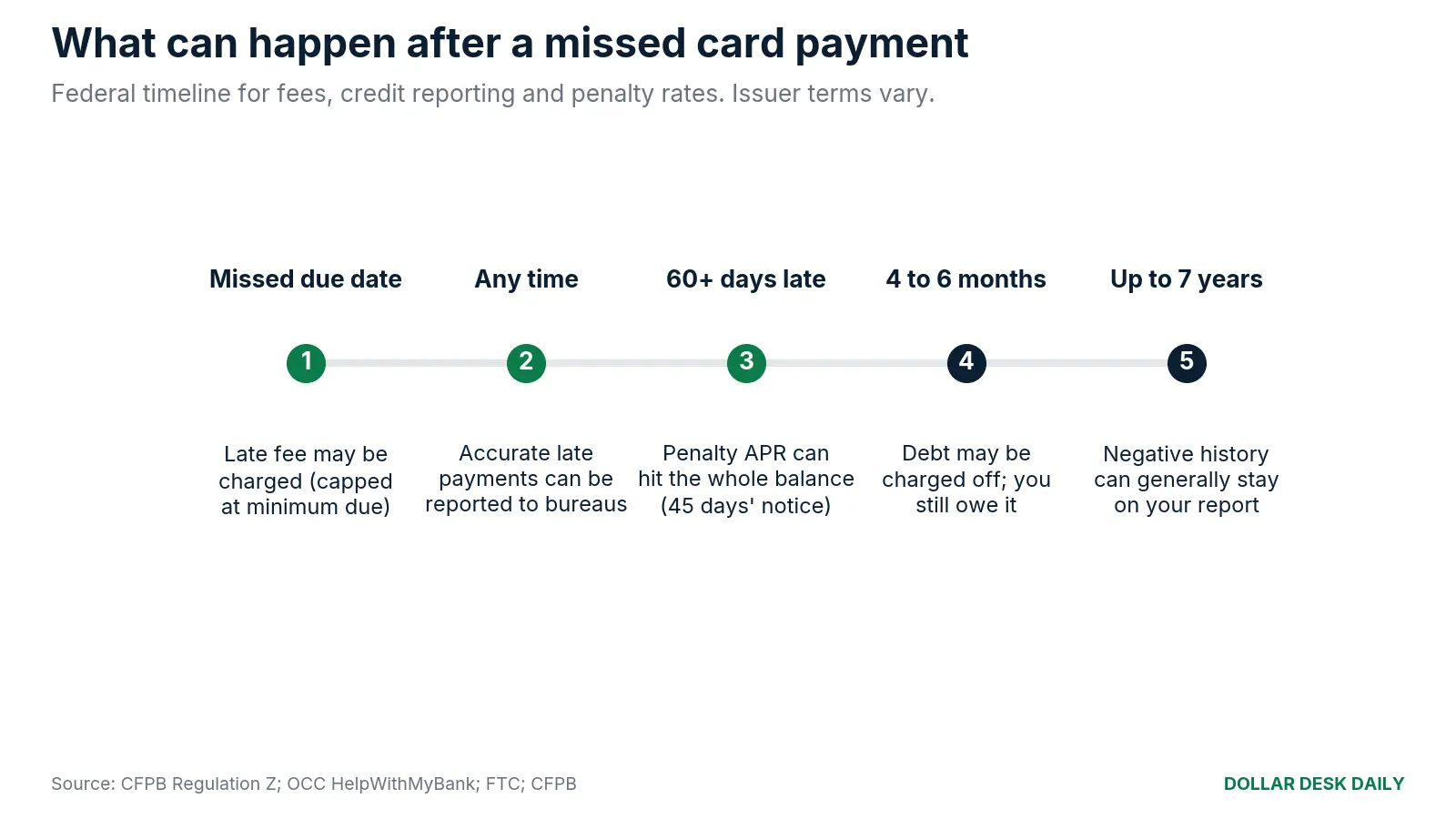
If you can’t pay your credit card bill this month, the Consumer Financial Protection Bureau (CFPB) says to contact your card company right away, because “many card companies are willing to work with you to change your payment if you’re facing a financial emergency.” The clock matters: under federal rules a late fee can follow a missed due date, a late payment can be reported to the credit bureaus, and a penalty interest rate can reach your whole balance once a payment is more than 60 days late.
This guide is for anyone about to miss a minimum payment, or who already has. It covers the timeline, hardship arrangements, nonprofit credit counseling, and the risks and scam signs around debt settlement. For how card interest is calculated, see how credit card interest works.
Step 1: Work out what you can pay
The CFPB’s first step is to add up income and expenses and look for costs to cut. If that still leaves you short of the minimum payment, decide how much you can afford to pay. That number is what the CFPB suggests bringing to the call with your issuer.
The Office of the Comptroller of the Currency (OCC), which regulates national banks, notes that many banks charge a late fee if a payment is late or is for less than the minimum amount due. Your card agreement spells out your issuer’s policy.
Step 2: Call your card company
The CFPB says to explain four things: why you can’t pay the minimum, how much you can afford, when you could restart normal payments, and what new payment amount you are requesting and for how long. The OCC says “many lenders may be willing to work with their customers on an alternate repayment or collection program.”
The Federal Trade Commission (FTC) adds that you can ask the issuer to negotiate a lower interest rate and suggest a payment plan you can afford. It also says to keep records of who you talk to and what you agree to, to ask for a written version of any agreement, and to save it until all payments are made. You don’t need to pay a company to call on your behalf.
Step 3: Know the timeline of fees, reporting and rate hikes
Regulation Z, the CFPB rule implementing the Truth in Lending Act, limits what a card issuer can do and when. The table combines the rule text with regulator guidance.
| When | What can happen | Source |
|---|---|---|
| After a missed due date | A late fee may be charged. It cannot exceed the missed minimum payment, and an issuer cannot charge more than one penalty fee for the same event. | Reg Z § 1026.52; OCC |
| Repeat late payment within the same or next six billing cycles | The rule allows a higher “repeat” fee than for the first one. | Reg Z § 1026.52(b)(1)(ii) |
| Any time, as long as it is accurate | The issuer can report a late payment to a credit reporting agency, including at 31 days late; the account agreement sets its reporting policy. | OCC |
| Before any penalty rate | Written notice at least 45 days before a rate increase due to delinquency or as a penalty. | Reg Z § 1026.9(g) |
| More than 60 days late | A penalty APR may apply to the entire existing balance, not only new purchases. | Reg Z § 1026.55(b)(4); OCC |
| Six on-time minimums after a penalty rate | The issuer must restore the pre-penalty rate on the balances it raised. | Reg Z § 1026.55(b)(4)(ii) |
| 4 to 6 months of missed minimums | A creditor may “charge off” the debt as a loss and may sell it to a collector. You still owe it. | FTC |
| Up to 7 years | Negative payment history can generally be reported. | CFPB |
For monthly accounts, Regulation Z’s commentary says an issuer “generally must not have received two consecutive required minimum periodic payments” for the account to count as more than 60 days late. The FTC adds that creditors “may be willing to negotiate with you even after they write your debt off as a loss.”
What a penalty rate can cost: an illustration
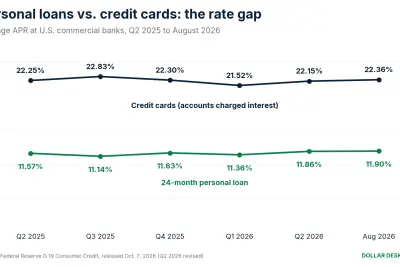
Assume a $6,000 balance at 22.36%, the average rate on credit card accounts assessed interest in August 2026, according to the Federal Reserve’s G.19 release of Oct. 7, 2026. Monthly interest is $6,000 × 22.36% ÷ 12 = $111.80.
Now assume the account goes more than 60 days late and the issuer applies a 28% penalty rate, the figure used in the Regulation Z commentary example. Monthly interest becomes $6,000 × 28% ÷ 12 = $140.00. That is $28.20 more a month, about $338 over a year, before any late fees. Your card agreement sets the actual penalty rate. How missed payments feed into your score is covered in how credit scores work.
Step 4: Consider nonprofit credit counseling
If a direct arrangement isn’t enough, the CFPB points to credit counseling organizations, which are “usually nonprofits that advise and educate you on managing your money and debts.” A counselor can set up a debt management plan (DMP): you make one payment to the agency, which pays your creditors. The CFPB says counselors work to lower your overall monthly payment, for example by getting creditors to lengthen the repayment time or lower interest rates, and to agree not to charge late fees while you are on the plan. They can’t erase your debts, and the arrangement usually doesn’t affect your taxes.
The FTC’s guidance on checking an agency:
- A reputable organization sends free information about its services before you describe your situation.
- Look for one that does not charge in advance, has counselors accredited or certified by an outside organization, gives a written quote for any fees, and helps even if you can’t afford the fees.
- Check with your state attorney general and local consumer protection agency, and ask whether the agency must be licensed in your state.
- The U.S. Trustee Program at the Department of Justice lists agencies approved for pre-bankruptcy counseling, but does not endorse any particular one.
The FTC also notes that nonprofit status doesn’t guarantee services are free, and that a DMP “can take 48 months or more to complete.” If a counselor says a DMP is your only option without a detailed review of your finances, the FTC says to find a different counselor. Paying debts down yourself in a chosen order is another route, compared in debt avalanche vs. debt snowball.
Step 5: Understand debt settlement before signing anything
Debt settlement companies are usually for-profit firms that offer to negotiate lump-sum payoffs for less than you owe. The CFPB and FTC describe these risks:
- They typically advise you to stop paying creditors while you save for a settlement, so late fees, penalty interest and collection activity can continue, and you could be sued.
- Creditors have no obligation to negotiate, and many lenders do not negotiate with settlement companies.
- You might not finish. If you drop out, the FTC says you are out the fees paid for debts already settled and still owe the rest.
- Forgiven debt may be taxable. The IRS says “if your debt is canceled, forgiven, or discharged for less than the amount owed, the amount of the canceled debt is taxable” in general, and the creditor may send a Form 1099-C.
Federal rules set limits. The FTC says a settlement company “can’t collect its fees from you before they settle your debt” and must disclose its fees, how long results will take and the consequences of stopping payments. Any dedicated savings account must be managed by an independent third party, and the money stays yours to withdraw at any time without penalty.
Step 6: Spot the scam signs
The CFPB and FTC list these warning signs:
- Any fee charged before a debt is settled or you are enrolled in a plan.
- A guarantee to make your debt go away or settle it for a promised percentage.
- A “new government program” to pay off credit card debt.
- Advice to stop communicating with your card company, or to stop paying, without explaining the consequences.
- A promise to stop all collection calls and lawsuits.
The CFPB also says credit repair companies cannot get accurate negative information, such as late payments, removed from your report; errors can be disputed on your own at no cost.
For how to start a cushion against the next shortfall, see the emergency fund guide.
Sources
- CFPB — What should I do if I can’t pay my credit card bills?
- CFPB — What is the difference between credit counseling and debt settlement, debt consolidation, or credit repair?
- CFPB — What is a debt relief program and how do I know if I should use one?
- CFPB — How long does information stay on my credit report?
- CFPB — Regulation Z, 12 CFR § 1026.52 Limitations on fees
- CFPB — Regulation Z, 12 CFR § 1026.55 Limitations on increasing annual percentage rates, fees, and charges
- CFPB — Regulation Z, 12 CFR § 1026.9 Subsequent disclosure requirements
- FTC Consumer Advice — How To Get Out of Debt
- OCC HelpWithMyBank — Can I make special payment arrangements on my credit card account?
- OCC HelpWithMyBank — My bank increased the minimum payment on my credit card account. What should I do if I can’t afford it?
- OCC HelpWithMyBank — Can the bank charge a late fee on my credit card?
- OCC HelpWithMyBank — I just received a notice saying that the rate on my credit card account is going to increase in 45 days
- OCC HelpWithMyBank — The bank raised my interest rate because I made a late payment on a credit card account with another bank
- OCC HelpWithMyBank — I paid my credit card bill on the 31st day after the due date and the bank reported a late payment
- OCC HelpWithMyBank — Can my bank report my loan late at only 30 days past due?
- U.S. Department of Justice, U.S. Trustee Program — List of Credit Counseling Agencies Approved Pursuant to 11 U.S.C. § 111
- IRS — Topic no. 431, Canceled debt – Is it taxable or not?
- Federal Reserve — G.19 Consumer Credit (released Oct. 7, 2026)