Personal Loans Explained: APR, Fees and What the Average Rate Is
A personal loan is a fixed-payment installment loan. Banks’ 24-month rate averaged 11.90% in August 2026, versus 22.36% on cards. See how APR and fees add up.
Key Takeaways
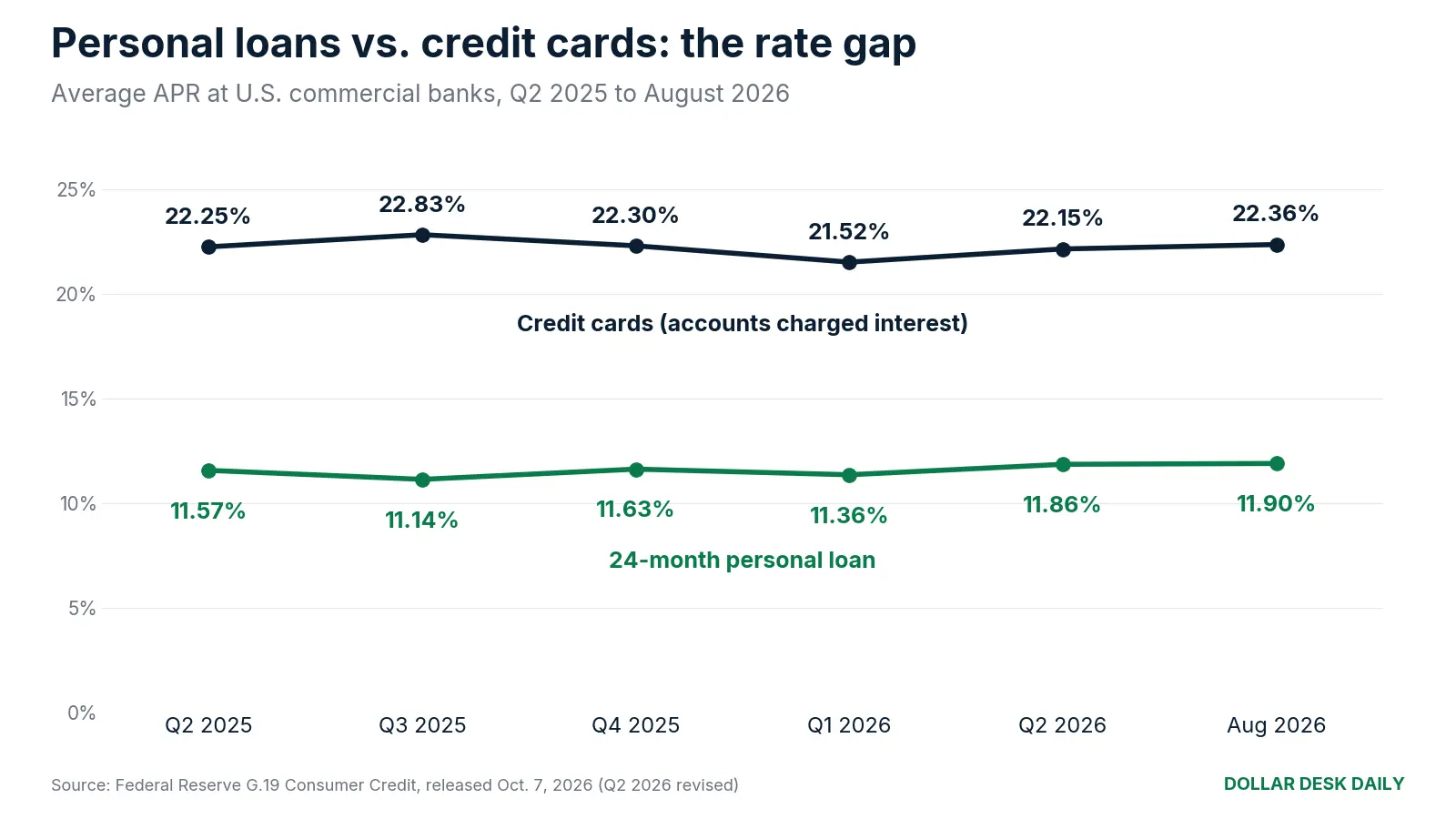
- Commercial banks’ average rate on a 24-month personal loan was 11.90% in August 2026, compared with 22.36% on credit card accounts that were charged interest, according to the Federal Reserve’s G.19 release.
- The APR, or annual percentage rate, is the interest rate plus fees such as origination charges, so comparing APR to APR is the fair way to compare loan offers, according to the CFPB.
- In our illustration, a $10,000, 36-month loan at 11.90% costs $1,939.96 in interest, but adding a hypothetical 6% origination fee raises the cost to $2,702.09 and the effective APR to about 16.26%.
In this article
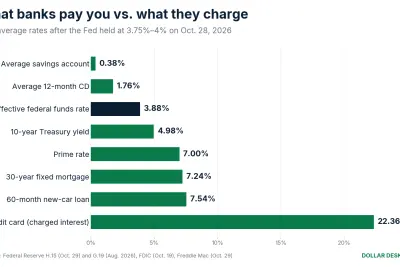
A personal loan is money you borrow once and repay in equal monthly installments over a set term. The Federal Reserve reports that commercial banks’ average rate on a 24-month personal loan was 11.90% in August 2026. In the same release, credit card accounts that were charged interest averaged 22.36%.
Those two averages are only a starting point. The rate you are quoted, the fees taken out of the loan and the length of the term all change what you pay.
How does a personal loan work?
A lender gives you a lump sum, and you repay it with interest in fixed monthly payments until a set end date. This is called an installment loan. Unlike a credit card, there is no revolving balance: once you have the money, you cannot borrow more on the same loan.
With a fixed rate, the payment stays the same each month. In the standard loan formula used below, early payments are mostly interest and later ones are mostly principal, the amount originally borrowed. The loan agreement shows the rate type and term.
APR vs. interest rate: what is the difference?
The interest rate is the cost of borrowing the money, on top of the amount you borrow. The APR, or annual percentage rate, is broader. According to the Consumer Financial Protection Bureau (CFPB), the APR is the interest rate plus additional fees charged with the loan, including origination charges and other fees charged when the loan is made.
The CFPB says the Truth in Lending Act requires lenders to give you disclosures, including the APR, before you finalize a loan; its page makes the point for car loans. Regulation Z requires closed-end creditors to make disclosures before consummation of the transaction, and to show the finance charge (“the dollar amount the credit will cost you”), the amount financed and the total of payments. The CFPB advises comparing APRs to APRs, not APRs to interest rates, because the two are not the same.
Regulation Z defines the finance charge as the cost of consumer credit as a dollar amount, including any charge the consumer pays that the creditor imposes as a condition of the loan. That is why a fee that is a condition of getting the loan shows up in the APR.
What is an origination fee?
An origination fee is one of the charges a lender makes when the loan is made, and the CFPB says the APR includes origination charges. The loan agreement and the Truth in Lending disclosure show whether a lender charges one and how much.
The fee matters because you pay interest on money you never see. If you need $10,000 in hand and a 6% fee is subtracted from the proceeds, you have to borrow about $10,638 to end up with $10,000. The worked example below shows the effect.
How do credit scores affect personal loan rates?
The CFPB says that in general, the higher your credit score, the lower your rates will be. It also notes that lenders are not required to offer you the best available rates, and that the best way to reduce your costs is to shop around and compare rates between lenders.
That means the Federal Reserve average is a reference point, not a quote. The G.19 figure is a simple unweighted average of each reporting bank’s most common rate, collected during the first calendar week of the middle month of each quarter. Your own offer can be higher or lower. Our guide to how credit scores work explains what goes into the number lenders look at.
What do personal loans cost on average?
The G.19 reports the 24-month personal loan rate at commercial banks, not seasonally adjusted. It is an APR as defined by Regulation Z. Here is the recent record next to the card rate for accounts charged interest.
| Period | 24-month personal loan | Credit card, accounts assessed interest |
|---|---|---|
| 2024 (annual) | 12.27% | 22.89% |
| 2025 (annual) | 11.50% | 22.32% |
| Q2 2025 | 11.57% | 22.25% |
| Q3 2025 | 11.14% | 22.83% |
| Q4 2025 | 11.63% | 22.30% |
| Q1 2026 | 11.36% | 21.52% |
| Q2 2026 | 11.86% | 22.15% |
| August 2026 | 11.90% | 22.36% |
Source: Federal Reserve G.19, released Oct. 7, 2026. The Q2 2026 figures are marked as revised in the release.
Across the six periods, the personal loan average stayed between 11.14% and 11.90%, while the card average stayed between 21.52% and 22.83%. The gap was roughly 10 to 12 percentage points throughout. The Fed’s card figure is a different measure from a stated card APR: it is total finance charges divided by the average daily balances that were charged interest.
What it means for you
These calculations are illustrations, not offers. They assume a $10,000 loan, a 36-month term and the August 2026 G.19 average of 11.90%. The monthly payment follows the standard loan formula, and interest equals total payments minus the amount you receive.
| Scenario | Monthly payment | Total paid | Cost of borrowing |
|---|---|---|---|
| A: 11.90%, no fee | $331.67 | $11,939.96 | $1,939.96 |
| B: 11.90% rate plus a 6% fee taken from the loan | $352.84 | $12,702.09 | $2,702.09 |
In scenario B, the borrower needs $10,638.30 of principal to receive $10,000 after a $638.30 fee. The extra principal and the fee raise the cost of borrowing by $762.13 over scenario A. Measured against the $10,000 actually received, the effective APR is about 16.26%, even though the quoted interest rate is still 11.90%. This is the gap that APR disclosures exist to show.
Compared with a credit card
Now suppose the same $10,000 sat on a credit card charged 22.36%, the August 2026 average for accounts assessed interest. If the cardholder paid the same $331.67 a month as in scenario A, the balance would take 45 months to clear and cost about $4,823.58 in interest, compared with $1,939.96 on the 36-month loan. Our guide to how credit card interest works shows how the daily calculation produces that result.
The comparison has limits. The card rate varies by account, and a loan has a fixed end date that a card does not. Whether a personal loan fits a given budget depends on the offered APR, the fees, and the payment the borrower can sustain.
Common mistakes when comparing loans
- Comparing rates instead of APRs. A loan with a lower interest rate and a large origination fee can cost more than one with a higher rate and no fee.
- Looking only at the monthly payment. A longer term lowers the payment but adds interest. A 60-month loan costs more in total than a 36-month loan at the same rate.
- Skipping the total of payments. The Truth in Lending disclosure lists it. It is the quickest way to see the full cost.
- Assuming the average is your rate. The CFPB notes lenders are not required to offer the best available rates, so offers differ.
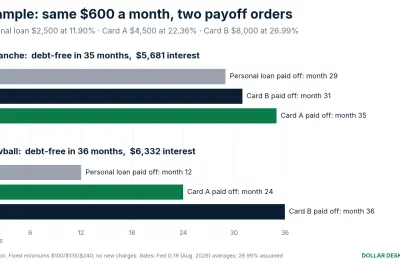
If you already carry card balances and are weighing ways to pay them down, debt avalanche vs. debt snowball compares two payoff orders. For background on the central bank’s role, see how Fed rate decisions affect your money.
What to watch next
The Federal Reserve publishes the G.19 monthly, and its personal loan rate is collected in the middle month of each quarter. The next quarterly reading will cover November 2026. Each release shows whether the roughly 10-to-12-point gap between personal loan and card rates is holding.
Sources
- Federal Reserve — G.19 Consumer Credit (released Oct. 7, 2026)
- Consumer Financial Protection Bureau — What is the difference between a loan interest rate and the APR?
- Consumer Financial Protection Bureau — Regulation Z, 12 CFR 1026.4 Finance charge
- Consumer Financial Protection Bureau — Regulation Z, 12 CFR 1026.18 Content of disclosures
- Consumer Financial Protection Bureau — Regulation Z, 12 CFR 1026.17 General disclosure requirements