How a CD Ladder Works: Rungs, Rates, Penalties and Insurance
A CD ladder splits savings across several maturities. See a $10,000 example at FDIC average rates, plus early-withdrawal penalties and brokered CD risks.
Key Takeaways
- A CD ladder splits money across CDs that mature at staggered dates, so part of the money comes due on a regular schedule instead of all at once.
- On Nov. 16, 2026, FDIC national average CD rates were 1.81% at 12 months, 1.60% at 24, 1.42% at 36, 1.33% at 48 and 1.44% at 60 months, so a $10,000 five-rung ladder blends to about 1.52%.
- Bank CDs are FDIC-insured up to $250,000 per depositor, per bank, per ownership category, while brokered CDs add broker risk and can lose principal if sold before maturity.
In this article
A certificate of deposit (CD) ladder is a way to hold several CDs with different maturity dates so that one comes due at regular intervals. On Nov. 16, 2026, the FDIC’s national average rate was 1.81% on a 12-month CD and 1.44% on a 60-month CD, so a ladder spread across five terms from one to five years would have blended to about 1.52%.
The idea is a trade-off between two things a single CD cannot give you at once: access to cash and a locked rate. This article explains how the structure works, runs the numbers with current FDIC averages, and covers penalties, brokered CDs and deposit insurance.
What is a CD ladder?
A CD is a type of savings account offered by banks and credit unions. According to the Consumer Financial Protection Bureau (CFPB), you generally agree to leave the money untouched for a set term, and withdrawing early means paying a penalty.
A ladder divides your total into equal parts, called rungs, and buys CDs with different terms. For example, a five-rung ladder might hold CDs maturing in one, two, three, four and five years. When the one-year CD matures, the cash is either spent or reinvested in a new five-year CD at the top of the ladder. After a few years, every rung is a five-year CD, but one still matures every year.
A ladder does not raise a rate by itself. It spreads out when your money comes due, and it spreads out the rate you lock in, because each rung is bought at a different point on the rate curve.
What do CDs pay right now?
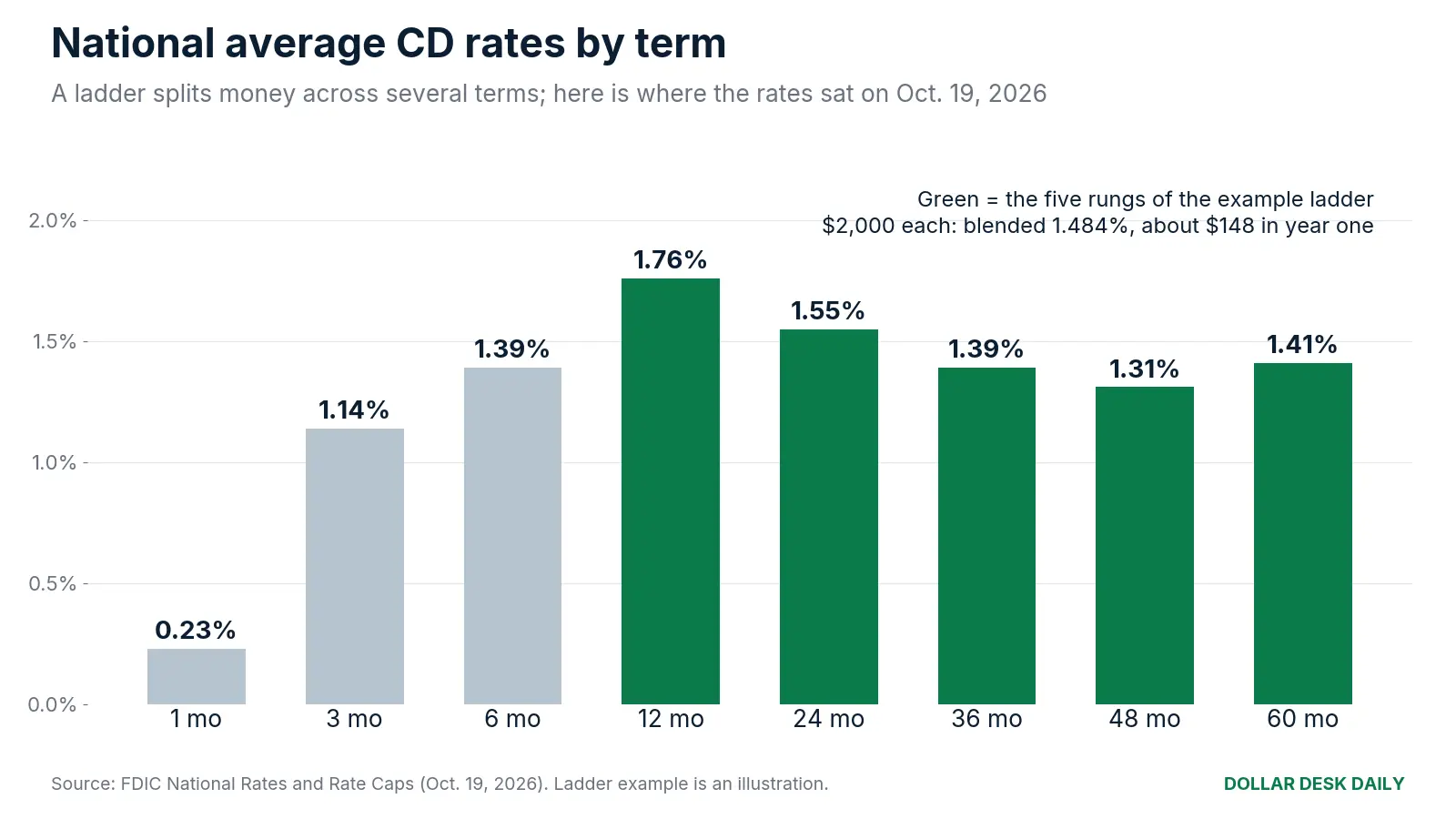
The FDIC publishes national average rates by CD term. These are averages weighted by each institution’s share of domestic deposits, based on data from banks and credit unions. Here is the table as of Nov. 16, 2026.
| CD term | National average rate (Nov. 16, 2026) |
|---|---|
| 1 month | 0.23% |
| 3 months | 1.14% |
| 6 months | 1.40% |
| 12 months | 1.81% |
| 24 months | 1.60% |
| 36 months | 1.42% |
| 48 months | 1.33% |
| 60 months | 1.44% |
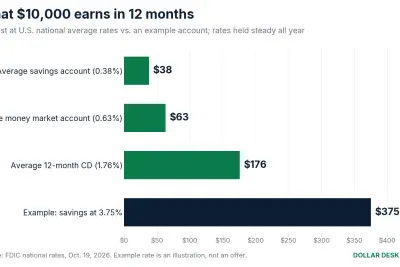
The CFPB says a later maturity date generally earns a higher rate, and gives the example that a two-year CD generally pays more than a six-month CD. The November FDIC averages show a more mixed picture: 12 months is the highest, and rates dip through 48 months before ticking up at 60. The FDIC updates these figures monthly, so check the date on any number.
Worked example: ,000 in a five-rung ladder
This is an illustration, not a recommendation. Assume you split $10,000 into five $2,000 CDs at the FDIC national averages above, and treat each rate as an annual rate for simplicity.
| Rung | Term | Rate | Interest in year one |
|---|---|---|---|
| 1 | 12 months | 1.81% | $36.20 |
| 2 | 24 months | 1.60% | $32.00 |
| 3 | 36 months | 1.42% | $28.40 |
| 4 | 48 months | 1.33% | $26.60 |
| 5 | 60 months | 1.44% | $28.80 |
| Total | $152.00 |
The blended rate is $152.00 divided by $10,000, or 1.52%. For comparison, putting the full $10,000 into a single 12-month CD at 1.81% would earn $181 in year one, and a single 60-month CD at 1.44% would earn $144.
What the ladder buys is timing. In this example, $2,000 matures after 12 months, another $2,000 after 24 months, and so on. Nobody can say in advance whether rates will be higher or lower when each rung matures. If rates rise, the maturing rung can be reinvested at the higher rate; if they fall, that rung locks in less than before, while the longer rungs still hold their old rates.
The CFPB also notes that a bank may roll a maturing CD into a new one automatically unless you tell it not to, and must send a written notice before maturity. The new rate may be higher or lower than the old one, which is why each rung’s maturity date is a decision point.
What does it cost to break a CD early?
Banks must disclose early-withdrawal penalties. Under Regulation DD, a bank must state that a penalty will or may be imposed, how it is calculated and the conditions for assessing it. The regulation’s examples include a flat dollar amount or “seven days’ interest plus accrued but uncredited interest.” Other listed examples include a lowered rate on the money that stays in the account.
Penalties vary by bank and by term, so read the account agreement. As a hypothetical only: if a bank charged six months of interest on one $2,000 rung earning 1.60%, the penalty would be $2,000 × 1.60% × 0.5, or $16.00. The CFPB advises comparing offers by the term, the rate and the size of the penalty.
A ladder reduces the chance you need to break anything, because a rung matures on a schedule. It does not eliminate it. A job loss in month three still means choosing between breaking a CD and using another source of cash, which is one reason to read the emergency fund guide alongside this one.
Bank CDs vs. brokered CDs
A bank CD is bought directly from a bank. A brokered CD is issued by a bank but sold through a broker, often in a brokerage account. The rules differ in ways that matter for a ladder.
- Early exit. A traditional bank CD has an early-withdrawal penalty set in the contract. A 2002 FINRA notice (Notice to Members 02-28, since superseded by 02-69) described long-term brokered CDs this way: the broker is generally just a custodian, so a customer cannot simply redeem early and pay a penalty; the broker must sell the CD in the secondary market, and when interest rates rise, the market value of a long-term CD generally declines. That can mean a loss of principal, not just interest. Because the notice is old and superseded, treat it as background on the concept and check a current broker’s disclosures for today’s terms.
- Insurance. The FDIC says brokers who offer brokered CDs are among the third parties whose customers can receive pass-through coverage, but only if requirements are met, including that the relationship is disclosed in the bank’s deposit account records and that each owner’s identity and ownership interest can be ascertained from the records. The 2002 FINRA notice also said deposit insurance does not protect buyers against the failure of a deposit broker and does not cover principal losses from selling before maturity; the FDIC pages saved for this article do not address those two points, so confirm them with a current disclosure.
How does FDIC insurance apply to a ladder?
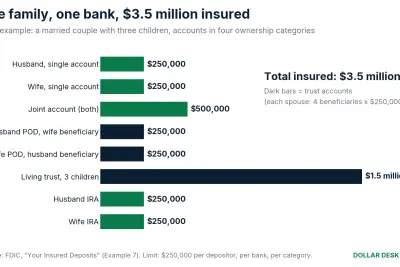
The FDIC insures deposits, including CDs, up to $250,000 per depositor, per insured bank, for each account ownership category. All deposits in the same ownership category at the same bank are added together.
For a ladder, the practical point is to count every rung at the same bank together. A ladder of five $60,000 CDs at one bank totals $300,000 in one ownership category, which is $50,000 over the limit. Using different banks, or different ownership categories such as single and joint accounts, changes the math. The CFPB says credit union CDs are insured separately by the National Credit Union Administration up to $250,000. See FDIC insurance explained for ownership categories.
Common mistakes with CD ladders
- Assuming a ladder earns more. In the November data, a single 12-month CD out-earned the five-rung blend. A ladder is about access and rate timing, not a higher yield.
- Forgetting the insurance limit. Several CDs at one bank are added together.
- Treating brokered CDs like bank CDs. The exit route, the penalty and the insurance chain are different.
If you are weighing CDs against other places to park cash, see CDs vs. high-yield savings vs. money market, and for how rates are quoted, APY vs. APR. The link between CD rates and government bond yields is covered in Treasury yields explained.
Sources
- FDIC — National Rates and Rate Caps (as of Nov. 16, 2026)
- CFPB — What is a certificate of deposit (CD)?
- CFPB — The interest rate offered for CDs (certificates of deposit) is low. Is there anything I can do about that?
- CFPB — What is a certificate of deposit (CD) rollover or renewal?
- CFPB — Regulation DD, 12 CFR 1030.4 (contract and disclosures, early withdrawal penalties)
- FDIC — Understanding Deposit Insurance
- FDIC — Your Insured Deposits (brochure)
- FINRA — Notice to Members 02-28: Member Obligations Regarding Long-Term Or Brokered Certificates Of Deposit (2002, superseded by NtM 02-69)