Disability Insurance Explained: Short-Term, Long-Term, SSDI, Taxes
Disability insurance replaces part of your pay when illness or injury stops work. How short- and long-term plans, SSDI and state programs differ, and tax rules.
Key Takeaways
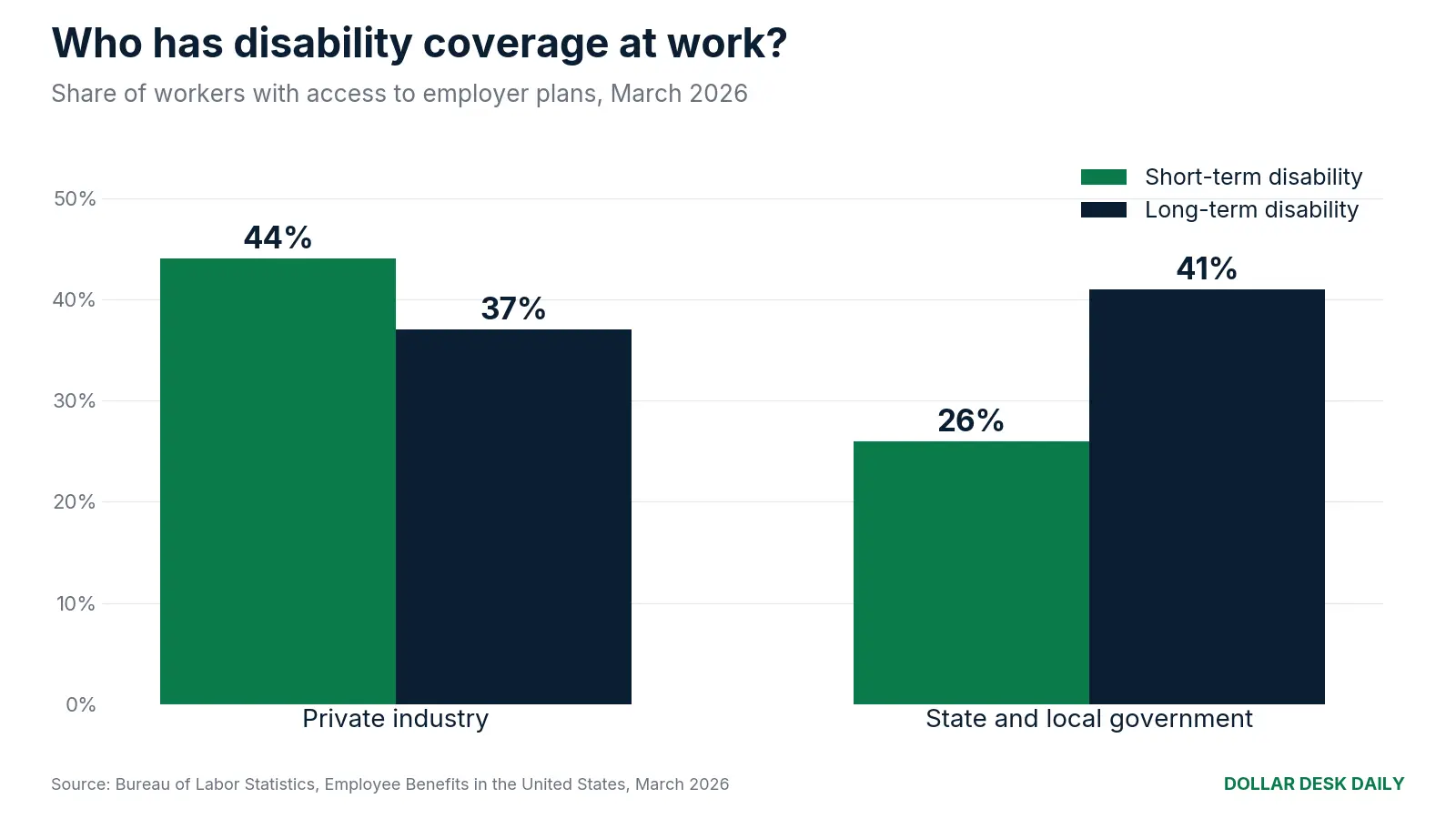
- In March 2026, 44% of private industry workers had access to employer short-term disability plans and 37% had access to long-term plans, according to the Bureau of Labor Statistics.
- Whether disability benefits are taxable depends on who paid the premiums: if your employer paid, benefits are generally taxable income; if you paid with after-tax money, they are not, according to IRS Publication 525.
- Social Security Disability Insurance (SSDI) applies a strict test: inability to do any substantial gainful activity, with a condition expected to last at least 12 months, and in 2027 monthly earnings above $1,770 ordinarily count as that activity.
In this article
Disability insurance pays you part of your income when an illness or injury keeps you from working. Most people with coverage get it through an employer: in March 2026, 44% of private industry workers had access to a short-term disability plan and 37% to a long-term plan, according to the Bureau of Labor Statistics (BLS). Government programs fill some gaps, but they work very differently from a paycheck-replacement policy.
This article explains the pieces: short-term vs. long-term coverage, the terms that decide what a policy pays, how benefits are taxed, and where Social Security Disability Insurance (SSDI) and state programs fit. It describes how the products work; it does not recommend any policy.
How many workers have it?
BLS asks employers which benefits they offer. Its March 2026 results show a split between sectors: private employers lean toward short-term plans, while public employers lean toward long-term plans.
| March 2026, share of workers with access | Short-term disability | Long-term disability |
|---|---|---|
| Private industry | 44% | 37% |
| State and local government | 26% | 41% |
Access also varies by region. BLS reports that 36% of civilian workers in the South had access to short-term disability plans, versus 66% in the Northeast. “Access” means the employer offers the plan, not that every worker has signed up or is covered.
Short-term vs. long-term disability
The two types differ mainly in how soon they start and how long they pay.
- Short-term disability (STD) generally covers a limited period, often weeks to months, such as a recovery from surgery or childbirth.
- Long-term disability (LTD) generally starts later and can pay for a longer period, with the length set by the policy.
The exact start dates and lengths are set by each contract, so two plans with the same label can behave differently. The state examples below show real figures.
The terms that decide what a policy pays
Policy wording varies by insurer and employer. These are general descriptions, not taken from an official source, so check each against the plan document.
- Elimination period (waiting period): the time after a disability begins before benefits start. A longer wait usually means a lower premium, but you cover the gap yourself.
- Benefit period: the maximum time benefits can be paid, such as 26 weeks, five years, or to a set age.
- Benefit percentage: the share of your pre-disability income the plan replaces. Plans often cap the monthly dollar amount too.
- Own-occupation vs. any-occupation: an own-occupation definition asks whether you can do your usual job. An any-occupation definition asks whether you can do any job you are reasonably suited for. The second is generally harder to meet. Some policies switch from one to the other after a set period.
State programs show how these terms look in real rules. Under Hawaii’s statutory temporary disability plan, benefits start on the eighth day of disability, last a maximum of 26 weeks, and pay 58% of average weekly wages up to a state maximum. New Jersey pays 85% of average weekly wage up to a yearly maximum, for up to 26 weeks.
Employer group plans vs. individual policies
A group plan is arranged by an employer for its workers, so coverage is tied to the job and the employer’s plan terms. An individual policy is bought directly by the person and is a separate contract with the insurer. BLS data cover only the employer side, so this article has no comparable official count of individual policies. Ask the employer or insurer for the plan document to see which terms apply.
Are disability benefits taxable?
It depends on who paid the premiums. IRS Publication 525 says that if your employer pays for the plan, you generally report the benefits as income. If both you and your employer pay, only the part due to your employer’s payments is income. If you pay the entire cost, the benefits are not income.
There is a wrinkle for plans run through a cafeteria plan (a workplace plan that lets you choose pretax benefits). The IRS says that if premiums were not included in your income, you are not considered to have paid them, so benefits are taxable. If the premiums were included in your income, benefits are not taxable.
Here is an illustration with assumed numbers, not a prediction for any policy. Say a worker earning $4,000 a month has a plan that replaces 60% of income, or $2,400 a month.
- Employer paid the premiums: the $2,400 is generally taxable, so a worker in a 12% bracket owes about $288 a month in federal income tax ($2,400 × 0.12), leaving about $2,112.
- Worker paid with after-tax pay: the full $2,400 arrives tax-free.
The tax rate here is an example only; see marginal vs. effective tax rate for how brackets apply.
How SSDI is different
SSDI is a federal program, and its test is strict. Federal regulation defines disability as the inability to do any substantial gainful activity because of a medically determinable impairment that is expected to result in death or has lasted, or is expected to last, at least 12 months. The Social Security Administration (SSA) considers whether you can do your past work or other work that exists in the national economy, based on your condition, age, education and work experience.
The “substantial gainful activity” line is a dollar figure that SSA resets each year. The Federal Register notice of Oct. 26, 2026 sets the 2027 amounts and gives the 2026 amounts as the current ones.
| SSA disability threshold | 2026 | 2027 |
|---|---|---|
| Substantial gainful activity, non-blind | $1,690/month | $1,770/month |
| Substantial gainful activity, blind | $2,830/month | $2,950/month |
| Trial work period month | $1,210/month | $1,270/month |
The SSA 2027 COLA fact sheet estimates the average monthly benefit for all disabled workers in January 2027 at $1,701 after the 3.6% cost-of-living adjustment, up from $1,642 before it (the Federal Register notice confirms the 3.6% COLA but not this average). Benefits are based on your earnings record, as described in how Social Security benefits are calculated, and rise with the 2027 COLA. SSDI is a federal benefit with its own formula, so it can differ a lot from a private plan’s percentage of pay. Whether a private plan adjusts its payment when SSDI is also paid is a contract detail to read in the plan document.
SSA also has a trial work period, in which a beneficiary can test their ability to work: nine months in a rolling 60-month period, with a month counting when earnings exceed the threshold ($1,270 in 2027).
State programs
Some states run their own programs. The five below are examples drawn from the agencies’ pages, not a full list:
- California: State Disability Insurance provides short-term wage replacement for non-work-related illness, injury, pregnancy or childbirth, plus Paid Family Leave.
- New Jersey: Temporary Disability Insurance, for up to 26 weeks. Workers contribute 0.19% of wages up to $171,100 in 2026, a maximum of $325.09.
- Hawaii: employers must provide temporary disability coverage; the employee share cannot exceed 0.5% of weekly wages.
- New York: Paid Family Leave offers up to a maximum weekly benefit of $1,228.53 in 2026 (family-care and bonding reasons, not a worker’s own illness).
- Washington: Paid Family and Medical Leave covers a serious health condition that prevents work, and family care.
The list is incomplete. New York, for example, also has a separate disability benefits law for a worker’s own non-work illness, and Rhode Island has Temporary Disability Insurance; this article did not review their terms. These programs are short-term and have their own eligibility rules; they are not a substitute for long-term coverage. Check your state agency for current terms.
What to watch next
The 2027 SSA thresholds above apply to 2027, so the 2026 column is the current one until then. State agencies post their own contribution rates and maximum benefits, so check the current year. A cash cushion, covered in the emergency fund guide, is what bridges an elimination period regardless of coverage.
Sources
- Bureau of Labor Statistics — Employee Benefits in the United States, March 2026 (news release)
- Internal Revenue Service — Publication 525 (2025), Taxable and Nontaxable Income
- Social Security Administration — 2027 Cost-of-Living Adjustment (COLA) Fact Sheet (read via Internet Archive copy; ssa.gov blocks automated access)
- Federal Register — Cost-of-Living Increase and Other Determinations for 2027 (Oct. 26, 2026)
- eCFR — 20 CFR 404.1505, Basic definition of disability
- California Employment Development Department — State Disability Insurance
- New Jersey Department of Labor — Temporary Disability Insurance
- Hawaii Department of Labor and Industrial Relations — About Temporary Disability Insurance
- New York State Paid Family Leave
- Washington Paid Family and Medical Leave