How P2P Payment Apps Work: FDIC Cover, Reg E and Scams
App balances may not be FDIC-insured if the app company fails, and Regulation E caps losses on unauthorized transfers. See the limits, timelines and scam gaps.
Key Takeaways
- Under Regulation E, a consumer who reports a lost-device unauthorized transfer within two business days is liable for no more than $50; after that the cap rises to $500, according to 12 CFR 1005.6(b).
- The CFPB says money kept in a nonbank payment app might not be FDIC-insured, and pass-through insurance protects against failure of the partner bank, not the app company.
- Consumers reported $15.9 billion in fraud losses in 2025, and the FTC said bank payments were the top payment method by aggregate losses, so checking who you are paying matters before you send.
In this article
A peer-to-peer (P2P) payment app moves money from you to another person without a check or cash, and the protections you get depend on where your money sits and how the payment was triggered. The federal rule that covers most of these transfers, Regulation E, caps your loss at $50 for some unauthorized transfers if you report quickly. The sources reviewed do not say those limits apply to a payment you knowingly sent to a scammer.
The Consumer Financial Protection Bureau (CFPB) says more than three quarters of U.S. adults have used a payment app, in an advisory that is now archived.
Two ways the money moves
Some P2P payments start inside your bank’s own app or website. The CFPB calls a payment that sends funds out of your deposit, prepaid or mobile account a “credit-push” payment.
Other apps are run by nonbank companies. The CFPB names PayPal, Venmo and Cash App as widely used examples. These apps can link to a bank account, credit union account or card, and they also let you store money inside the app. Money you receive “generally stays in your payment app account” until you move it to a linked account, the CFPB says.
That difference matters for insurance. Money in a bank account is covered by the Federal Deposit Insurance Corporation (FDIC) if the bank fails. An app’s stored balance may not be at a bank at all. For the basics of the $250,000 limit, see our guide to FDIC insurance.
Is an app balance FDIC-insured?
Sometimes, but only under conditions, and never against the app company itself failing. The CFPB advisory says money in a nonbank payment app “might not” offer federal deposit insurance, and that “deposit insurance does not apply when a nonbank payment company fails.”
Some apps offer pass-through insurance. This is coverage that “passes through” the app to each customer when the app holds pooled customer money at an insured bank. According to the Fed, FDIC and OCC joint statement, three conditions apply:
- The funds must first be on deposit at an FDIC-insured bank.
- The bank’s records must disclose a basis for pass-through coverage, such as a custodial or agency relationship, and the real owners and their shares must be ascertainable from the bank’s records or from records kept in good faith by another party.
- The relationship must be genuine, with the money actually owned by the named customers.
The FDIC’s rule at 12 CFR 330.5 sets out the records requirements (disclosure of the relationship and ascertainable owners and interests); the joint statement also cites 12 CFR 330.7. The CFPB adds that some apps require extra steps, such as getting a company-branded card, and says pass-through insurance “doesn’t insure you against the failure of the payment app company,” so a failed app could still delay access to your money.
The joint statement warns that a nonbank can be “reasonably mistaken” for a bank, and that marketing about FDIC insurance may not mention that coverage protects only against the failure of the bank.
What Regulation E covers
Regulation E, which implements the Electronic Fund Transfer Act, covers electronic transfers to or from consumer accounts, including prepaid accounts. According to the CFPB’s FAQs, any P2P payment that meets the definition of an electronic fund transfer is covered, whether it comes from a bank app or a nonbank app. A nonbank provider counts as a financial institution if it holds an account for you, or issues an access device and agrees to provide transfer services.
A key term is “unauthorized electronic fund transfer”: a transfer initiated by someone other than you, without actual authority, from which you receive no benefit (12 CFR 1005.2(m)). The CFPB’s FAQs say this includes transfers made by a fraudster who tricked you into revealing login details or a texted confirmation code. A transfer a fraudster starts through an app you have no relationship with can also count.
The CFPB’s FAQs add that an agreement or a network’s “final and irrevocable” rule cannot waive these rights.
The scam gap: payments you authorize
Regulation E’s definition turns on who initiated the transfer. It excludes transfers started by a person you furnished with access to your account, unless you told the bank that person was no longer authorized. The CFPB’s FAQs say that exclusion does not apply when a fraudster obtained access through fraud.
The harder case is when you yourself send money to a scammer, for example to a fake seller or a person posing as a relative. The CFPB and Regulation E sources reviewed for this article do not say that such payments count as unauthorized transfers, and none of them guarantees reimbursement for them. Whether a given payment is refundable is not settled by those sources.
The scale is large. The FTC told Congress on March 25, 2026 that consumers reported $15.9 billion in fraud losses in 2025, up from over $12 billion in 2024. It said consumers reported the highest aggregate losses from sending money to scammers via bank payments, followed by cryptocurrency, and that approximately half of 2025 losses were investment scams.
Liability limits and timelines
Under 12 CFR 1005.6, how much you can lose depends on how fast you report. These limits apply only if the institution provided the required disclosures.
| Situation | Your maximum liability |
|---|---|
| Report within 2 business days of learning your device was lost or stolen | Lesser of $50 or the transfers made before you reported |
| Report later than 2 business days | Lesser of $500 or the sum of $50 plus transfers after day 2 that the institution shows would not have happened had you reported in time |
| Unauthorized transfer on a statement and you miss 60 days | Transfers after the 60 days that the institution shows would have been avoided by reporting |
Tell the institution within 60 days after it sends the statement showing the problem. For an error notice, it must investigate and determine whether an error occurred within 10 business days, or take up to 45 days if it provisionally credits your account within those 10 business days (12 CFR 1005.11). The 10-business-day period becomes 20 business days for transfers within 30 days after an account’s first deposit, and the 45-day period becomes 90 days for that case, for transfers not initiated within a state, and for point-of-sale debit card transactions.
What it means for you: a worked example
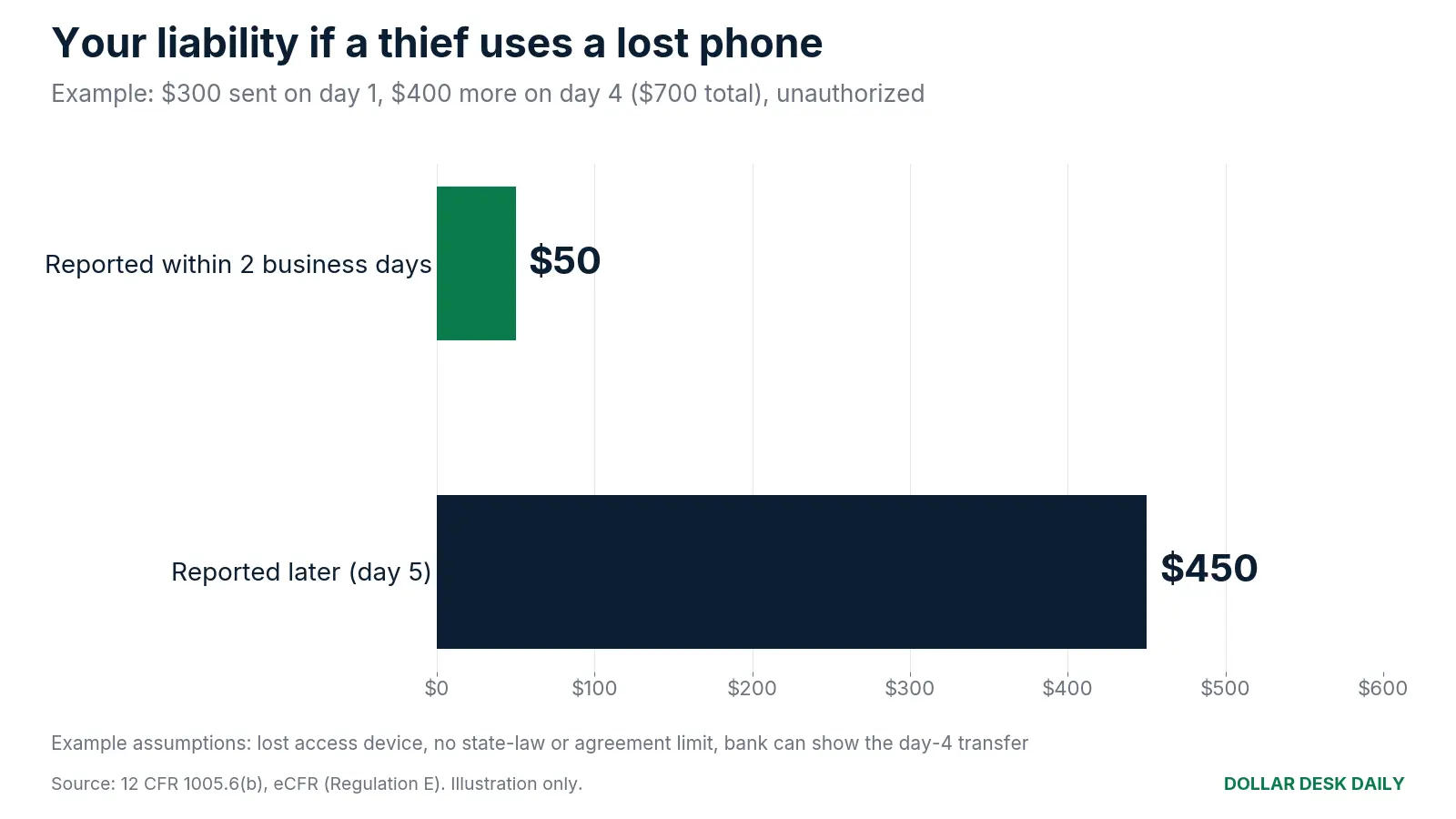
This is an illustration, not a real case. Say a thief uses a lost phone to send $300 on day 1 and $400 on day 4, $700 in total. Assume the owner learns of the loss on day 1, days are business days, and the transfers are unauthorized.
- Report within two business days of learning the phone is gone: liability is the lesser of $50 or the $300 sent before notice, so $50. The bank bears the rest.
- Report on day 5, after the two-day window: first $50 (the lesser of $50 or the $300 sent within the two days), plus $400 sent after the window, assuming the bank shows the day-4 transfer would not have happened with timely notice. That is $450, below the $500 cap.
With a $900 second transfer, the sum would be $950 and the $500 cap would apply. Lower liability under state law or your agreement controls.
Before you send money to someone new
These steps follow from how the rules work, not from any app’s policy:
- Confirm the recipient through a contact you already had. The FTC says a text message was the top reported contact method in 2025 fraud reports where a method was identified.
- Treat a request to send money fast, or to share a login code, as a warning sign. A code you read out can lead to a transfer you did not make.
- Keep only what you need in a nonbank app balance, and check whether the partner bank and pass-through terms apply to you.
- Alerts and statement reviews help you spot problems in time. The 60-day clock runs from the statement date.
- If something goes wrong, report it to the provider immediately, by phone or in writing, and keep the date. Notice counts once you take reasonable steps to give the pertinent information.
For bank-run payment tools, see how to compare checking accounts.
Sources
- eCFR — 12 CFR 1005.6, Liability of consumer for unauthorized transfers (Regulation E)
- eCFR — 12 CFR 1005.11, Procedures for resolving errors (Regulation E)
- eCFR — 12 CFR 1005.2, Definitions (Regulation E)
- CFPB — Electronic Fund Transfers FAQs (compliance aid; page last modified Jan. 16, 2025)
- CFPB — Consumer advisory: Your money is at greater risk when you hold it in a payment app, instead of moving it to an account with deposit insurance (archived)
- eCFR — 12 CFR 330.5, Recognition of deposit ownership and fiduciary relationships (FDIC)
- Federal Reserve, FDIC and OCC — Joint Statement on Banks’ Arrangements with Third Parties to Deliver Bank Deposit Products and Services
- FDIC — Understanding Deposit Insurance
- FTC — Prepared statement before the Joint Economic Committee on the rising scam economy (March 25, 2026)