Fed Holds Rates at 3.75%–4%: What It Means for Your Money
The Fed kept its key rate at 3.75%–4% on Oct. 28, but two officials wanted a hike. Here is what that means for savings, credit cards, mortgages and car loans.
Key Takeaways
- The Federal Reserve kept the federal funds target range at 3.75% to 4% on Oct. 28, 2026, in a 10–2 vote.
- Two officials, Lisa Cook and Beth Hammack, voted for a quarter-point increase, a sign that a hike is being discussed while inflation runs at 3.7%.
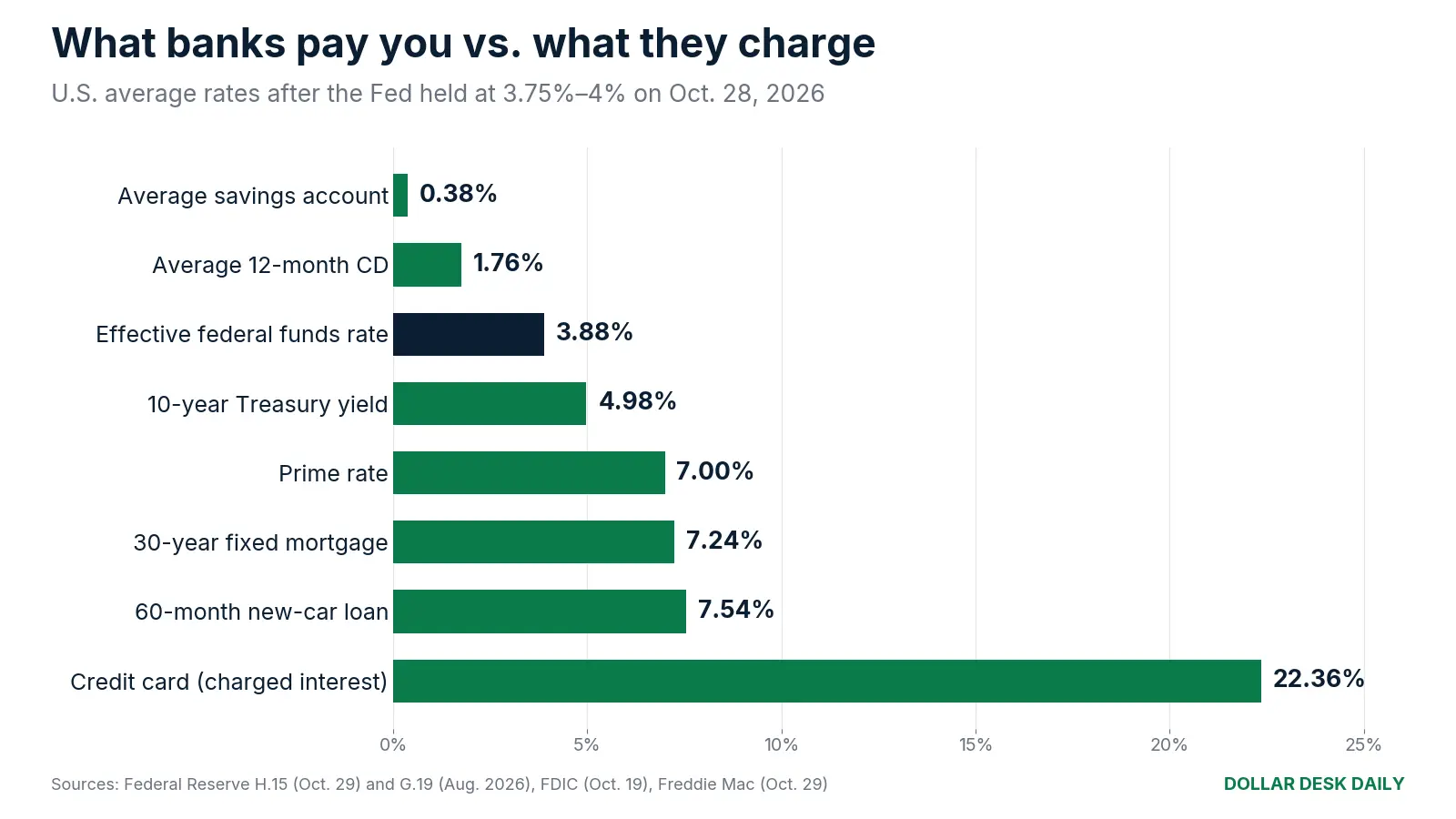
- Rates you pay and earn barely move after a hold, but the gap is wide: the average savings account pays 0.38%, while card balances that are charged interest average 22.36%.
In this article
The Federal Reserve left its benchmark interest rate unchanged on Oct. 28, 2026, keeping the federal funds target range at 3.75% to 4%. The decision passed 10–2, and the two dissents pointed the other way from a cut: Fed Governor Lisa D. Cook and Cleveland Fed President Beth M. Hammack wanted to raise the range by a quarter of a percentage point.
For your wallet, a hold means the rates on your savings, credit cards and loans should stay roughly where they are for now. The dissents matter because they show that a rate increase is on the table while inflation stays high.
Why the Fed stood still
In its statement, the Fed said economic activity “is expanding at a strong pace,” that domestic spending “has been resilient” and that the unemployment rate “has changed little.” It also said plainly: “Inflation remains elevated.”
The latest numbers back that up. Consumer prices rose 3.7% in the 12 months through September 2026, according to the Bureau of Labor Statistics. Gasoline did much of the damage: the gasoline index jumped 9.1% in September alone and accounted for more than half of that month’s increase. Prices excluding food and energy, a measure the Fed watches to see the underlying trend, rose 2.6% over the year.
The Fed’s goal is 2% inflation. With prices still well above that, the committee said it wants “more information” before deciding its next step.
What it means for you
A hold does not change your bills overnight, but it locks in the current gap between what banks pay you and what they charge you.
| Rate | Latest level | Date / period |
|---|---|---|
| Average savings account | 0.38% | FDIC, Oct. 19, 2026 |
| Average 12-month CD | 1.76% | FDIC, Oct. 19, 2026 |
| Effective federal funds rate | 3.88% | Fed H.15, Oct. 29, 2026 |
| 10-year Treasury yield | 4.98% | Fed H.15, Oct. 29, 2026 |
| Prime rate | 7.00% | Fed H.15, Oct. 29, 2026 |
| 60-month new-car loan (banks) | 7.54% | Fed G.19, August 2026 |
| 30-year fixed mortgage | 7.24% | Freddie Mac, Oct. 29, 2026 |
| Credit card, accounts charged interest | 22.36% | Fed G.19, August 2026 |
Savings: the average account is far behind the Fed
The Fed’s rate sits near 3.9%, yet the national average savings account pays just 0.38%, according to the FDIC. On $10,000, that is about $38 a year. The same $10,000 in an account paying 3.75% would earn about $375 a year — an illustration of how much the gap is worth, not a specific offer. If your bank pays close to the average, a hold is a reminder to compare rates rather than wait for the Fed.
Credit cards: the most expensive debt, and the most rate-sensitive
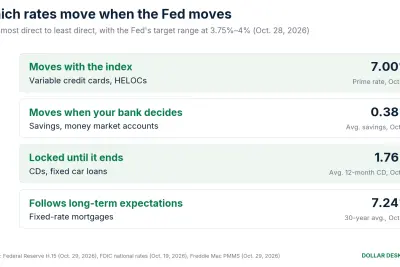
Many credit cards have variable rates tied to the prime rate, which moves with the Fed. Card accounts that were charged interest averaged 22.36% in August 2026, according to the Fed.
On a $6,000 balance, that works out to about $112 in interest a month ($6,000 × 22.36% ÷ 12). A quarter-point Fed increase would add only about $1.25 a month to that bill. The rate you already pay matters far more than the Fed’s next move, which is why paying down card balances usually beats waiting for relief.
Mortgages: driven by longer-term yields
Fixed mortgage rates do not follow the Fed directly. They track longer-term Treasury yields, and the 10-year Treasury yield was 4.98% on Oct. 29. The average 30-year fixed mortgage was 7.24% that day, according to Freddie Mac, down from 7.32% a week earlier but up from 6.17% a year earlier.
On a $350,000 loan, 7.24% means a principal-and-interest payment of about $2,385 a month. At last year’s 6.17%, the same loan would cost about $2,137 — roughly $248 a month less.
Car loans and home equity lines
Banks charged an average of 7.54% on 60-month new-car loans in August 2026, according to the Fed. Fixed car loans you already have will not change. Home equity lines of credit, which usually float with the prime rate (7.00% on Oct. 29), will stay where they are after a hold but would rise if the Fed raises rates.
The signal in the two dissents
Dissents in favor of a higher rate tell you which way some officials are leaning. Cook and Hammack both preferred a quarter-point increase at this meeting. The statement did not promise a hike, but borrowers with variable-rate debt should be aware that the next change could be up, not down.
Market rates already reflect some of that: on Oct. 29, the 3-month Treasury yield was 4.18% and the 2-year yield was 4.61%, both above the effective federal funds rate of 3.88%.
What to watch next
- Nov. 10, 2026: the October consumer price index from the BLS. Another big jump in energy prices would add pressure for a hike.
- Dec. 8–9, 2026: the Fed’s final meeting of the year, which also comes with updated economic projections from Fed officials.
- Weekly, on Thursdays: Freddie Mac’s mortgage rate survey, the quickest read on how home loan rates are reacting.
Sources
- Federal Reserve — FOMC statement, October 28, 2026
- Federal Reserve — FOMC meeting calendar
- Federal Reserve — H.15 Selected Interest Rates (released Oct. 30, 2026)
- Federal Reserve — G.19 Consumer Credit (released Oct. 7, 2026)
- FDIC — National Rates and Rate Caps (as of Oct. 19, 2026)
- Freddie Mac — Primary Mortgage Market Survey (Oct. 29, 2026)
- Bureau of Labor Statistics — Consumer Price Index, September 2026