Debt Avalanche vs. Debt Snowball: Which Payoff Order Costs Less?
In a month-by-month example with three debts, the avalanche saved $650.95 in interest, while the snowball cleared its first debt 17 months sooner.
Key Takeaways
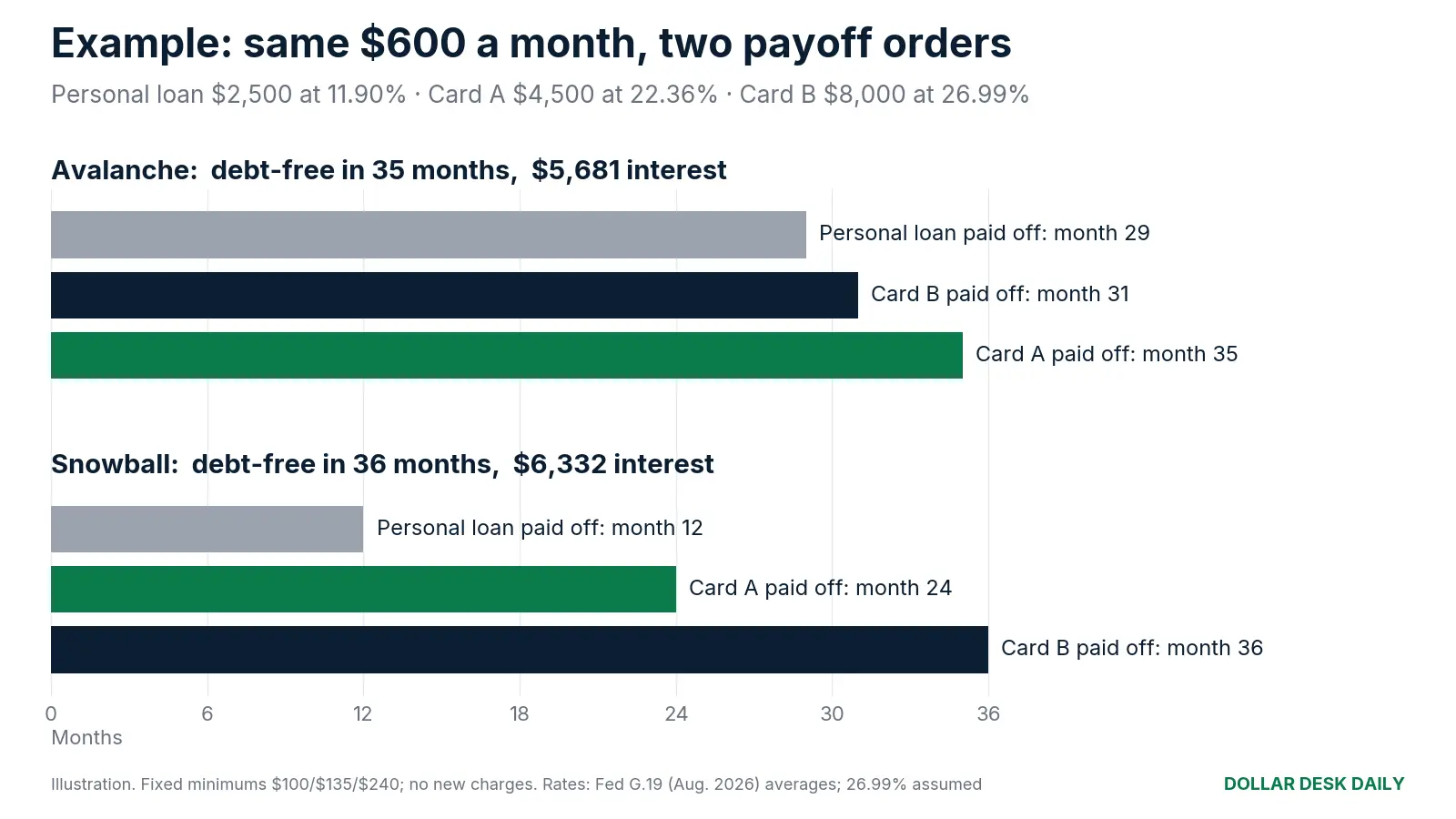
- In our $15,000 example paid at $600 a month, the avalanche method finished in 35 months with $5,680.61 in interest, versus 36 months and $6,331.56 for the snowball.
- The snowball paid off its first debt in month 12, while the first debt to disappear under the avalanche was gone only in month 29.
- Either method beat paying only the $475 in minimums, which in the same example took 63 months and cost $9,931.16 in interest.
In this article
The debt avalanche pays off your highest-interest debt first, and the debt snowball pays off your smallest balance first. In our month-by-month example with three debts and $600 a month, the avalanche cost $650.95 less in interest and finished one month sooner, while the snowball wiped out its first debt 17 months earlier.
Both methods start the same way: you pay the minimum on every debt, put every extra dollar toward one target debt, and roll that payment into the next target once the first is gone. Only the order differs.
The short verdict
- The avalanche fits better if your goal is the lowest total interest and you can keep going for many months without a debt disappearing.
- The snowball fits better if quick wins are what keep you paying month after month.
- Neither fits if you cannot cover your minimums. That calls for a different set of steps, covered below.
The Consumer Financial Protection Bureau (CFPB) frames it the same way: the highest-rate method can save money in the long run, while the snowball shows progress quickly but may cost more.
| Debt avalanche | Debt snowball | |
|---|---|---|
| Extra money goes to | Highest APR first | Smallest balance first |
| First debt paid off (example) | Month 29 | Month 12 |
| Debt-free (example) | Month 35 | Month 36 |
| Total interest (example) | $5,680.61 | $6,331.56 |
| Main strength | Lowest cost | Fast early wins |
How the debt avalanche works
The CFPB calls this the highest interest rate method. You list your debts by APR, the yearly interest rate, from highest to lowest. The extra money goes to the top of the list because that debt costs the most each month.
The downside is patience. If your highest-rate debt is also your biggest, it can take a long time before any balance hits zero. In our example, the avalanche’s first target took 31 months to clear.
How the debt snowball works
You list debts by balance, smallest to largest, regardless of rate. The smallest balance goes first, and each payoff frees its minimum payment to roll into the next debt, so the payment “snowballs.”
The CFPB notes that this method can cost more over time because larger, costlier debts wait their turn. How big that extra cost is depends on your balances and on how far apart your rates are.
What it means for you: a worked example
We ran the same three debts through both methods in a month-by-month calculation written in Python. This is an illustration, not a forecast.
| Example debt | Balance | APR | Minimum payment |
|---|---|---|---|
| Personal loan | $2,500 | 11.90% | $100 |
| Card A | $4,500 | 22.36% | $135 |
| Card B | $8,000 | 26.99% | $240 |
| Total | $15,000 | $475 |
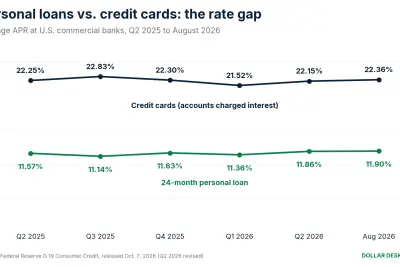
Assumptions: The 11.90% rate is the Federal Reserve’s August 2026 average for 24-month personal loans at banks, and 22.36% is its August 2026 average for credit card accounts charged interest. The 26.99% rate is our assumption for a higher-rate card. The total budget is $600 a month, so $125 a month is extra. Each month, interest equals the balance × APR ÷ 12, rounded to the cent; then every open debt gets its minimum, held at the starting amount; then the rest goes to the target. No new charges, fees or rate changes.
Month 1: interest adds $24.79 to the loan ($2,500 × 11.90% ÷ 12), $83.85 to Card A and $179.93 to Card B, or $288.57 in all. The avalanche sends the extra $125 to Card B; the snowball sends it to the personal loan.
Results:
| Avalanche | Snowball | Minimums only | |
|---|---|---|---|
| Personal loan paid off | Month 29 | Month 12 | Month 29 |
| Card A paid off | Month 35 | Month 24 | Month 53 |
| Card B paid off | Month 31 | Month 36 | Month 63 |
| Total interest | $5,680.61 | $6,331.56 | $9,931.16 |
Under the avalanche, the loan disappeared in month 29 on its minimum payments alone. Card B, the avalanche’s target, was gone in month 31. Under the snowball, Card B ran until the end and generated $4,763.95 in interest, compared with $3,143.53 under the avalanche. That extra $1,620.42 outweighed what the snowball saved on the other two debts ($744.24 on Card A and $225.23 on the loan), leaving the $650.95 net difference.
The bigger lesson is in the last column, which pays only the three minimums, $475 a month, and never rolls a paid-off minimum into another debt. Adding $125 a month above the minimums, in either order, saved more than $3,500 in interest and more than two years compared with paying only the minimums. For how card interest builds month to month, see how credit card interest works.
How to decide
Start by listing every debt with its balance, APR and minimum payment. The CFPB offers a debt reduction worksheet for this. Then check three things:
- How far apart are the rates? A wide spread, such as 11.90% versus 26.99% in our example, makes the avalanche’s savings larger.
- Is your highest-rate debt also your largest? If so, the avalanche’s first payoff will be slow, which is when the snowball’s early wins matter most.
- Can you stick with it? The order only pays off if the extra payment keeps going every month.
Mistakes that undo either method
- Adding new charges. Our example assumes no new spending. The CFPB says many people do not succeed in paying off debt by taking on more debt unless they lower their spending.
- Missing a minimum. If a card payment is not received within 60 days of the due date, the issuer can raise the rate on your existing balance, according to the CFPB. That would make the math above worse under either order.
- Letting freed-up money drift. When a debt is paid off, the order only works if its minimum moves to the next debt instead of back into the monthly budget.
CFPB resources if the minimums are too much
Both methods assume you can pay every minimum. If you cannot, the CFPB suggests acting right away:
- Contacting the card company. The CFPB says to explain why you cannot pay, how much you can afford, and when you could restart normal payments. Some creditors may lower payments, waive fees or cut the rate.
- Nonprofit credit counseling. Counselors can help with a budget and may organize a debt management plan, which typically lowers payments and interest charges. The CFPB says to ask about fees first and to confirm your creditors accepted the plan before sending money.
- Consolidation. A consolidation loan or balance transfer may offer a lower rate, but promotional rates can expire, transfer fees are likely, and a longer term can cost more overall, the CFPB warns.
- Debt settlement red flags. A debt settlement company may not collect fees before it settles a debt. Promises to make debt disappear, or advice to stop paying, are warning signs.
- Rights with collectors. The CFPB’s debt collection pages explain what a collector must tell you and how to dispute a debt.
The final step is the same for both methods: once the order is chosen, the plan works only if the extra payment goes out every month and each paid-off debt’s minimum moves to the next one on the list.
Sources
- Consumer Financial Protection Bureau — How to reduce your debt (archived blog post)
- Federal Reserve — G.19 Consumer Credit (released Oct. 7, 2026)
- Consumer Financial Protection Bureau — What should I do if I can’t pay my credit card bills?
- Consumer Financial Protection Bureau — What is credit counseling?
- Consumer Financial Protection Bureau — What do I need to know about consolidating my credit card debt?
- Consumer Financial Protection Bureau — When can my credit card company increase my interest rate?
- Consumer Financial Protection Bureau — Debt collection