2026 Tax Brackets and Standard Deduction for Returns Filed in 2027
For tax year 2026, the standard deduction is $16,100 for singles and $32,200 for couples. See every IRS bracket and what the same pay costs in tax vs. 2025.
Key Takeaways
- For tax year 2026, the IRS set the standard deduction at $16,100 for single filers, $32,200 for married couples filing jointly and $24,150 for heads of household.
- The 37% top rate applies to 2026 taxable income above $640,600 for single filers and $768,700 for married couples filing jointly, according to the IRS.
- In an illustration, a single filer earning $70,000 in both years owes about $6,570 in federal income tax for 2026, down $279 from 2025, because the deduction and brackets rose with inflation.
In this article
The federal income tax return you file in early 2027 covers tax year 2026, and the IRS has already set its numbers. The standard deduction is $16,100 for single filers, $32,200 for married couples filing jointly and $24,150 for heads of household, and the seven tax rates run from 10% to 37%, according to the IRS release of Oct. 9, 2025 (IR-2025-103).
Those figures replace the 2025 amounts and reflect both the annual inflation adjustment and changes made by the 2025 tax law the IRS calls the One, Big, Beautiful Bill. As of Nov. 4, 2026, the IRS newsroom had not yet published its adjustments for tax year 2027, so the 2026 tables below are the ones that apply to the next filing season.
What are the 2026 federal tax brackets?
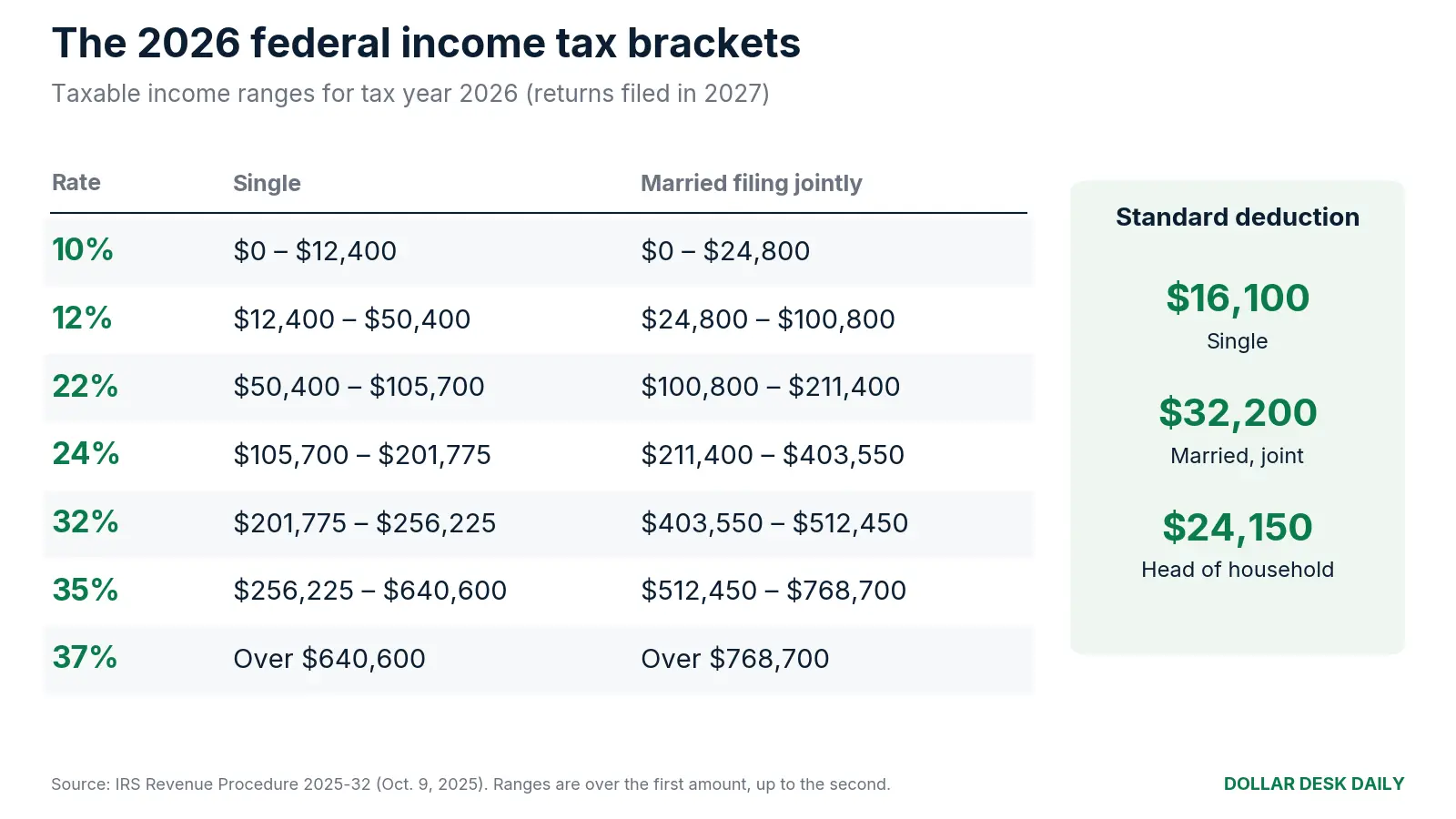
A tax bracket is a slice of taxable income (income after deductions) that is taxed at one rate. The table shows where each 2026 slice starts and ends, taken from the IRS tax rate tables in Revenue Procedure 2025-32. Each range means over the first number, up to the second.
| Rate | Single | Married filing jointly | Head of household |
|---|---|---|---|
| 10% | $0 – $12,400 | $0 – $24,800 | $0 – $17,700 |
| 12% | $12,400 – $50,400 | $24,800 – $100,800 | $17,700 – $67,450 |
| 22% | $50,400 – $105,700 | $100,800 – $211,400 | $67,450 – $105,700 |
| 24% | $105,700 – $201,775 | $211,400 – $403,550 | $105,700 – $201,750 |
| 32% | $201,775 – $256,225 | $403,550 – $512,450 | $201,750 – $256,200 |
| 35% | $256,225 – $640,600 | $512,450 – $768,700 | $256,200 – $640,600 |
| 37% | Over $640,600 | Over $768,700 | Over $640,600 |
Married people filing separately use the single brackets up to $256,225, but their 35% bracket ends at $384,350, and income above that is taxed at 37%.
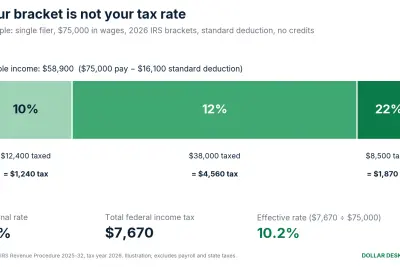
Each rate applies only to the income inside its slice. That is why a higher bracket never takes a bigger share of the dollars you already earned. Our explainer on marginal vs. effective tax rates walks through that math.
How much is the 2026 standard deduction?
The standard deduction is a flat amount you subtract from income before tax is figured, if you do not itemize. Here is how 2026 compares with 2025, according to the IRS.
| Filing status | Tax year 2025 | Tax year 2026 | Change |
|---|---|---|---|
| Single or married filing separately | $15,750 | $16,100 | +$350 |
| Married filing jointly | $31,500 | $32,200 | +$700 |
| Head of household | $23,625 | $24,150 | +$525 |
People who are 65 or older, or blind, add an extra amount. For 2026 it is $1,650, or $2,050 if the person is unmarried and not a surviving spouse, according to Revenue Procedure 2025-32. The 2025 amounts were $1,600 and $2,000, according to IRS training material.
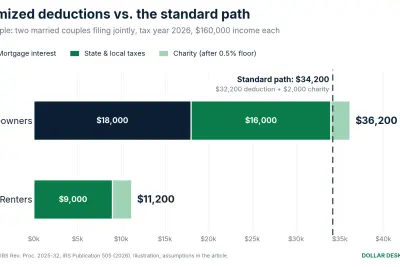
Separately, the 2025 law created a deduction of up to $6,000 for each person age 65 or older, for tax years 2025 through 2028. It phases out above $75,000 of modified adjusted gross income ($150,000 for joint filers), and it is available whether you itemize or not, the IRS says. Whether itemizing beats the flat amount is covered in our guide to the standard deduction vs. itemizing.
What it means for you
Because the brackets and the deduction both moved up, the same income produces a slightly smaller tax bill for 2026. These two illustrations assume wage income only, the standard deduction, no other deductions and no credits. They use the IRS rate schedules; your actual return can differ.
Single filer earning $70,000 in both years
- 2025: $70,000 − $15,750 = $54,250 taxable. Tax = 10% × $11,925 ($1,192.50) + 12% × $36,550 ($4,386) + 22% × $5,775 ($1,270.50) = $6,849.
- 2026: $70,000 − $16,100 = $53,900 taxable. Tax = 10% × $12,400 ($1,240) + 12% × $38,000 ($4,560) + 22% × $3,500 ($770) = $6,570.
- Difference: $279 less for 2026.
Married couple filing jointly earning $150,000 in both years
- 2025: $150,000 − $31,500 = $118,500 taxable. Tax = $2,385 + $8,772 (12% × $73,100) + $4,741 (22% × $21,550) = $15,898.
- 2026: $150,000 − $32,200 = $117,800 taxable. Tax = $2,480 + $9,120 (12% × $76,000) + $3,740 (22% × $17,000) = $15,340.
- Difference: $558 less for 2026.
The couple saves more mainly because the top of the joint 12% bracket rose from $96,950 to $100,800, so $3,850 more of their income is taxed at 12% instead of 22%. If your pay rose in 2026 roughly in step with inflation, your tax may look similar to last year’s rather than lower.
Other 2026 numbers worth knowing
The IRS adjusted more than 60 provisions for tax year 2026. These are the ones most households run into:
| Item (tax year 2026) | Amount |
|---|---|
| Maximum child tax credit, per child | $2,200 (up to $1,700 refundable) |
| Maximum Earned Income Tax Credit, 3+ children | $8,231 (2025: $8,046) |
| Health FSA salary-reduction limit | $3,400 (up $100) |
| Annual gift tax exclusion | $19,000 (unchanged) |
| Maximum adoption credit | $17,670 (2025: $17,280) |
| Estate tax basic exclusion | $15,000,000 (2025: $13,990,000) |
| AMT exemption, single / joint | $90,100 / $140,200 |
The alternative minimum tax (AMT), a separate, parallel way of figuring tax, begins to phase out its exemption at $500,000 for single filers and $1,000,000 for joint filers in 2026.
Common misreadings of the bracket table
“My bracket is my tax rate.” Your bracket is the rate on your last dollar. The single filer above is in the 22% bracket but pays about 9.4% of gross pay ($6,570 ÷ $70,000).
“The bracket thresholds are salary limits.” They apply to taxable income, after the standard deduction or itemized deductions. A single filer with $60,000 of wages and the standard deduction has $43,900 of taxable income, which sits in the 12% bracket.
“These are the 2027 brackets.” They are for income earned during 2026. The IRS publishes each year’s adjustments separately, and the 2027 figures had not been released as of Nov. 4, 2026.
What to watch next
- The IRS 2027 inflation adjustments: the release will set brackets and the standard deduction for income earned in 2027. The 2026 numbers came out on Oct. 9, 2025.
- Your withholding: the IRS says its Tax Withholding Estimator reflects the 2025 law changes, which can help you check whether your paycheck withholding matches the 2026 rules before the year ends.
Sources
- IRS — IRS releases tax inflation adjustments for tax year 2026, including amendments from the One, Big, Beautiful Bill (IR-2025-103, Oct. 9, 2025)
- IRS — Revenue Procedure 2025-32
- IRS — Federal income tax rates and brackets
- IRS — Working Families Tax Cuts – Individuals and workers
- IRS — IRS Courseware – Link & Learn Taxes (Standard Deduction)
- IRS — News releases for current month