CDs vs. High-Yield Savings vs. Money Market: Which Fits Your Cash?
CDs lock a rate, savings and money market rates float. Compare access, penalties, FDIC coverage and what $10,000 earns in a year at October 2026 averages.
Key Takeaways
- As of the FDIC’s Oct. 19, 2026, update, national average rates were 0.38% on savings, 0.63% on money market accounts and 1.76% on 12-month CDs.
- Savings and money market deposit accounts at FDIC-insured banks and bank CDs are all covered up to $250,000 per depositor, per bank, per ownership category, but money market mutual funds are investments, not deposits.
- A fixed-rate CD’s rate is locked until maturity while savings and money market rates can change, and breaking a CD early costs a penalty that the bank must disclose in advance.
In this article
A CD pays a locked rate in exchange for leaving your money alone, while savings and money market accounts let you withdraw any time but pay a rate that can change. At national averages, the CD has the higher rate right now: 1.76% on a 12-month CD versus 0.38% on savings and 0.63% on money market accounts, according to FDIC figures published Oct. 19, 2026.
A high-yield savings account is a regular savings account that pays well above that 0.38% average. The choice comes down to when you will need the money, whether you want a guaranteed rate, and how much a penalty would hurt.
Which one is better for you?
- A high-yield savings account is better if you need the money soon or don’t know when you’ll need it, such as an emergency fund. There is no penalty to withdraw, but the rate can fall.
- A money market account is better if you want savings that may come with check-writing or a debit card and can keep any required minimum balance.
- A CD is better if you won’t touch the money until a set date and want the rate guaranteed until then. Leaving early costs a penalty.
How the three compare
| Feature | High-yield savings | Money market account | CD |
|---|---|---|---|
| National average rate (FDIC, Oct. 19, 2026) | 0.38% (all savings accounts) | 0.63% | 1.76% (12-month) |
| Rate type | Variable | Variable | Fixed until maturity, unless a variable-rate CD |
| Access | Withdraw any time | Withdraw any time; some limits on checks, card and transfers | Locked until maturity |
| Early-withdrawal penalty | None | None | Yes, disclosed when you open it |
| Deposit insurance | FDIC/NCUA up to $250,000 | FDIC/NCUA up to $250,000 | FDIC/NCUA up to $250,000 |
The FDIC national rate is a deposit-weighted average for all insured banks and credit unions with available data. Savings rates are based on the $2,500 balance tier; money market and CD rates average the $10,000 and $100,000 tiers. The FDIC does not publish a separate average for accounts marketed as “high-yield.”
High-yield savings: flexible, but the rate floats
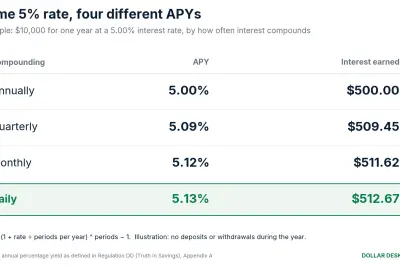
Savings accounts are variable-rate accounts. Under the CFPB’s Regulation DD, which governs deposit account disclosures, a bank must tell you that the rate and annual percentage yield, or APY, may change and how the rate is set, either tied to an index or at the bank’s discretion. (See APY vs. APR.)
In April 2020, the Federal Reserve deleted the six-per-month limit on “convenient” transfers from the savings deposit definition in Regulation D. Banks may stop enforcing that limit, so whether yours still caps withdrawals depends on your account agreement.
The trade-off is rate risk. A bank that changes its rate at its own discretion must disclose that the rate may change at any time, under Regulation DD. For context, the Fed held its benchmark range at 3.75% to 4% on Oct. 28, 2026, and the effective federal funds rate was 3.88% on Oct. 29. More detail is in our guide to high-yield savings accounts.
Money market accounts: savings with a few checking features
A money market account is a deposit account at a bank or credit union, according to the CFPB. These accounts tend to pay more than other savings accounts; the national averages are 0.63% versus 0.38%. They often limit transactions by check, debit card or electronic transfer, while ATM, in-person, mail and phone withdrawals are usually unlimited. Some require a minimum deposit.
Do not confuse it with a money market mutual fund. The CFPB says a money market fund is an investment, not a savings or checking account, even if it offers check-writing. FDIC insurance does not cover mutual funds.
CDs: a locked rate with a price for leaving early
With a certificate of deposit, you agree to leave your money in the account for a set term, and withdrawing early means paying a penalty, the CFPB says. Under Regulation DD, the bank must tell you up front whether a penalty applies and how it is calculated. Penalties can be a dollar amount, a number of days’ interest, a lower rate on the remaining balance or a clawed-back bonus. The Fed’s Regulation D sets a floor: money withdrawn within six days of the deposit must lose at least seven days’ simple interest.
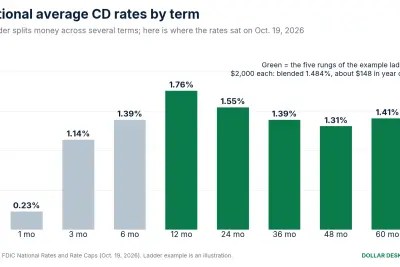
Longer terms do not always pay more. The CFPB notes that a two-year CD generally pays more than a six-month CD, and the averages bear that out, but every longer term averages less than the 12-month CD:
| CD term | National average rate (Oct. 19, 2026) |
|---|---|
| 6 months | 1.39% |
| 12 months | 1.76% |
| 24 months | 1.55% |
| 36 months | 1.39% |
| 60 months | 1.41% |
Watch the maturity date too. A bank or credit union may roll a CD into a new one automatically unless you say otherwise, the CFPB says, and the new rate may be higher or lower. The bank must send a written notice before the CD matures.
What it means for you: ,000 over 12 months
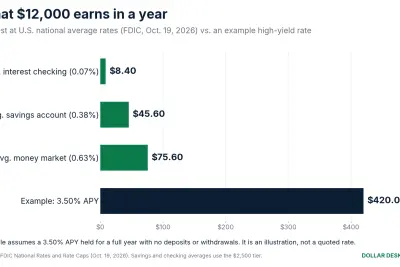
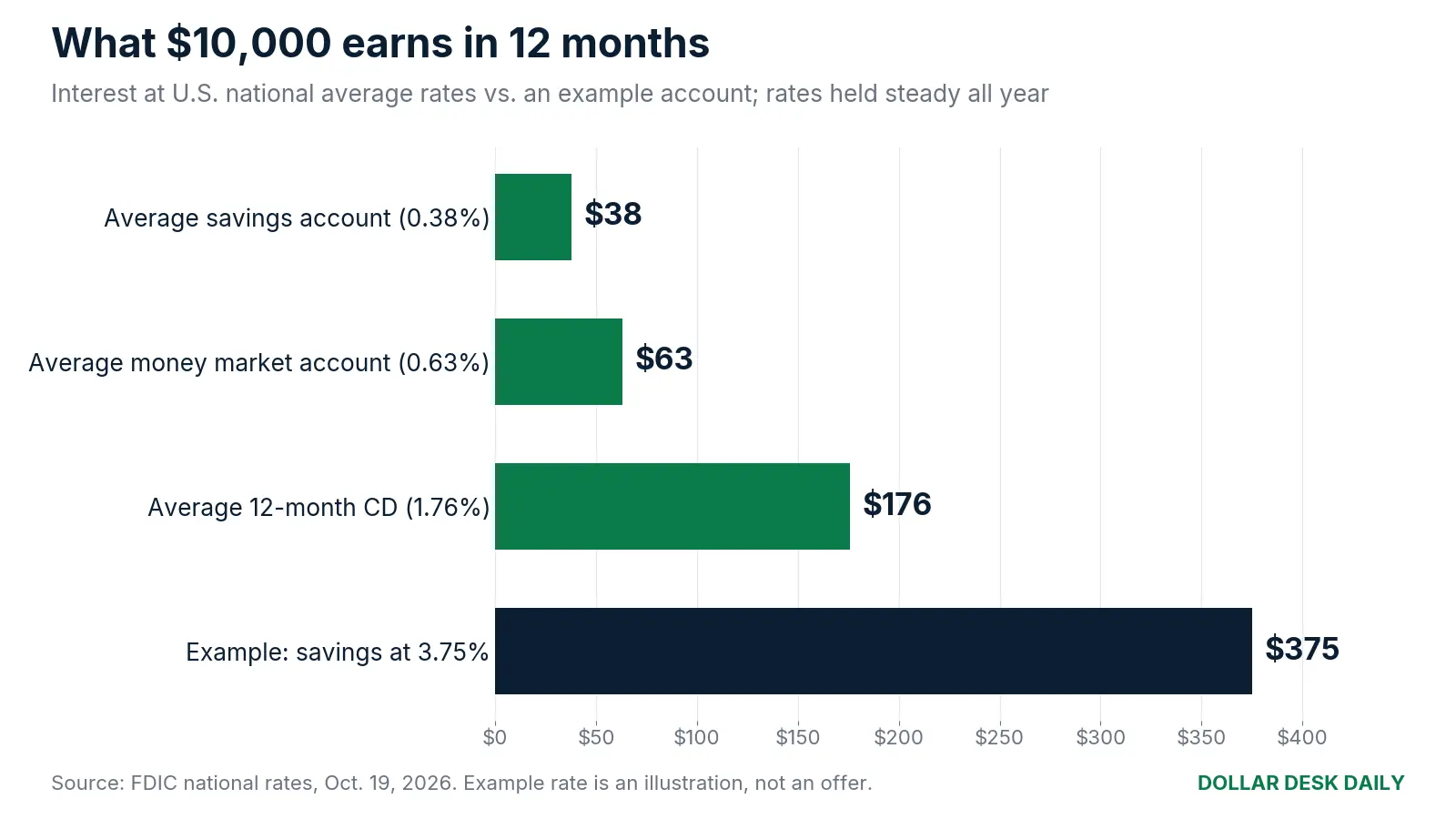
This is an illustration. It assumes a $10,000 deposit, no withdrawals, and that each rate stays the same for the full year. Interest equals the deposit times the APY.
| Where the $10,000 sits | Rate | Interest after 12 months |
|---|---|---|
| Average savings account | 0.38% | $10,000 × 0.0038 = $38 |
| Average money market account | 0.63% | $10,000 × 0.0063 = $63 |
| Average 12-month CD | 1.76% | $10,000 × 0.0176 = $176 |
| Example: savings account paying 3.75% | 3.75% | $10,000 × 0.0375 = $375 |
Two twists show the trade-offs, also as illustrations using simple interest:
- The savings rate drops. If the 3.75% account cut its rate to 3.25% after six months, you would earn about $187.50 in the first half ($10,000 × 3.75% ÷ 2) and $162.50 in the second ($10,000 × 3.25% ÷ 2), or $350 total. A CD’s fixed rate would not change.
- You break a CD early. Say a 12-month CD pays 4.00% and has a penalty of 90 days’ interest (an assumed figure). Cash out after six months and you have earned about $200 ($10,000 × 4.00% ÷ 2). The penalty is about $98.63 ($10,000 × 4.00% × 90 ÷ 365), leaving roughly $101, less than the $187.50 the 3.75% savings account would have paid over the same six months.
Is your money insured in all three?
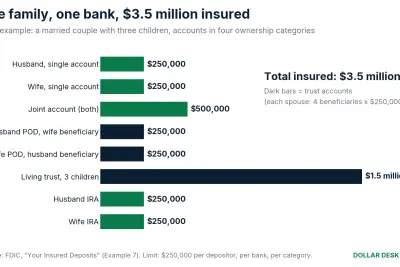
Yes, at an insured institution. The FDIC covers savings accounts, money market deposit accounts and CDs up to $250,000 per depositor, per FDIC-insured bank, per ownership category. CDs and money market accounts at credit unions are insured up to $250,000 by the National Credit Union Administration, according to the CFPB. Our FDIC insurance explainer shows how ownership categories work.
How to decide
- Date the money. Cash you may need without warning fits savings or money market accounts; cash with a known spending date can match a CD term.
- Compare the APY to the 0.38% savings average and the 1.76% 12-month CD average.
- Read the CD penalty disclosure and work out what an early exit would cost in dollars.
- Check the account type. Confirm it is a deposit at an FDIC- or NCUA-insured institution, not a money market fund.
- Mark the maturity date so a CD does not renew at a rate you did not choose.
Sources
- FDIC — National Rates and Rate Caps (as of Oct. 19, 2026)
- FDIC — Understanding Deposit Insurance
- FDIC — Deposit Insurance FAQs
- Federal Reserve — Federal Reserve Board announces interim final rule to delete the six-per-month limit on convenient transfers from the “savings deposit” definition in Regulation D (April 24, 2020)
- Federal Reserve — Compliance Guide to Small Entities: Regulation D, Reserve Requirements of Depository Institutions
- Federal Reserve — FOMC statement, October 28, 2026
- Federal Reserve — H.15 Selected Interest Rates (released Oct. 30, 2026)
- CFPB — § 1030.4 Account disclosures (Regulation DD)
- CFPB — What is a certificate of deposit (CD)?
- CFPB — What is a certificate of deposit (CD) rollover or renewal?
- CFPB — The interest rate offered for CDs (certificates of deposit) is low. Is there anything I can do about that?
- CFPB — What is a money market account?