How to Build an Emergency Fund on a Tight Budget, Step by Step
37% of U.S. adults wouldn’t cover a $400 emergency with cash, a Fed survey found. A step-by-step plan to build an emergency fund from $120 a month, with math.
Key Takeaways
- In the Federal Reserve’s survey of nearly 13,000 adults taken in October 2025, 63% said they would cover a $400 emergency expense with cash or its equivalent, and 12% said they could not pay it at all.
- Fifty-nine percent of adults had a major unexpected expense in the prior 12 months, and the median major car repair, house repair or medical bill cost $1,000 to $1,999.
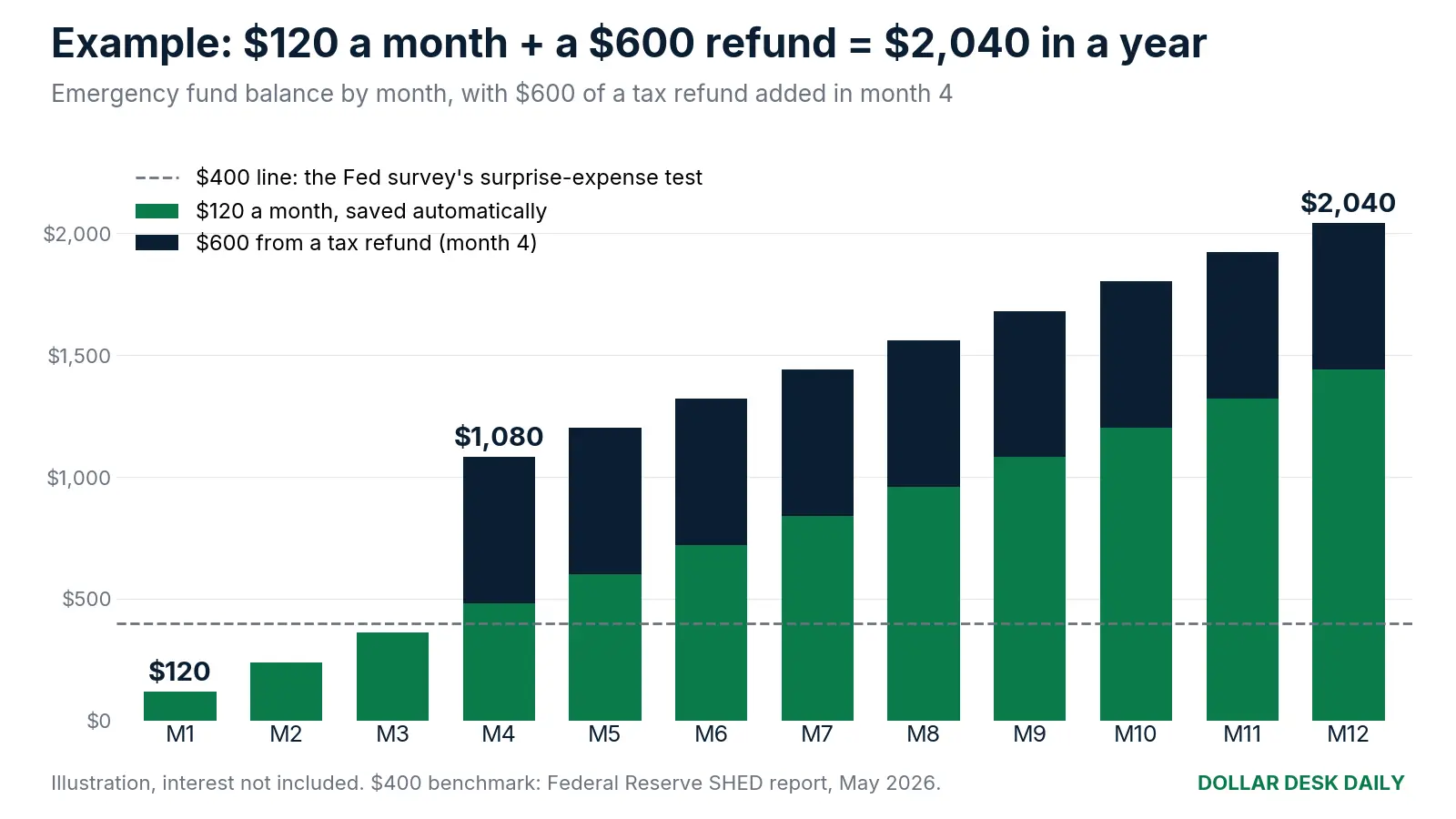
- In an illustration, saving $120 a month and $600 of a tax refund builds an emergency fund of $2,040 in 12 months, passing $1,000 in month 4.
In this article
- How much cushion do Americans have?
- Step 1: Set a first goal you can reach
- Step 2: Find the money in your cash flow
- Step 3: Make the saving automatic
- Step 4: Put windfalls to work
- Step 5: Keep it safe, separate and earning something
- What it means for you: a 12-month example
- Your emergency fund checklist
- Mistakes to avoid
You can build an emergency fund on a tight budget by starting with a small, specific goal, moving a fixed amount into savings automatically, and adding windfalls like a tax refund. The need is real: 37% of U.S. adults would not have covered a surprise $400 expense entirely with cash or its equivalent, according to the Federal Reserve’s latest survey of household finances, taken in October 2025 and published May 13, 2026.
This guide is for anyone living paycheck to paycheck or with income that changes month to month. The Consumer Financial Protection Bureau (CFPB) says even a small amount set aside can provide some financial security.
How much cushion do Americans have?
The Fed’s Survey of Household Economics and Decisionmaking (SHED) asked nearly 13,000 adults about their finances. Sixty-three percent said they would pay a hypothetical $400 emergency using only cash, savings or a credit card paid off at the next statement. That share was unchanged from the previous three years but down from 68% in 2021. Twelve percent said they could not pay it by any means.
The survey also asked the largest emergency expense people could handle right now using only savings:
| Largest expense you could cover with savings | Share of adults (2025) |
|---|---|
| Less than $100 | 18% |
| $100–$499 | 12% |
| $500–$999 | 9% |
| $1,000–$1,999 | 11% |
| $2,000–$4,999 | 12% |
| $5,000 or more | 38% |
Emergencies are common. Fifty-nine percent of adults had a major unexpected expense in the prior 12 months. The most frequent was a major car repair or replacement (30%), followed by house or appliance repairs (22%) and major medical bills (21%). For each of those three, the median cost was $1,000 to $1,999 among people who knew the amount.
Step 1: Set a first goal you can reach
An emergency fund is cash set aside only for unplanned costs, such as car repairs, medical bills or a loss of income, the CFPB says. It suggests basing your goal on the surprise expenses you have actually had and what they cost.
A common longer-term yardstick is three months of expenses: 55% of adults said they had a rainy day fund that large in 2025, according to the Fed. The CFPB says a specific goal can help you stay motivated, and to set the next one once you reach it. For example, based on the survey figures above, a first goal of $1,000 would cover a typical phone or computer repair (median $500 to $999), and a second goal of $2,000 would cover a typical car, home or medical surprise (median $1,000 to $1,999).
Step 2: Find the money in your cash flow
Cash flow is the timing of money coming in and going out. The CFPB suggests asking creditors such as your landlord, utility or card company to move due dates, and moving a little extra into savings in weeks when you have more.
In the Fed survey, 86% of adults who always had money left over at the end of the month had three months of expenses saved, compared with 13% of those who never did.
Step 3: Make the saving automatic
The CFPB calls automatic saving one of the easiest ways to stay consistent. Options include:
- A recurring transfer from checking to savings on a date you choose; the CFPB’s example times it to payday. Some banks set a minimum transfer amount.
- Split direct deposit, if your employer lets you send part of each paycheck straight to savings.
- Round-ups, where some banks and companies move the change from each purchase into savings. An $87.45 grocery bill would move $0.55.
An automatic transfer that hits when the account is short can trigger an overdraft fee, the CFPB warns.
Step 4: Put windfalls to work
A tax refund is one of the largest checks many households get all year, the CFPB notes, and cash gifts are another chance. As the example below shows, a lump sum speeds things up.
If your income is irregular
The CFPB says automatic transfers and split deposits fit people with consistent income best. It says that for people with a limited ability to save, managing cash flow and saving part of a tax refund are the easiest ways to start, and it points to one-time windfalls as especially useful when income is irregular.
Step 5: Keep it safe, separate and earning something
The CFPB lists three places to keep emergency money: a bank or credit union account, generally considered one of the safest options; a prepaid card; or cash, which can be lost or stolen. It suggests a place where you won’t be tempted to spend the money.
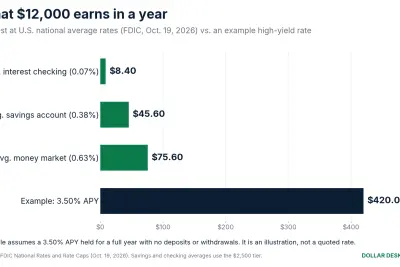
Rates differ by account type. The national average savings account paid 0.38% and money market accounts paid 0.63%, according to the FDIC’s Oct. 19, 2026, figures. Our comparison of CDs, high-yield savings and money market accounts explains the trade-offs, and our FDIC insurance explainer covers how deposits are protected.
What it means for you: a 12-month example
This is an illustration. It assumes someone saves $50 from each of two monthly paychecks ($100), adds $20 a month from round-ups and small spending cuts, and puts $600 of a tax refund into savings in month 4.
| Month | Deposit | Balance |
|---|---|---|
| 1 | $120 | $120 |
| 3 | $120 | $360 |
| 4 | $120 + $600 refund | $1,080 |
| 6 | $120 | $1,320 |
| 9 | $120 | $1,680 |
| 12 | $120 | $2,040 |
The math: $120 × 12 months = $1,440, plus the $600 refund = $2,040. Without the refund, the fund would pass $400 in month 4 ($480) and reach $1,440 by month 12.
Interest adds a little. With each deposit made at the start of the month and interest credited monthly, the balance would earn about $5 over the year at the 0.38% national average, or about $46 in an example account paying 3.75%.
Your emergency fund checklist
| Step | What to do | Done when |
|---|---|---|
| 1 | Pick a first goal from your past surprise costs | You have a dollar target, such as $1,000 |
| 2 | Map paydays and due dates | You know which week has room to save |
| 3 | Automate a transfer or split deposit | Money moves without you acting |
| 4 | Plan for your tax refund or other windfall | You have decided the share to save |
| 5 | Open or name a separate account | The fund is apart from spending money |
| 6 | Write down what counts as an emergency | You can tell a surprise from a want |
Mistakes to avoid
- Turning an emergency into debt. In the Fed survey, 15% of adults said they would put a $400 expense on a credit card and pay it off over time. Card accounts charged interest averaged 22.36% in August 2026, according to the Fed’s G.19 release. At that rate, $400 costs about $7.45 a month in interest ($400 × 22.36% ÷ 12).
- Setting a transfer you can’t sustain. The CFPB notes you can start small and adjust the amount over time.
- Not defining an emergency. The CFPB suggests setting your own guidelines for what counts and applying them consistently.
- Never using it. The CFPB says not to be afraid to use the fund when you need it; if you spend it down, the final step is to rebuild it.
Sources
- Federal Reserve — Economic Well-Being of U.S. Households in 2025: Executive Summary (May 13, 2026)
- Federal Reserve — Economic Well-Being of U.S. Households in 2025: Savings and Investments
- Federal Reserve — Economic Well-Being of U.S. Households in 2025: Economic Hardships
- Federal Reserve — Survey of Household Economics and Decisionmaking
- Federal Reserve — G.19 Consumer Credit (released Oct. 7, 2026)
- FDIC — National Rates and Rate Caps (as of Oct. 19, 2026)
- CFPB — An essential guide to building an emergency fund
- CFPB — Looking for an easy way to save money? Make it automatic