High-Yield Savings Accounts: How They Work and What to Compare
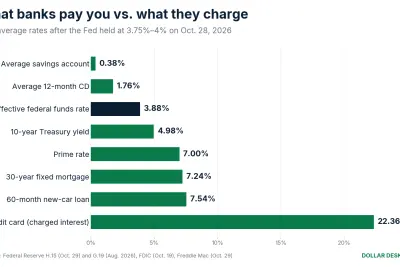
The average savings account paid 0.38% as of Oct. 19, 2026. Here is how high-yield accounts work, why rates differ so much and what to check in the disclosures.
Key Takeaways
- The national average savings account paid 0.38% as of Oct. 19, 2026, according to the FDIC, while the effective federal funds rate was 3.88% on Oct. 29.
- On a variable-rate savings account, federal rules let the bank change the interest rate without advance notice, so an advertised APY is not a promise for the year.
- FDIC insurance covers $250,000 per depositor, per insured bank, per ownership category, and that limit counts accrued interest as well as the money you deposited.
In this article
A high-yield savings account is an insured savings account that pays well above the national average, which was just 0.38% as of Oct. 19, 2026, according to the FDIC. Your money stays available, and it earns more. The trade-off: on a variable-rate account, the bank can change that rate at any time without warning you first.
How a high-yield savings account works
“High-yield” is a marketing label, not a legal category: the definitions in the federal Truth in Savings rules (Regulation DD) do not use the term, so the same rules apply as for any savings account. The bank must disclose the interest rate and the annual percentage yield (APY), the yearly return once compounding is counted. Our APY vs. APR explainer shows how compounding changes the number.
Federal rules also set how interest is paid. Once you meet any minimum balance required to earn interest, the bank must pay the stated rate on the whole balance, not just the part above the minimum. Interest keeps accruing until the day you withdraw the money. Banks can compound daily, monthly, quarterly or on another schedule, but they must tell you which.
Unlike a CD, a savings account has no fixed term. The FDIC notes that savings accounts do not come with checks and that the bank may limit how many withdrawals you make.
Why rates vary so much
Banks set their own savings rates. For a variable-rate account, the disclosures must say how the rate is determined: the index and margin if it is tied to an index, or a statement that changes are at the bank’s discretion. They must also say how often the rate can change and any floor or ceiling.
The Federal Reserve’s rate sets the backdrop, but banks do not have to pass it on. The effective federal funds rate was 3.88% on Oct. 29, 2026, according to the Fed, about 3.5 percentage points above the average savings rate. Our explainer on how Fed rate decisions affect your money covers why.
| Account type | National average rate | FDIC national rate cap |
|---|---|---|
| Interest checking | 0.07% | 4.63% |
| Savings | 0.38% | 4.63% |
| Money market | 0.63% | 4.63% |
| 12-month CD | 1.76% | 6.20% |
Source: FDIC, as of Oct. 19, 2026. Savings and checking averages use the $2,500 balance tier.
The rate cap is a limit the FDIC sets for banks that are less than well capitalized; it does not apply to well-capitalized banks. For savings, it is the higher of the national average plus 0.75 point or the federal funds rate plus 0.75 point. In its CD shopping guide, the FDIC also warns that an advertised rate far above the competition can be a lure to sell uninsured products.
Two account features can make the headline rate misleading:
- Tiers. Some accounts pay different rates at different balances. The bank must disclose an APY for each tier.
- Introductory rates. If a variable-rate account starts with a higher rate for a set time, the APY must blend the teaser rate with the regular rate for the rest of the year. Sign-up bonuses are not counted in the APY.
The rate is variable, and notice is not required
Banks generally must give 30 days’ notice before a change that could lower your yield or otherwise hurt you, such as a new fee. Interest rate changes on variable-rate accounts are exempt from that rule. The rate you open with is a starting point, not a guarantee.
Check the deposit insurance
FDIC insurance covers $250,000 per depositor, per insured bank, for each account ownership category, such as single or joint accounts. The limit counts the money you deposited plus accrued interest. You can confirm a bank is insured with the FDIC’s BankFind tool or by calling 1-877-ASK-FDIC.
Accounts opened through apps need an extra check. The FDIC says nonbank companies “are never FDIC-insured.” Your money qualifies only after the company places it at an insured bank and keeps records showing who owns how much. FDIC insurance does not protect you if the app company itself fails. More detail is in our FDIC insurance explainer.
What it means for you
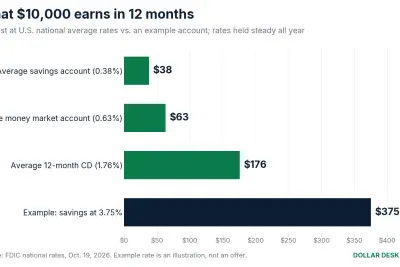
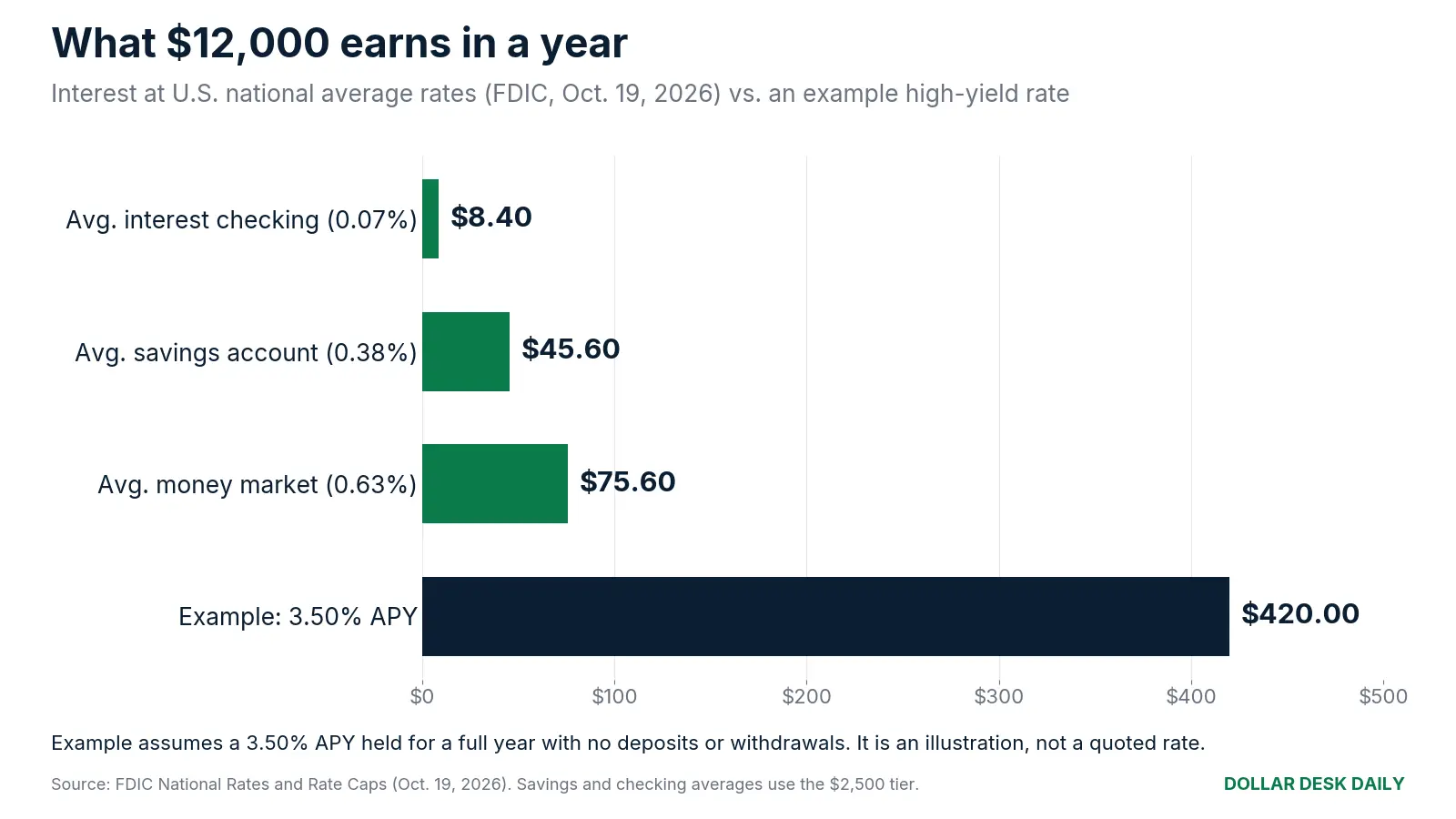
Example 1: what $12,000 earns in a year. This is an illustration. It assumes no deposits or withdrawals, treats each rate as the full-year yield, and assumes no rate changes. The 3.50% figure is hypothetical, not a quote from any bank.
| Where the $12,000 sits | Yearly rate | Interest in one year |
|---|---|---|
| Average interest checking | 0.07% | $8.40 |
| Average savings account | 0.38% | $45.60 |
| Average money market account | 0.63% | $75.60 |
| Example high-yield account | 3.50% | $420.00 |
The math: $12,000 × 3.50% = $420.00, versus $12,000 × 0.38% = $45.60, a difference of $374.40.
Example 2: the rate is cut midyear. Same $12,000, but the bank lowers the APY from 3.50% to 3.00% after six months. The first half earns $12,000 × (1.035^0.5 − 1) = $208.19. The second half earns $12,208.19 × (1.03^0.5 − 1) = $181.77. The total is $389.96, about $30 less than if the rate had held.
Example 3: interest can push you over the limit. You hold $245,000 in a single-owner account at one bank and earn 3.50% for a year. Interest of $8,575 brings the balance to $253,575, so $3,575 sits above the $250,000 limit for that ownership category, assuming no other single accounts at that bank.
Common mistakes
- Comparing interest rates instead of APYs. APY is the figure that includes compounding.
- Treating a teaser rate as permanent. Check how long it lasts and what it becomes.
- Assuming an app is a bank. Find out which insured bank holds the money.
- Ignoring the minimum balance. If your balance drops below it, the bank may pay no interest for those days or that period.
What to compare before you open one
Read the account disclosures, which the Truth in Savings rules require banks to give you, and look for:
- The APY at your balance, and whether tiers apply.
- Whether the rate is variable, how it is set and how often it can change.
- Any introductory rate and when it ends.
- Fees and the minimum balance to earn interest or avoid fees.
- How often interest compounds and is credited.
- Withdrawal limits.
- The name of the FDIC-insured bank holding your deposit, checked in BankFind.
If you are deciding where an emergency fund should live, our comparison of CDs, high-yield savings and money market accounts lays out the trade-offs between them.
Sources
- FDIC — National Rates and Rate Caps (as of Oct. 19, 2026)
- Federal Reserve — H.15 Selected Interest Rates (released Oct. 30, 2026)
- FDIC — Deposit Accounts
- FDIC — Saving for the Unexpected and Your Future
- FDIC — Deposit Insurance At A Glance
- FDIC — Understanding Deposit Insurance
- FDIC — Deposit Insurance FAQs
- FDIC — Banking With Third-Party Apps
- FDIC — Shopping for a Certificate of Deposit?
- CFPB — Regulation DD § 1030.2 Definitions
- CFPB — Regulation DD § 1030.4 Account disclosures
- CFPB — Regulation DD § 1030.5 Subsequent disclosures
- CFPB — Regulation DD § 1030.7 Payment of interest
- CFPB — Regulation DD Appendix A, Annual Percentage Yield Calculation