APY vs. APR: What’s the Difference and Why Compounding Matters
APY shows what savings earn with compounding; APR shows the yearly cost of borrowing. See how one 5% rate yields four APYs, and what a card’s 22.36% APR costs.
Key Takeaways
- APY is the yearly yield on a deposit account including compounding, set out in the Truth in Savings rules; APR is the yearly cost of credit, set out in the Truth in Lending rules.
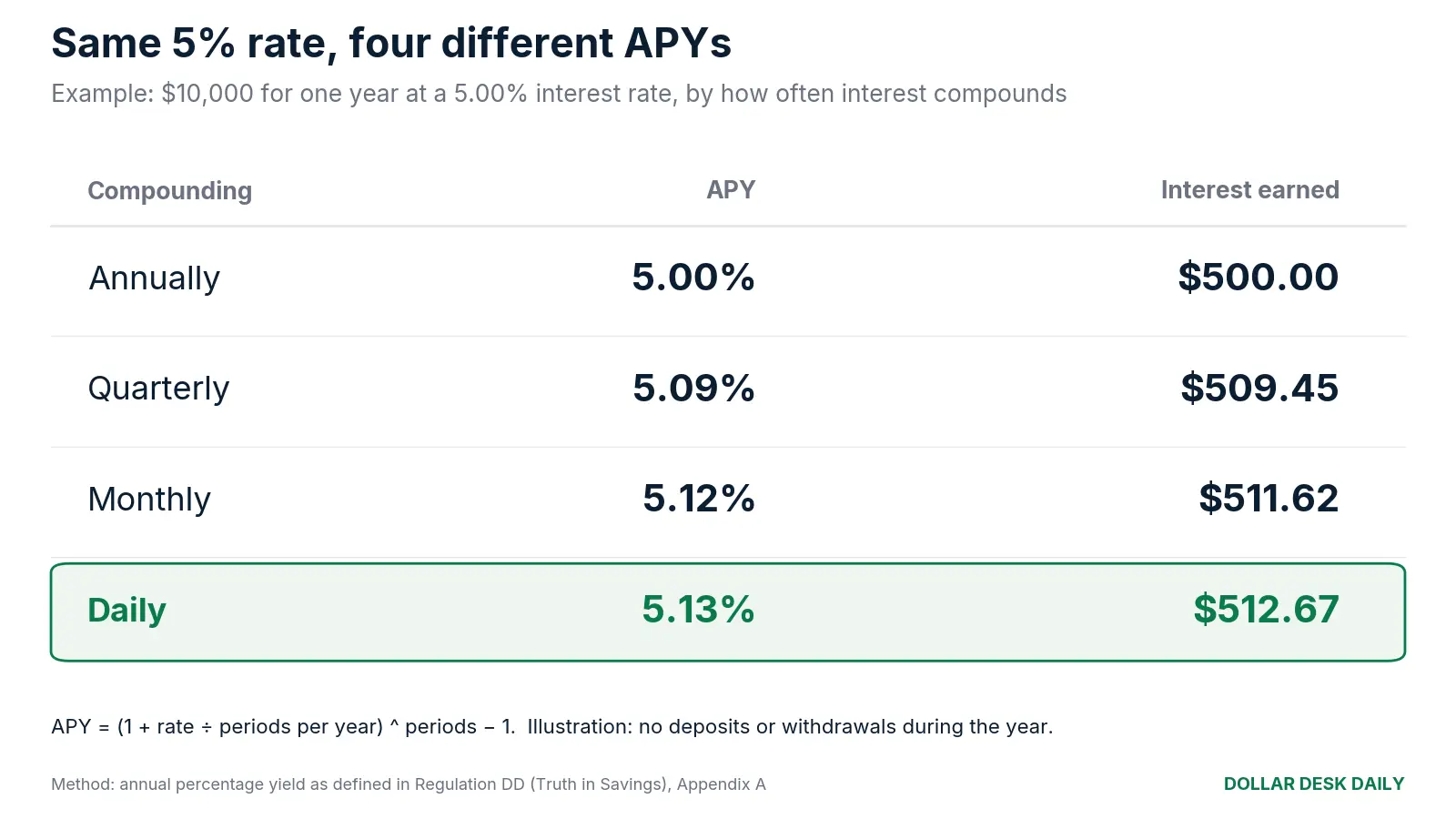
- In an example, a 5.00% interest rate on $10,000 earns $500.00 in a year compounded annually and $512.67 compounded daily, an APY of 5.13%.
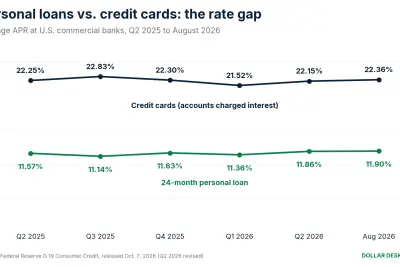
- A credit card APR of 22.36%, the Fed’s August 2026 average for accounts charged interest, works out to about 25.05% a year if interest compounds daily on an unpaid balance.
In this article
APY and APR both express interest as a yearly percentage, but they answer different questions. The annual percentage yield (APY) shows what a deposit account earns in a year once compounding is counted. The annual percentage rate (APR) shows the yearly cost of borrowing. In a simple example, a 5.00% interest rate compounded daily produces a 5.13% APY.
Compounding means earning interest on interest: each time interest is added to the balance, the next round of interest is figured on a bigger amount. It works for you in a savings account and against you on a credit card balance.
APY: what your savings earn
Federal Truth in Savings rules, known as Regulation DD, define APY as a percentage rate reflecting the total interest paid on an account, based on the interest rate and how often it compounds over 365 days. The plain “interest rate,” by contrast, “does not reflect compounding.”
Banks must calculate APY with a set formula: APY = 100 × [(1 + Interest ÷ Principal)^(365 ÷ Days in term) − 1]. The formula assumes your money stays on deposit for the full term with no withdrawals. It leaves out sign-up bonuses. On a variable-rate account, it uses the rate in effect when you open the account and assumes that rate does not change, so the real yield can turn out higher or lower.
APR: what borrowing costs
Under the Truth in Lending rules, Regulation Z, APR is “a measure of the cost of credit, expressed as a yearly rate.” What goes into it depends on the product.
- Loans: For a car loan, APR is the interest rate plus fees such as origination charges, according to the Consumer Financial Protection Bureau (CFPB). For a mortgage, it also reflects points and broker fees, so it is usually higher than the interest rate.
- Credit cards: The interest rate is stated as a yearly APR. Regulation Z has card issuers compute it by multiplying the periodic rate by the number of periods in a year, so the APR itself does not show compounding. Some issuers apply a daily periodic rate, the APR divided by 360 or 365, and add each day’s interest to the balance, which means interest compounds daily, according to the CFPB.
Two laws, two numbers
| APY | APR | |
|---|---|---|
| Used for | Savings, CDs, money market and interest checking | Mortgages, car loans, personal loans, credit cards |
| Federal rule | Truth in Savings Act, Regulation DD | Truth in Lending Act, Regulation Z |
| Stated purpose | Let consumers make “meaningful comparisons” among banks | “Promote the informed use of consumer credit” |
| What it adds to the base rate | Compounding | Certain fees on loans; on cards, the periodic rate annualized |
| Higher number is better for you? | Yes | No |
Example 1: same rate, different compounding
This is an illustration. It assumes $10,000 deposited for one year at a 5.00% interest rate, with no deposits or withdrawals. With n compounding periods a year, APY = (1 + 0.05 ÷ n)^n − 1.
| Compounding | Periods per year | APY | Interest on $10,000 |
|---|---|---|---|
| Annually | 1 | 5.00% | $500.00 |
| Quarterly | 4 | 5.09% | $509.45 |
| Monthly | 12 | 5.12% | $511.62 |
| Daily | 365 | 5.13% | $512.67 |
The daily math: (1 + 0.05 ÷ 365)^365 − 1 = 0.05127, or 5.13%. On $10,000 that is $512.67, which is $12.67 more than annual compounding.
That gap is real, but the rate matters more. A 5.25% rate compounded once a year earns $525.00, more than 5.00% compounded daily. This is why comparing APYs works: the APY already folds in compounding, so a higher APY means more interest for the same balance and term.
Example 2: the card APR versus what you pay
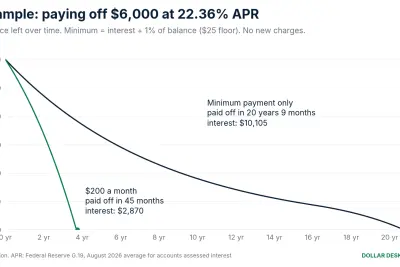
Credit card accounts charged interest averaged a 22.36% APR in August 2026, according to the Federal Reserve. This is an illustration that assumes a $3,000 balance, no payments and no new charges for a full year, an unrealistic case used only to show the math.
- Daily periodic rate: 22.36% ÷ 365 = 0.0613% a day.
- Without compounding: $3,000 × 22.36% = $670.80 for the year.
- With daily compounding: $3,000 × [(1 + 0.2236 ÷ 365)^365 − 1] = $751.46, an effective yearly rate of about 25.05%.
If the issuer divides by 360 instead, the daily rate is 0.0621% and the effective yearly rate is about 25.44%, or $763.12 on the same balance. The CFPB notes that because interest accrues daily, paying down a balance sooner means less interest when there is no grace period. Our explainer on how credit card interest works walks through a monthly statement.
Common mistakes
Comparing an APY with an APR. One measures what you earn and the other what you pay, so the two cannot be compared directly.
Comparing an interest rate with an APR. The CFPB advises comparing APRs only with other APRs, because a loan’s APR includes fees its interest rate does not.
Comparing APRs across different loan types. The CFPB warns that an adjustable-rate mortgage’s APR does not reflect its maximum rate, and that a home equity line’s APR leaves out fees that a closed-end loan’s APR includes.
Reading “APR” on a savings disclosure as a loan cost. Regulation DD lets banks also call a deposit account’s interest rate an “annual percentage rate.” The APY is still the figure that includes compounding.
How to use each number
When you save, compare APYs for the same balance and term, and check whether the rate is variable. Our guide to high-yield savings accounts lists what else to read in the disclosures.
When you borrow, compare APRs for the same type and length of loan. On a mortgage Loan Estimate, the interest rate is on page 1 under “Loan Terms,” and the APR is on page 3 under “Comparisons.” On a credit card you carry a balance on, multiply the balance by the APR and divide by 12 for a rough monthly interest cost, and remember that daily compounding adds a little more.
Sources
- CFPB — Regulation DD § 1030.2 Definitions
- CFPB — Regulation DD § 1030.1 Authority, purpose, coverage, and effect on state laws
- CFPB — Appendix A to Part 1030, Annual Percentage Yield Calculation
- CFPB — Regulation Z § 1026.1 Authority, purpose, coverage, organization, enforcement, and liability
- CFPB — Regulation Z § 1026.14 Determination of annual percentage rate
- CFPB — Regulation Z § 1026.22 Determination of annual percentage rate
- CFPB — What is the difference between a mortgage interest rate and an APR?
- CFPB — What is the difference between a loan interest rate and the APR?
- CFPB — What is a credit card interest rate? What does APR mean?
- CFPB — What is a “daily periodic rate” on a credit card?
- CFPB — How does my credit card company calculate the amount of interest I owe?
- Federal Reserve — G.19 Consumer Credit (released Oct. 7, 2026)