How to Read Your Credit Report and Dispute an Error, Step by Step
Get free reports from all three bureaus weekly, check each section for errors and file a dispute the bureau must investigate within 30 days under federal law.
Key Takeaways
- You can view your credit report from each of the three nationwide bureaus once a week for free at AnnualCreditReport.com, the only site authorized to fill the free reports federal law guarantees, according to the FTC and CFPB.
- The CFPB lists the errors to look for: wrong identity details, someone else’s accounts mixed into your file, closed accounts shown as open, wrong late-payment dates, duplicate debts, and incorrect balances or credit limits.
- Under the Fair Credit Reporting Act, a bureau must investigate a dispute within 30 days of receiving it, send the dispute to the furnisher within 5 business days, and mail you written results within 5 business days of finishing.
- Accurate negative information cannot be removed by a dispute: most of it can be reported for seven years and bankruptcies for up to 10, and the CFPB warns against paying anyone to ‘repair’ accurate history.
In this article
- Step 1: Order your reports from the official site
- Step 2: Read each section and know what to check
- Step 3: Separate errors from accurate bad news
- Step 4: Dispute with the credit bureau
- Step 5: Dispute with the furnisher too
- What the law requires after you file
- What it means for you: a dispute calendar
- If the result goes against you
- Mistakes to avoid
You can see your credit report from each of the three nationwide bureaus, Equifax, Experian and TransUnion, once a week for free at AnnualCreditReport.com, and if you find a mistake, federal law gives the bureau 30 days after it receives your dispute to investigate. This guide walks through ordering the reports, reading each section, deciding what counts as an error and filing a dispute that holds up.
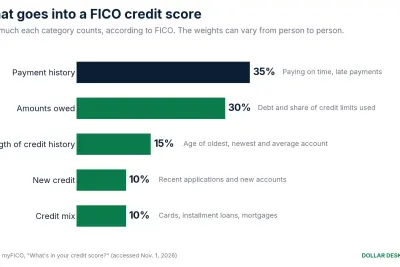
It is for anyone who has not checked their reports lately, is about to apply for a loan, an apartment or a job, or has spotted an account they do not recognize. The Federal Trade Commission says a report can decide whether you get credit and what it costs, and it feeds your credit score, so an error can show up as a lower number.
Step 1: Order your reports from the official site
Federal law requires each bureau to give you a free report once every 12 months, and the bureaus have permanently extended a program that lets you check each report once a week for free, according to the FTC. These are the only ways to order:
- Online at AnnualCreditReport.com, with immediate access.
- By phone at 1-877-322-8228; the report is mailed within 15 days.
- By mail, using the Annual Credit Report Request Form; also mailed within 15 days.
Expect to verify your identity separately for each bureau, and order all three: the FTC says each bureau may collect data from different sources, so the reports may not match. Avoid lookalike sites, too. The FTC warns that imposters use “free report” in their names or misspell the official address, and that neither AnnualCreditReport.com nor the bureaus will email you asking for your Social Security number.
Step 2: Read each section and know what to check
The CFPB describes five kinds of information on a credit report. Compare each with your own records. The last column mixes the CFPB’s error list with its advice to check that the report “contains only items about you.”
| Section | What it lists | What to check for |
|---|---|---|
| Personal information | Names used, addresses, birth date, Social Security number, phones | Wrong name, phone or address; another person’s details |
| Credit accounts | Type, status, limit, balance, payment history, dates opened and closed | Closed accounts shown as open; owner instead of authorized user; wrong late marks or dates; wrong balance or limit |
| Collection items | Missed payments, debts sent to collections, verified overdue child support | The same debt listed twice, possibly under different names |
| Public records | Bankruptcies | Records that are not yours |
| Inquiries | Companies that accessed your report | Inquiries you do not recognize |
Two details are easy to miss because they do not look like a missed payment: the CFPB lists an incorrect balance and an incorrect credit limit as “data management errors.” Compare each card’s reported balance and limit with your latest statement; if the balance is accurate but higher than you expected, see how credit card interest works on a carried balance. If you see accounts you never opened, both agencies point you to IdentityTheft.gov for a recovery plan.
Step 3: Separate errors from accurate bad news
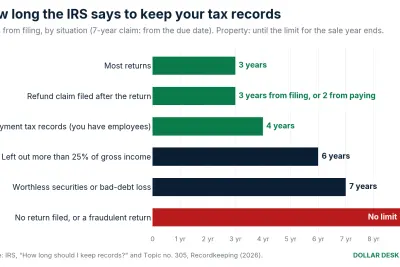
A dispute only works for information that is wrong or incomplete. The FTC says a bureau can report most accurate negative information for seven years and bankruptcy for 10 years. The CFPB’s warning is blunt: no one has the right to remove accurate negative information such as late payments, and you can fix real errors yourself at no cost. If old collections are the problem, a payoff plan such as the avalanche or snowball method addresses the debt itself.
Step 4: Dispute with the credit bureau
Both the bureau and the business that supplied the information, which the CFPB calls the furnisher, must correct wrong or incomplete information for free, the FTC says. File with each bureau whose report shows the error. The CFPB’s checklist for a dispute letter:
- Your complete name, address and phone number, plus the report confirmation number if you have one.
- Each error you want fixed, with the account number, and a clear explanation of why it is wrong.
- A request that the information be removed or corrected.
- A copy of the part of your report with the disputed items circled.
- Copies, not originals, of supporting documents.
The CFPB publishes sample letters for both disputes, and both agencies suggest certified mail with a return receipt and keeping copies of everything. You can also dispute online or by phone: Equifax at (866) 349-5191, Experian at (888) 397-3742 and TransUnion at (800) 916-8800, per the CFPB. Mailing addresses are on your report and on the FTC’s dispute page.
Step 5: Dispute with the furnisher too
Send a second written dispute to the lender, landlord or collector that reported the item, at the dispute address on your report or one the business specifies, the CFPB says. Furnishers generally must investigate and respond within 30 days, and if the information is wrong or cannot be verified, correct it and notify all the credit reporting companies. If a furnisher keeps reporting a disputed item, the bureau must mark it as disputed, according to the FTC.
What the law requires after you file
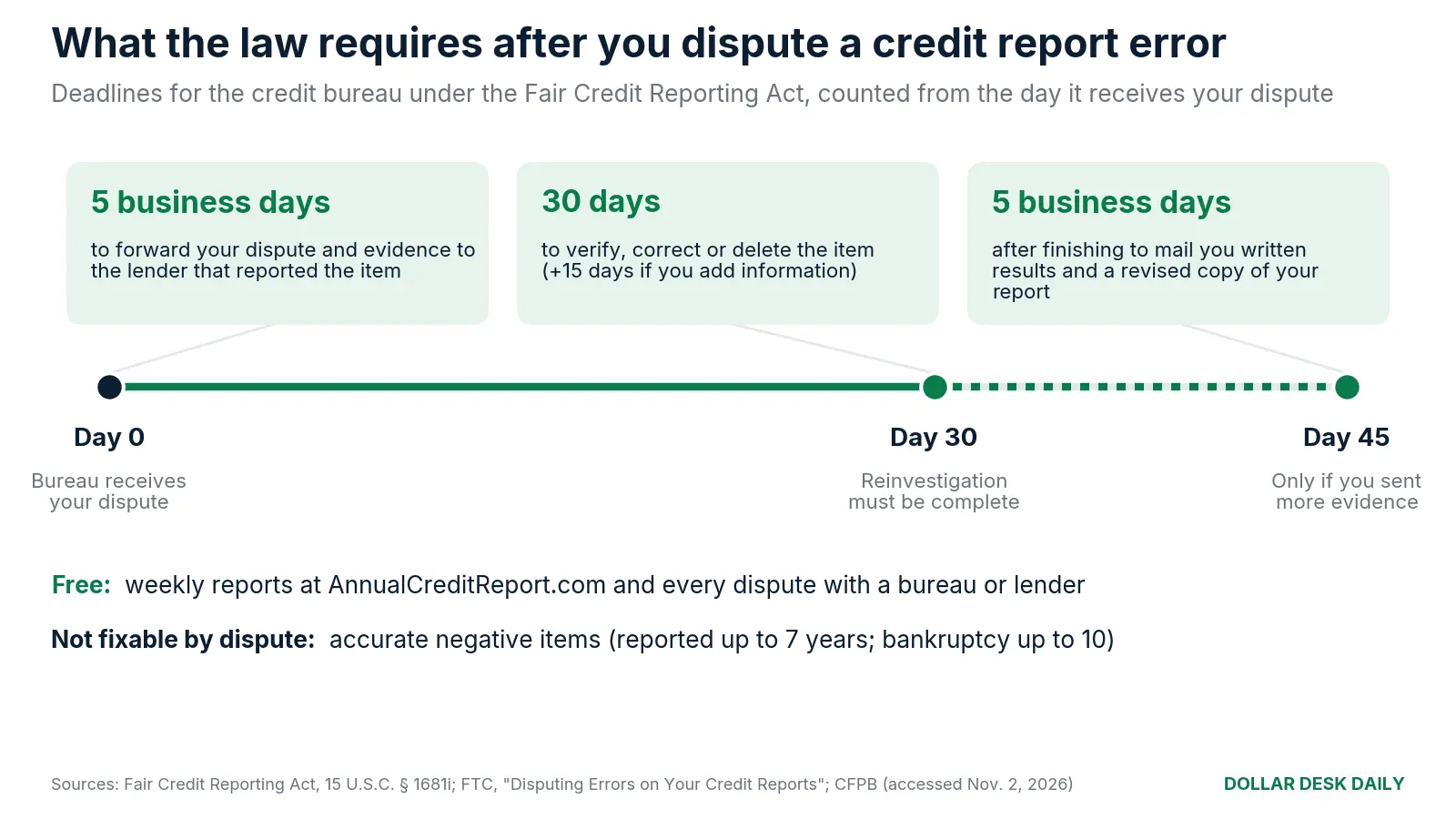
The Fair Credit Reporting Act, at 15 U.S.C. § 1681i, sets the clock. The bureau must verify, correct or delete the item within these deadlines.
| Deadline (FCRA § 1681i) | What happens |
|---|---|
| 5 business days after receiving your dispute | Bureau must forward the dispute and your evidence to the furnisher |
| 30 days after receiving your dispute | Bureau must finish its reinvestigation |
| Up to 15 extra days | Allowed only if you send more relevant information during the 30 days |
| 5 business days after finishing | Bureau must send written results, including a revised copy of your report |
| 5 business days after deciding | If the bureau calls a dispute “frivolous or irrelevant,” it must tell you why |
The results notice must include a report revised after the reinvestigation, and the FTC notes that a free report sent after a change does not count as your annual free report.
What it means for you: a dispute calendar
Here is an illustration of the deadlines on a calendar. Assume a bureau receives your certified letter on Tuesday, Nov. 3, 2026, and count business days as Monday through Friday, ignoring holidays.
- Forward to furnisher: 5 business days after Nov. 3 is Nov. 10.
- Reinvestigation complete: 30 days after Nov. 3 is Dec. 3.
- Written results: 5 business days after Dec. 3 is Dec. 10.
- If you sent extra evidence on Nov. 20, the deadline can stretch 15 days, to Dec. 18.
In this illustration the written results are due about five weeks after the letter arrives, so the timeline is worth knowing before a mortgage or rental application, when a lender or landlord may pull your report.
If the result goes against you
If the reinvestigation does not resolve the dispute, the FCRA lets you file a brief statement of dispute, which the bureau may limit to 100 words if it helps you write a clear summary. Future reports must then note the item as disputed and include your statement or a summary. You can also ask the bureau to tell anyone who got your report in the past six months, or two years for employment, that an item was deleted or is disputed, and you can submit a complaint to the CFPB online or at (855) 411-2372.
Mistakes to avoid
- Disputing with only one bureau when the error appears on two or three reports.
- Sending a vague dispute; the CFPB says a bureau can decline to investigate one that does not say which information is wrong.
- Mailing original documents instead of copies.
- Expecting a dispute to erase accurate late payments; it cannot.
Once the results arrive, pull a fresh free report from the same bureau at AnnualCreditReport.com and confirm the item was corrected or removed. If it was not, check that it now carries a dispute notice and decide whether to add your statement.
Sources
- Federal Trade Commission — Free Credit Reports (June 2026)
- Federal Trade Commission — Disputing Errors on Your Credit Reports (April 2024)
- CFPB — How do I dispute an error on my credit report? (last reviewed Sept. 2, 2026)
- CFPB — How do I get a free copy of my credit reports? (last reviewed Oct. 15, 2026)
- CFPB — What is a credit report? (last reviewed Oct. 29, 2026)
- CFPB — What are common credit report errors that I should look for on my credit report? (last reviewed Sept. 2, 2026)
- CFPB — How long does information stay on my credit report? (last reviewed Sept. 2, 2026)
- CFPB — Sample letters to dispute information on a credit report
- 15 U.S.C. § 1681i — Procedure in case of disputed accuracy (Fair Credit Reporting Act), Cornell Legal Information Institute