How Charitable Donations Reduce Taxes in 2026: New Rules Explained
For 2026, non-itemizers can deduct up to $1,000 of cash gifts ($2,000 joint) and itemizers face a 0.5%-of-AGI floor. See limits, records and a worked example.
Key Takeaways
- Beginning with tax year 2026, people who do not itemize may deduct up to $1,000 of cash gifts to certain qualified organizations, or $2,000 on a joint return, according to the IRS.
- For 2026, itemizers can deduct charitable gifts only to the extent they exceed 0.5% of adjusted gross income, under Section 70425 of Public Law 119-21.
- Any gift of $250 or more needs a written acknowledgment from the charity, and noncash gifts above $500 require Form 8283.
- The qualified charitable distribution limit from an IRA, available from age 70½, is $111,000 per person for 2026, according to IRS Notice 2025-67.
In this article
- How does a charitable gift reduce your tax?
- What changes for 2026?
- How much can you deduct? The AGI limits
- Worked example: what counts for 2026
- What records do you need?
- What about donating appreciated stock?
- What is a qualified charitable distribution?
- How do you check that a charity qualifies?
- Common mistakes
A charitable donation lowers your federal income tax by lowering the income that gets taxed, not by refunding the gift. For tax year 2026, two rules from Public Law 119-21 (the 2025 law known as the One Big Beautiful Bill Act) change the math: people who take the standard deduction may deduct up to $1,000 of cash gifts ($2,000 on a joint return), and people who itemize can deduct only the part of their giving above 0.5% of adjusted gross income.
This guide covers the limits, the records the IRS expects, donated stock and IRA gifts.
How does a charitable gift reduce your tax?
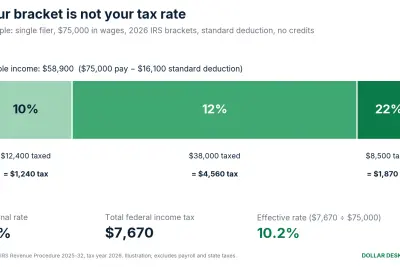
A deduction reduces taxable income. If a gift is fully deductible and you are in a 22% bracket, a $1,000 gift cuts your tax by about $220, not $1,000. To see how brackets work, read marginal vs. effective tax rate.
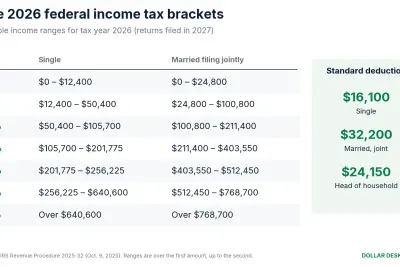
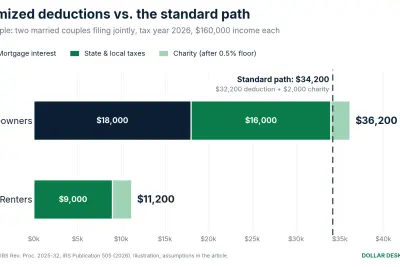
The IRS says that, currently, charitable gifts are deductible only if you itemize on Schedule A. Itemized deductions help only when they exceed the standard deduction, which is $16,100 for single filers and $32,200 for joint filers for 2026, according to the IRS. Our guide to standard deduction vs. itemizing compares the two.
Only qualified organizations count. Gifts to individuals are not deductible, the IRS says. If you get something in return, such as a dinner at a charity gala, you can deduct only the amount above the fair market value of what you received.
What changes for 2026?
Three provisions of Public Law 119-21 touch giving. All apply to taxable years beginning after Dec. 31, 2025.
| Provision | Law section | What it says |
|---|---|---|
| Non-itemizer deduction | Sec. 70424 | Makes permanent the deduction for people who do not itemize and raises it to $1,000 ($2,000 joint) |
| 0.5% floor | Sec. 70425 | Individuals’ gifts are deductible only to the extent they exceed 0.5% of their contribution base for the year |
| Cap on the benefit of itemizing | Sec. 70111 | Reduces itemized deductions by 2/37 of the lesser of (1) the deductions or (2) the taxable income, before the reduction and counting the itemized deductions, above where the 37% bracket begins |
Contribution base is generally adjusted gross income (AGI), income after certain adjustments. The IRS says the non-itemizer deduction applies to cash gifts to certain qualified organizations. The law’s floor language also provides for carrying forward amounts disallowed by the floor in some cases; the statute’s carryover wording is detailed.
The third row affects only the top bracket. The IRS describes it as a limit on the tax benefit of itemized deductions for taxpayers in the 37% bracket, which begins above $640,600 for single filers and $768,700 for joint filers in 2026. As arithmetic only: if $10,000 of deductions sat entirely in that bracket, the formula trims them by 2/37, or about $541, leaving about $9,459. At 37% that is $3,500 of tax, or 35 cents per dollar if the entire $10,000 were gifts and nothing else were itemized.
How much can you deduct? The AGI limits
For itemizers, a deduction cannot exceed a share of AGI that depends on what you give and to whom. Publication 526 says the overall cap is generally 60% of AGI, and cash gifts to the main category of public charities fall under that 60% limit.
| What you give | Typical AGI limit (Pub. 526, 2025 edition) |
|---|---|
| Cash to public charities and similar “50% limit” organizations | 60% |
| Noncash gifts to those organizations | 50%, minus cash gifts counted under the 60% limit |
| Appreciated long-term property at full market value to those organizations | 30% |
| Cash or other gifts to the “second category” of organizations, such as certain private foundations | 30% (or less) |
Gifts above the limit are not necessarily lost. Publication 526 says most excess amounts can be carried forward and deducted over the next 5 years.
Worked example: what counts for 2026
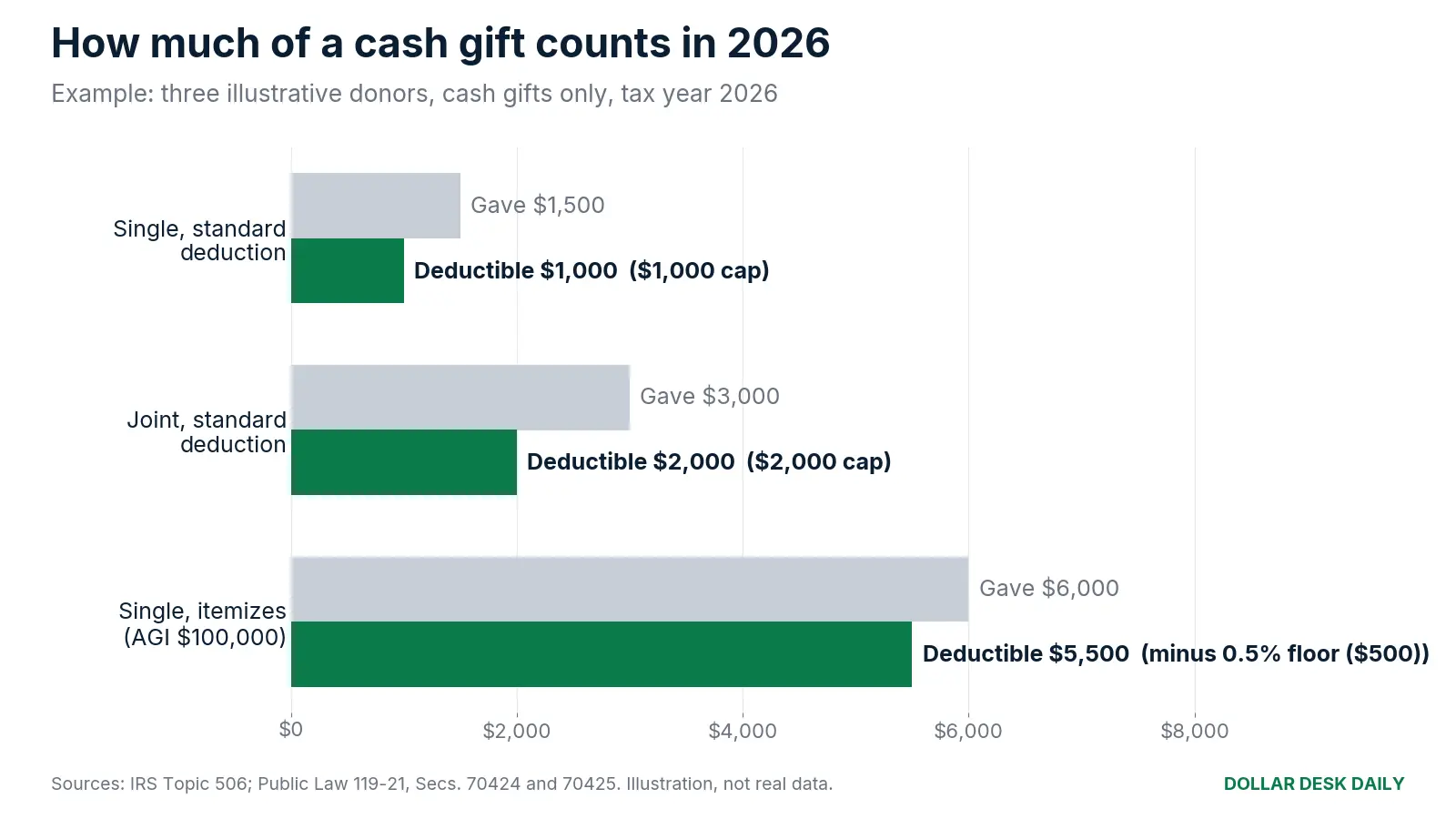
The table below is an illustration with invented donors, not data. It assumes 2026 rules as described above, a 22% marginal rate for the savings estimate, and that the itemizer’s total itemized deductions exceed the standard deduction.
| Donor (illustrative) | Cash gifts | Rule applied | Deductible | Tax saved at 22% |
|---|---|---|---|---|
| Single, standard deduction | $1,500 | $1,000 cap | $1,000 | $220 |
| Joint, standard deduction | $3,000 | $2,000 cap | $2,000 | $440 |
| Single, itemizes, AGI $100,000 | $6,000 | Floor is 0.5% × $100,000 = $500 | $5,500 | $1,210 |
In the third row, the 60% limit would be $60,000, so the gift is far below it.
What records do you need?
The IRS sets three levels of paperwork, summarized in Topic 506:
- Any cash gift: a bank record or a written note from the charity showing its name, the amount and the date.
- $250 or more: a written acknowledgment from the charity, in hand before you file, stating the amount (or describing noncash property) and whether the charity gave you goods or services in return.
- Noncash gifts over $500: Form 8283. Items worth more than $500 up to $5,000 go in Section A. Over $5,000 per item or group of similar items, you need a qualified appraisal and Section B. Above $500,000, the appraisal must be attached to the return.
Our tax document checklist lists where these papers fit in a filing-season routine.
What about donating appreciated stock?
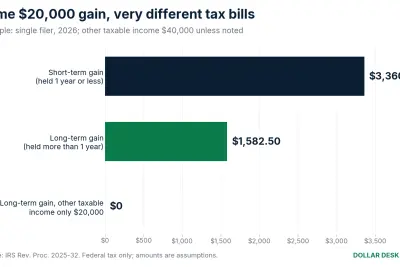
Publication 526 says that for capital gain property, which includes assets held more than 1 year, you can generally deduct the full fair market value. For gifts to public charities, that can be higher than what you paid. Stock held a year or less is ordinary income property, and the deduction is generally limited to its basis.
Illustration: shares bought for $2,000 and worth $5,000 after more than a year. A gift would be a $5,000 deduction, subject to the 30% limit. A sale would first create a $3,000 long-term gain; how capital gains tax works covers the rates. The IRS notes that if the gift counts as noncash above $500, Form 8283 applies.
What is a qualified charitable distribution?
A qualified charitable distribution (QCD) is a transfer made directly from an IRA trustee to a qualified charity. Publication 590-B says you must be at least age 70½ when it is made, and the amount that would otherwise be taxable is excluded from income, so it is not deducted on Schedule A. IRS Notice 2025-67 sets the 2026 annual limit on QCDs not included in gross income at $111,000 per person. The 2027 notice (Notice 2026-66) raises it to $114,000.
A QCD counts toward a required minimum distribution, according to Publication 590-B. The mechanics are in required minimum distributions explained.
How do you check that a charity qualifies?
Publication 526 points to IRS.gov/TEOS, the IRS Tax Exempt Organization Search tool, for checking whether an organization can receive deductible gifts. The IRS says the tool uses deductibility status codes, which show whether the 50%, 30% or 20% limits apply. Contributors may rely on its Publication 78 data to the extent Revenue Procedure 2011-33 allows.
Common mistakes
- Assuming the $1,000 or $2,000 deduction also applies to people who itemize. Itemizers use Schedule A and the 0.5% floor instead.
- Missing the written acknowledgment for a gift of $250 or more.
- Forgetting that noncash gifts of more than $500 need Form 8283.
The AGI limits above come from the 2025 edition of Publication 526; final 2026 forms and instructions may differ.
Sources
- IRS — Topic no. 506, Charitable contributions
- IRS — Publication 526 (2025), Charitable Contributions
- Public Law 119-21 (One Big Beautiful Bill Act), GovInfo — Secs. 70111, 70424, 70425
- IRS — IRS releases tax inflation adjustments for tax year 2026, including amendments from the One, Big, Beautiful Bill (IR-2025-103)
- IRS — Instructions for Form 8283
- IRS — Publication 590-B (2025), Distributions from Individual Retirement Arrangements (IRAs)
- IRS — Notice 2025-67, 2026 Amounts Relating to Retirement Plans and IRAs
- IRS — Notice 2026-66, 2027 Amounts Relating to Retirement Plans and IRAs
- IRS — Charitable Contribution Deductions