How Social Security Benefits Are Calculated, Step by Step
Your Social Security check comes from your top 35 years of indexed pay, a three-tier formula and your claiming age. Here is the math with 2026 bend points.
Key Takeaways
- Social Security averages your highest 35 years of wage-indexed earnings into a monthly figure called AIME, then applies a formula to get your basic benefit, the PIA.
- For workers who turn 62 in 2026, the PIA is 90% of the first $1,286 of AIME, 32% of AIME from $1,286 to $7,749 and 15% above $7,749, according to SSA.
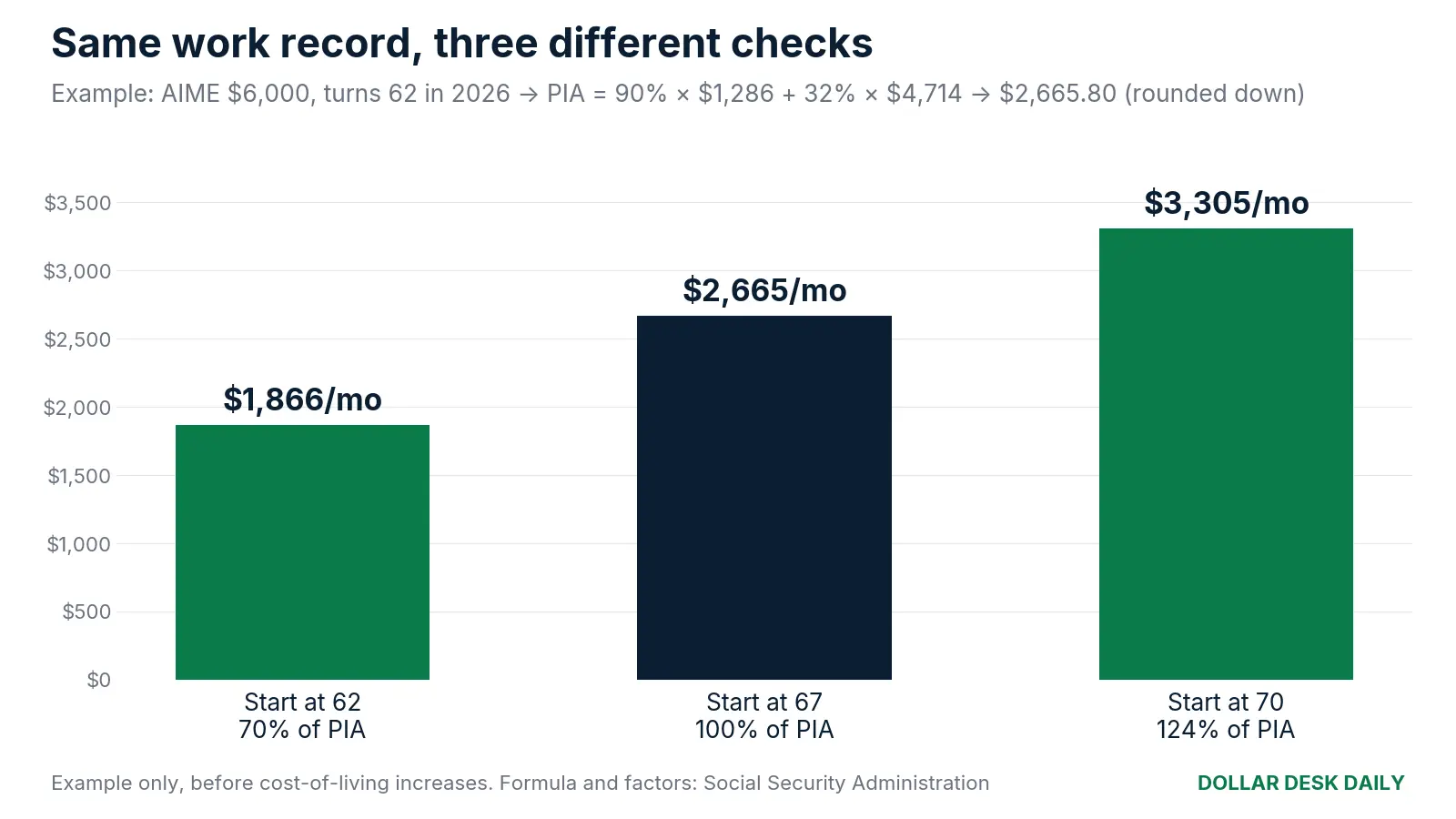
- For people born in 1960 or later, claiming at 62 pays 70% of the PIA and waiting until 70 pays 124%, so in our example the same work record pays $1,866 or $3,305 a month depending on when benefits start.
In this article
Social Security calculates your retirement benefit in three steps: it averages your highest 35 years of earnings, adjusted for wage growth, into a monthly figure; it runs that average through a three-tier formula to get your basic benefit; and it raises or lowers that amount depending on the age you start. For workers who turn 62 in 2026, the formula’s dollar thresholds, called bend points, are $1,286 and $7,749 a month, according to the Social Security Administration (SSA).
The result of the formula is your primary insurance amount, or PIA: the monthly benefit you would get if you started exactly at full retirement age. Everything else, from early claiming to cost-of-living raises, is applied to the PIA.
Step 1: Qualify with 40 credits
Before any math, you need enough work history. You earn “credits” by working and paying Social Security tax, and people born in 1929 or later need 40 credits, or about 10 years of work, to get retirement benefits, according to SSA. In 2026, you earn one credit for each $1,890 of earnings, up to four a year. That amount rises to $1,970 in 2027.
Step 2: Index your earnings to today’s wages
Average pay has more than doubled since 2000, as measured by SSA’s national average wage index. So SSA “indexes” each year of past earnings, scaling it up by the growth in that index.
Indexing is tied to the year you turn 62, your year of eligibility. Earnings are always indexed to the average wage two years before that year, SSA says. For someone turning 62 in 2026, that is the 2024 average wage index of $69,846.57. Earnings from 2024 onward count at face value.
Example: $40,000 earned in 2000, when the average wage index was $32,154.82, becomes $40,000 × ($69,846.57 ÷ $32,154.82) = about $86,888 in indexed earnings. That is the figure that goes into your average, not the $40,000 on your old W-2.
Only earnings up to the yearly taxable maximum count. In 2026 that cap is $184,500; it rises to $192,300 in 2027. SSA describes this base as both the most you pay Social Security tax on and the most it uses to figure your benefit.
Step 3: Average your top 35 years (AIME)
SSA takes your 35 highest years of indexed earnings, adds them up and divides by the number of months in those years (35 × 12 = 420). It rounds the result down to the dollar. That figure is your average indexed monthly earnings, or AIME.
If you worked fewer than 35 years, or had years of low pay, SSA says your benefit “may be lower than if you had worked steadily.” A short career means fewer high years to average.
Step 4: Apply the bend-point formula (PIA)
The PIA formula replaces a large share of the first slice of your AIME and smaller shares of higher slices. That is how Social Security gives lower earners a bigger percentage of their pay back. The percentages are fixed by law; the bend points rise each year with average wages.
| Year you turn 62 | 90% of AIME up to | 32% of AIME between | 15% of AIME above |
|---|---|---|---|
| 2025 | $1,226 | $1,226 – $7,391 | $7,391 |
| 2026 | $1,286 | $1,286 – $7,749 | $7,749 |
| 2027 | $1,340 | $1,340 – $8,077 | $8,077 |
SSA rounds the PIA down to the nearest 10 cents. According to the agency, benefits started at 67 replace as much as 78% of pre-retirement income for very low earners, about 42% for medium earners and about 28% for high earners.
Worked example: one record, three claiming ages
This is an illustration. Assumptions: the worker turns 62 in 2026 (born in 1964, so full retirement age is 67), has 35 years of indexed earnings totaling $2,520,000, and claims at the ages shown. Figures are before cost-of-living increases.
AIME: $2,520,000 ÷ 420 months = $6,000.
PIA with 2026 bend points: – 90% × $1,286 = $1,157.40 – 32% × ($6,000 − $1,286) = 32% × $4,714 = $1,508.48 – 15% × $0 (the AIME is below $7,749) = $0 – Total: $2,665.88, rounded down to $2,665.80
Monthly benefit by starting age:
| Start benefits at | Share of PIA (born 1960 or later) | Monthly benefit |
|---|---|---|
| 62 | 70% | $1,866 |
| 67 (full retirement age) | 100% | $2,665 |
| 70 | 124% | $3,305 |
The math: $2,665.80 × 0.70 = $1,866.06; $2,665.80 × 1.24 = $3,305.59. SSA pays the monthly benefit in whole dollars, rounding down. Starting at 70 instead of 62 pays $1,439 more a month, for life, in exchange for eight fewer years of checks.
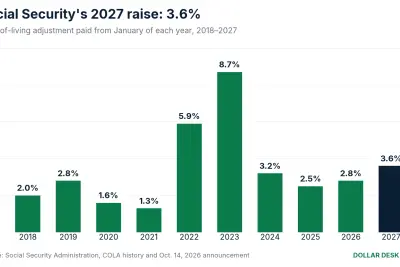
Cost-of-living raises also start counting at 62, even if you have not claimed. Because this worker becomes eligible in 2026, the 3.6% COLA announced for 2027 applies to the PIA: $2,665.80 × 1.036 = $2,761.77, which SSA rounds down to $2,761.70, before any claiming adjustment. Our coverage of the 2027 Social Security COLA has the details.
How claiming age changes the check
For people born in 1960 or later, full retirement age is 67. Claim at 62 and the benefit is cut by 30%, according to SSA, because it is reduced a little for each of the 60 months before full retirement age. A spouse’s benefit claimed at 62 is cut by 35%.
Wait past 67 and SSA adds delayed retirement credits of 8% for each full year, up to age 70, when the benefit reaches 124% of the PIA. The increase stops at 70, even if you wait longer. SSA also notes that people who delay benefits past 65 should still apply for Medicare within three months of their 65th birthday, because Part B and Part D coverage may cost more for those who wait.
Common misconceptions
- “It is based on my last few years of pay.” It is based on your highest 35 years, indexed to wages, wherever they fall in your career.
- “Earnings above the cap raise my benefit.” Pay above the taxable maximum ($184,500 in 2026) is not taxed for Social Security and does not count toward your benefit.
- “Every extra dollar of earnings raises my benefit by the same amount.” In the 2026 formula, each extra dollar of AIME above $7,749 adds only 15 cents to the PIA, compared with 90 cents for each of the first $1,286.
- “Working longer cannot help after 35 years.” Each extra year of work adds a year to your record, and a high year can replace a lower one among your top 35.
Related decisions
Your SSA estimate depends on your actual earnings record, so the first practical step is to check it. SSA suggests using a personal my Social Security account to review your earnings record to ensure it is correct and to see estimates for different starting ages. A missing or understated year can lower your AIME.
Social Security is meant to replace part of your pay, not all of it. How much you save on top of it, and in which kind of account, is a separate choice; our guide to 401(k) vs. Roth IRA compares the two most common options.
Sources
- Social Security Administration — Social Security Benefit Amounts (Office of the Chief Actuary)
- Social Security Administration — Benefit Formula Bend Points
- Social Security Administration — Primary Insurance Amount
- Social Security Administration — Indexing Factors for Earnings
- Social Security Administration — Starting Your Retirement Benefits Early
- Social Security Administration — Delayed Retirement: If you were born in 1960 or later
- Social Security Administration — Retirement Benefits (Publication No. 05-10035, January 2026)
- Social Security Administration — Your Retirement Benefit: How It’s Determined (Publication No. 05-10070)
- Social Security Administration — 2027 Cost-of-Living Adjustment (COLA) Fact Sheet
- Federal Register — Cost-of-Living Increase and Other Determinations for 2027 (Oct. 26, 2026)
- Federal Register — Cost-of-Living Increase and Other Determinations for 2026 (Nov. 3, 2025)