Term vs. Whole Life Insurance: How They Differ and Who Each Fits
Term life covers a set number of years for a lower premium; whole life covers you for life and builds cash value. How each works, what it costs and who it fits.
Key Takeaways
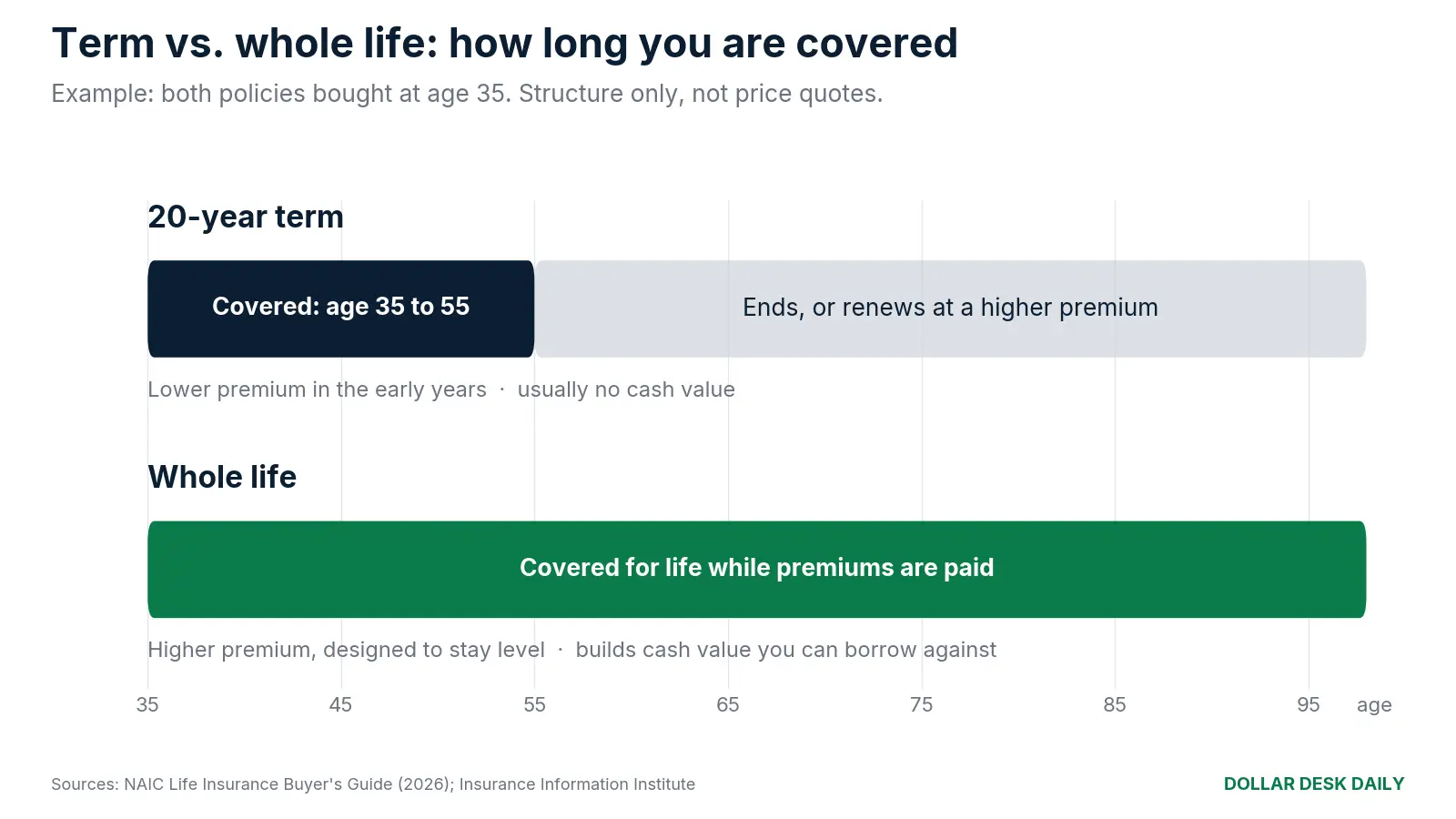
- Term life insurance covers a set period, such as 10 or 20 years, and most term policies build no cash value, according to the National Association of Insurance Commissioners.
- Whole life insurance covers you for life with a level premium that is set higher than early insurance costs, and the extra builds a cash value you can borrow against.
- Unpaid policy loans plus interest are subtracted from the death benefit, so in our example a $20,000 loan left unpaid for five years at 6% cuts a $250,000 payout to about $223,235.
In this article
Term life insurance covers you for a set number of years, such as 10 or 20, and pays only if you die during that period. Whole life insurance covers you for your entire life as long as premiums are paid, and part of each premium builds a cash value you can borrow against. Term is designed to be the lower-cost option; whole life costs more because of that savings piece, according to the National Association of Insurance Commissioners (NAIC), the group of state insurance regulators.
The short answer: which one fits which situation
Based on the guidance from the NAIC and the Insurance Information Institute (Triple-I):
- Term may fit better if you need coverage for a known stretch, such as until children grow up or a mortgage is paid off, or you need a large death benefit on a limited budget.
- Whole life may fit better if you need coverage for as long as you live, want a premium that stays the same as you age, and want a tax-deferred savings element you can borrow from.
- Either way, the NAIC says not to cancel an existing policy until you have received the new one.
Term vs. whole life at a glance
| Feature | Term life | Whole life |
|---|---|---|
| How long it covers | A set term, often 10 or 20 years | Your lifetime, while premiums are paid |
| Premium | Lower in the early years; rises if you renew | Higher; traditional whole life is designed to stay level |
| Cash value | Usually none | Builds over time; you can borrow against it |
| What happens at the end | Coverage ends, or renews at a higher premium | No end date |
| Main risk | Coverage stops at the end of the term unless renewed | Costly to quit in the early years, the NAIC says |
Sources: NAIC Life Insurance Buyer’s Guide (2026); Triple-I.
How term life works
A term policy lasts “for a certain period of time (a term), like a ten-year or 20-year period,” the NAIC wrote in an October 2026 consumer article. Triple-I lists terms from one year to 30 years. If you die during the term, your beneficiaries get the death benefit. If you outlive it, the policy pays nothing.
Most term policies can be renewed at the end of the term even if your health has changed, but the NAIC’s 2026 buyer’s guide says the new premiums are higher. It suggests asking what renewal would cost and whether you lose the right to renew at a certain age.
Some term policies are convertible. During a conversion period, you may be able to trade the policy for a cash value policy, but the NAIC says premiums for the new policy will be higher than what you were paying for term. Triple-I also describes “return of premium” term policies, which refund part of your premiums if no claim is paid, and cost more upfront.
How whole life and cash value work
The cost of insuring a person rises with age. Triple-I explains that the insurer charges a level premium that is higher than needed in the early years, invests the extra and uses it later to cover the higher cost of insuring you when you are older. By law, once those overpayments reach a certain amount, they become cash value available to you.
Under certain conditions, you can withdraw cash value or borrow against it. Triple-I says the savings element grows on a tax-deferred basis and can be borrowed even if your credit is weak, because the death benefit is the collateral. But in most policies the cash value stays with the insurer when you die, and the NAIC notes that only some whole life policies pay both the death benefit and the cash value.
Cash value can build slowly at first. The NAIC says some policies have low cash values in the early years that grow faster later, and it warns that a cash value policy “may be very costly if you quit during the early years of the policy.”
Whole life is one type of permanent coverage. Universal life lets you vary premiums within limits, and variable life ties cash value to investments such as stock and bond funds, which the NAIC says carries the greatest potential and the greatest risk of losing value.
What it means for you: two worked examples
How much coverage?
The NAIC says some insurance experts suggest buying five to eight times your current income. Applied to three incomes, as an illustration:
| Annual income | 5 times income | 8 times income |
|---|---|---|
| $50,000 | $250,000 | $400,000 |
| $75,000 | $375,000 | $600,000 |
| $100,000 | $500,000 | $800,000 |
Triple-I points out that the multiple-of-salary approach ignores other income your family would have, such as Social Security survivors’ benefits, and does not account for inflation. It suggests adding up what your dependents would need, plus final expenses, minus other income sources.
What a policy loan does to the payout
On loans against cash value, the NAIC says: “Any loans you have not repaid (plus interest) will be subtracted from the death benefit.”
Example (illustration). Assumptions: a whole life policy with a $250,000 death benefit; you borrow $20,000 of cash value; the loan charges an assumed 6% a year, and you pay nothing back for five years.
- Loan balance after five years: $20,000 × 1.06^5 = about $26,765
- Payout to beneficiaries: $250,000 − $26,765 = about $223,235
Loan rates vary by policy; this rate is only an assumption. Taking cash value out can also affect premiums: for a paid-up policy where the insurer plans to use the cash value to pay premiums, the NAIC warns that “if you take cash value out, there may not be enough to pay premiums.”
Common misconceptions
- “Term is wasted money if I don’t die.” A term premium pays for coverage during the term. Triple-I describes term as a way to replace income for a set period, such as until a child grows up, or to pay off a debt such as a mortgage.
- “Whole life premiums can never change.” Traditional whole life premiums are designed to stay level, but the NAIC notes that premiums for many policies are sensitive to the insurer’s investment earnings, claims and expenses. It suggests asking what the highest premium could be.
- “Buy term and invest the difference always wins.” The NAIC calls the phrase “a popular sales slogan for term life” and lists points to weigh: term premiums rise with age; if you invested the difference, you could use it to pay the higher cost; if you spent it, you would have to dip into other savings. See index funds and 401(k) vs. Roth IRA for how those accounts work.
How to decide
The NAIC’s buyer’s guide frames the decision around needs that continue after your death, such as whether anyone depends on you financially and whether employer coverage is enough. Its checklist includes asking what renewal would cost, what the highest possible premium could be and, for cash value policies, an illustration showing future values and benefits.
After you buy, the NAIC says you can usually return a new policy for a full refund within a certain period, usually 10 days after you receive it; the review period is usually stated on the first page of the policy.
Sources
- National Association of Insurance Commissioners — Life Insurance Buyer’s Guide (2026)
- National Association of Insurance Commissioners — What Type of Life Insurance Is Right for You? (Oct. 12, 2026)
- National Association of Insurance Commissioners — Life Insurance (consumer page)
- Insurance Information Institute — What are the principal types of life insurance?
- Insurance Information Institute — How to choose the right type of life insurance
- Insurance Information Institute — What are the different types of permanent life insurance policies?
- Insurance Information Institute — How much life insurance do I need?