How Capital Gains Tax Works: 2026 Rates, Losses and Wash Sales
Gains on assets held over a year are taxed at 0%, 15% or 20% for 2026. See the income limits, the $3,000 loss rule, wash sales and the home-sale exclusion.
Key Takeaways
- A gain on an asset held more than one year is long-term and, for tax year 2026, is taxed at 0% for a single filer with taxable income up to $49,450, according to IRS Revenue Procedure 2025-32.
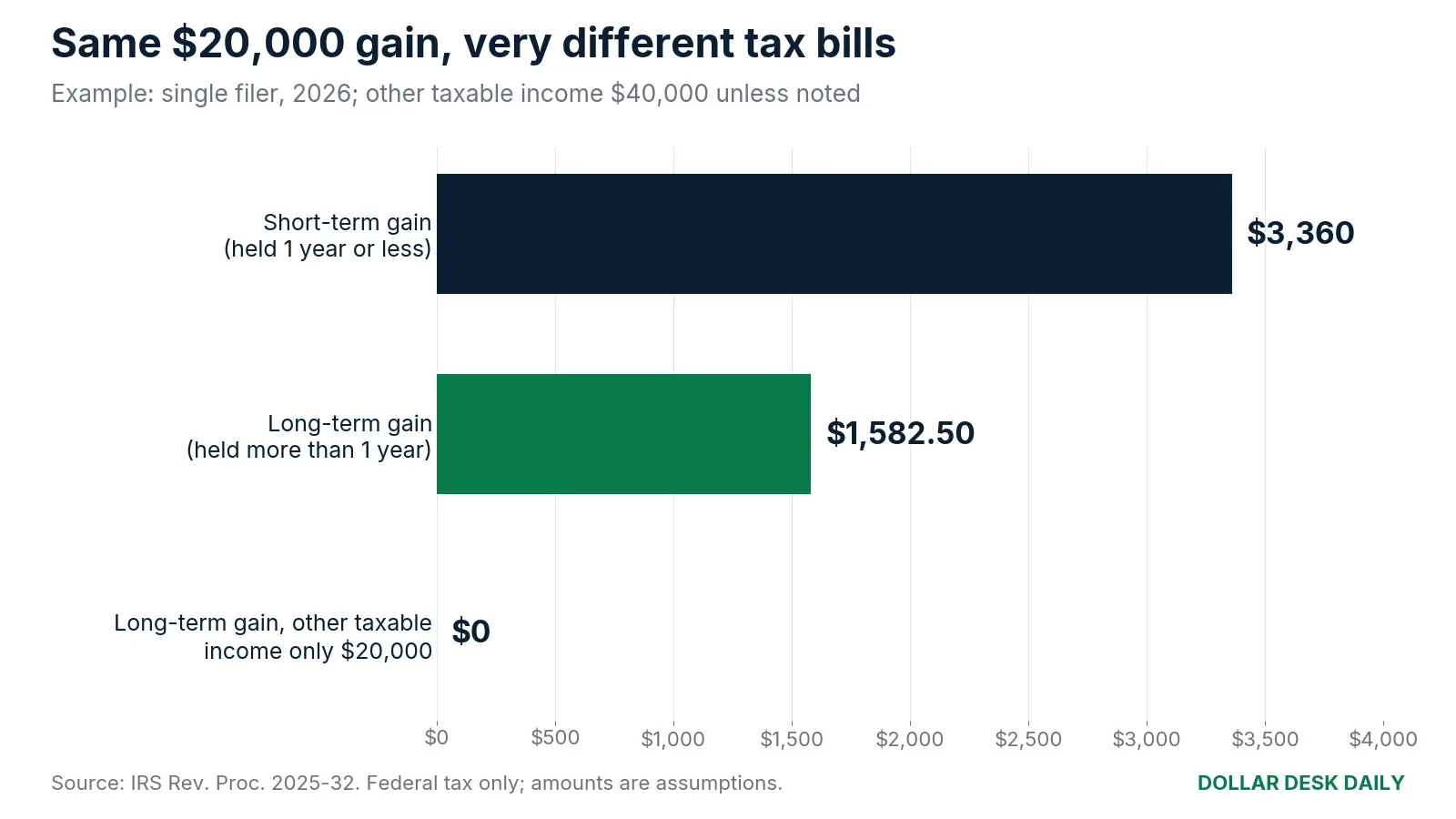
- In an illustration, a $20,000 gain on top of $40,000 of other taxable income costs a single filer $1,582.50 in federal tax if long-term, versus $3,360 if short-term.
- Net capital losses reduce other income by up to $3,000 a year ($1,500 if married filing separately), and the IRS says any excess carries forward to later years.
In this article
- What counts as a capital gain or loss?
- Short-term vs. long-term: the one-year line
- What are the 2026 capital gains rates?
- What is the net investment income tax?
- How do capital losses offset gains?
- What is the wash-sale rule?
- Does selling your home trigger capital gains tax?
- What it means for you: a worked example
A capital gain is the profit when you sell something you own for more than you paid. For tax year 2026, the federal rate on a long-term gain is 0%, 15% or 20%, depending on your taxable income, while a short-term gain is taxed like ordinary income. A single filer pays 0% on long-term gains if taxable income is $49,450 or less, according to IRS Revenue Procedure 2025-32.
What counts as a capital gain or loss?
The IRS says almost everything you own for personal or investment use is a capital asset, including a home, household furnishings, stocks and bonds. When you sell, the difference between your adjusted basis (generally what you paid, with some adjustments) and the amount you received is a capital gain or loss. If you sell for more than basis, you have a gain. If you sell for less, you have a loss.
Losses on personal-use property, such as your home or car, are not tax deductible, the IRS says.
Short-term vs. long-term: the one-year line
If you hold an asset more than one year before selling, the gain or loss is long-term. If you hold it one year or less, it is short-term. The IRS counts from the day after you acquired the asset through the day you sold it.
The label decides the rate. Net short-term gains are taxed as ordinary income at the regular graduated rates, the same ones that apply to wages (see our guide to the 2026 tax brackets). Net long-term gains get the lower rates below.
Long-term gains and losses are netted against each other, as are short-term ones, and unused losses from earlier years join the matching group.
What are the 2026 capital gains rates?
For tax years beginning in 2026, Revenue Procedure 2025-32 sets the top of the 0% zone and the top of the 15% zone by filing status. The 20% rate applies to taxable income above the 15% limit.
| Filing status | 0% rate up to | 15% rate up to | 20% above |
|---|---|---|---|
| Single | $49,450 | $545,500 | $545,500 |
| Married filing jointly / surviving spouse | $98,900 | $613,700 | $613,700 |
| Head of household | $66,200 | $579,600 | $579,600 |
| Married filing separately | $49,450 | $306,850 | $306,850 |
The thresholds apply to taxable income, which is income after deductions. Your gain stacks on top of your other taxable income, so part of one gain can fall in the 0% zone and part in the 15% zone. For how the standard deduction lowers taxable income, see standard deduction vs. itemizing.
A few gains are taxed above 20%: the IRS lists a 28% maximum for collectibles such as coins or art and a 25% maximum for unrecaptured section 1250 gain on real property.
The IRS Topic 409 page still shows 2025 thresholds ($48,350 for singles); those apply to 2025 returns.
What is the net investment income tax?
Higher earners can owe an extra 3.8% on investment income. The net investment income tax (NIIT) applies to the lesser of two amounts: your net investment income, or the amount your modified adjusted gross income (MAGI) exceeds a threshold. The IRS lists the thresholds as $200,000 for single filers and heads of household, $250,000 for married couples filing jointly and $125,000 for married filing separately.
Net investment income includes interest, dividends, rents and royalties, and net gains from selling stocks, bonds, mutual funds and real estate. It does not include wages. It also excludes gain from a principal residence that is excluded from regular income tax.
An illustration: a single filer has MAGI of $230,000, of which $50,000 is net investment income. MAGI exceeds the $200,000 threshold by $30,000. The NIIT applies to the lesser of $50,000 and $30,000, so it is 3.8% × $30,000 = $1,140.
How do capital losses offset gains?
Losses first cancel gains. If your losses for the year exceed your gains, the IRS says you can use the lesser of $3,000 ($1,500 if married filing separately) or your total net loss to lower other income, such as wages. Any loss above that limit carries forward to later years. The IRS points to the Capital Loss Carryover Worksheet in Publication 550 or the Schedule D instructions for the math.
Illustration: you sell one stock for a $9,000 loss and another for a $1,000 gain, so your net loss is $8,000. You deduct $3,000 this year and carry $5,000 forward. If next year you have no other sales, you deduct another $3,000 and carry $2,000.
What is the wash-sale rule?
The wash-sale rule stops you from claiming a loss on a sale if you effectively keep the position. According to Publication 550, a wash sale occurs when you sell stock or securities at a loss and, within 30 days before or after the sale, you buy substantially identical stock or securities, acquire them in a fully taxable trade, buy a contract or option to buy them, or acquire substantially identical stock for your IRA or Roth IRA. A purchase by your spouse or a corporation you control also counts.
The loss is not gone forever. You add the disallowed loss to the cost of the new shares, which postpones the deduction. Publication 550’s example: you buy 100 shares for $1,000, sell for $750, then rebuy for $800 within 30 days. The $250 loss is disallowed, and your basis in the new shares becomes $1,050.
Does selling your home trigger capital gains tax?
Often it does not. If you sell your main home, you may exclude up to $250,000 of gain from income, or up to $500,000 if you file jointly, according to IRS Topic 701. To qualify you generally must have owned the home and used it as your main residence for at least 24 months out of the five years before the sale. The two periods do not have to be the same two years.
The IRS also says you generally cannot take it if you excluded gain from another home sale in the prior two years. If you get a Form 1099-S, you must report the sale even when the gain is fully excludable. Gain above the exclusion is a regular capital gain.
What it means for you: a worked example
This is an illustration with assumed numbers. A single filer has $40,000 of taxable income for 2026 before any investment sale, then realizes a $20,000 gain. The 0% zone for singles ends at $49,450.
If the gain is long-term:
- The first $9,450 of gain ($49,450 minus $40,000) is taxed at 0%.
- The remaining $10,550 is taxed at 15%: $10,550 × 0.15 = $1,582.50.
- Federal tax on the gain: $1,582.50.
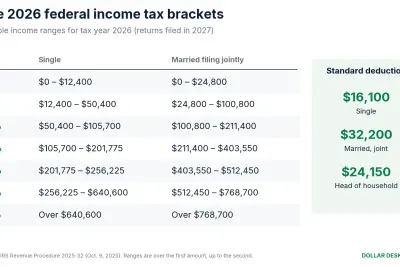
If the gain is short-term: the gain is taxed as ordinary income. Using the 2026 single-filer tax table in Revenue Procedure 2025-32, tax on $40,000 is $1,240 + 12% × ($40,000 − $12,400) = $4,552. Tax on $60,000 is $5,800 + 22% × ($60,000 − $50,400) = $7,912. The difference is $3,360.
Waiting past the one-year mark in this case changes the tax from $3,360 to $1,582.50, a difference of $1,777.50. If other taxable income were only $20,000, the whole gain would land below $49,450 and the federal tax on it would be $0. State taxes are not included.
Common mistakes the rules above point to:
- Assuming the 15% rate applies to all of your income. It applies only to net long-term gain, stacked on top of other income.
- Overlooking that buying the same security in an IRA can trigger a wash sale.
- Forgetting the home-sale reporting step when you receive Form 1099-S.
Basis records drive the result; our tax document checklist lists what to gather. For how bracket math works more broadly, see marginal vs. effective tax rate. Gains inside a 401(k) or IRA follow different rules, covered in 401(k) vs. Roth IRA.
Report most sales on Form 8949 and summarize them on Schedule D (Form 1040), the IRS says. If you have a taxable gain, you may also need to make estimated tax payments, as described in Publication 505.
Sources
- IRS — Topic no. 409, Capital gains and losses
- IRS — Revenue Procedure 2025-32 (tax year 2026 inflation adjustments)
- IRS — IRS releases tax inflation adjustments for tax year 2026, including amendments from the One, Big, Beautiful Bill (IR-2025-103)
- IRS — Topic no. 559, Net investment income tax
- IRS — Publication 550 (2025), Investment Income and Expenses
- IRS — Topic no. 701, Sale of your home
- IRS — Publication 523 (2025), Selling Your Home